The water letter that decides whether Costa Rican land is buildable
Without a water availability letter, a Costa Rican municipality will not issue a construction permit. What the document is, who issues it for your lot, and how to check the one a seller hands you.
Most foreign buyers in Costa Rica commission a title study, check for liens, and confirm the boundaries. Far fewer ask whether anyone will sell the property water. That is the check that decides whether the land can be built on at all, and as of August 2026 it is the one most likely to come back negative.
Key points
- Without a water availability letter, the municipality will not issue a construction permit, so the letter decides whether you can build.
- "The water letter" is at least four different documents. Sellers routinely hand over the wrong one.
- In 2022, the most recent year measured, 23% of new requests were refused, and refusal was more common in the more developed cantons.
- When the answer is no, a separate document names the works that would make service possible.
What the document is
The formal name is a constancia de disponibilidad, a statement from a water operator that it can serve a given property. It exists because Costa Rican municipalities will not approve construction without proof that water will reach the building.
The rules come from AyA's Reglamento para la Prestación de los Servicios, approved by board agreement 2020-442 on December 8, 2020 and in force since March 15, 2021.[1] Almost nothing written for foreign buyers cites it, which is unfortunate, because it is specific about what the operator is deciding. A positive answer requires a technical feasibility analysis in which all four of these hold:
- The distribution and collection networks pass in front of the property's boundaries, or the property has direct access by public road or by a servidumbre de paso, a registered right of way.
- The systems have enough water, hydraulic capacity, treatment and potabilization to take on new service.
- The system meets its quality standards.
- The connection complies with environmental regulation.[2]
Condition 1 means water availability depends on legal access. A landlocked lot is usually also an unserviceable one, and what counts as legal access has its own rules on width, registration and who owes it maintenance.
It is not one document
Most buyers get this wrong, and no real estate site we found separates the documents clearly:
| Document | What it says |
|---|---|
| Constancia de disponibilidad | The operator can serve this property |
| Constancia de capacidad hídrica | Issued after a refusal: the water exists but the infrastructure does not, and these are the works needed |
| Constancia de servicios existentes | This property is already receiving service |
| Nota de disponibilidad de alcantarillado sanitario | Sewerage, not drinking water |
A letter confirming existing service to a house does not answer whether you can build a second structure, subdivide, or develop, and neither does a sewerage note. Check which document you have been handed before you check anything else on it.[3]
Finding out who your operator is
There is no single national water utility. AyA serves much of the country directly. A substantial share of the population is served by ASADAs, community associations that run local aqueducts under delegation from AyA. Heredia has its own utility, and some municipalities run their own systems.
This matters because the regulation binds them differently. It applies fully to AyA, to delegated ASADAs only "as far as materially possible," and to other operators on a merely supplementary basis. That single provision explains most of the inconsistency buyers run into: the procedure, the paperwork and the validity period differ from one operator to another.[4]
To identify the operator for a lot that already has service, look at who issues the water bill; an ASADA bills in its own name, not AyA's. For raw land, ask the municipality's uso de suelo desk, ask the immediate neighbors who bills them, or contact AyA directly at linea800@aya.go.cr. No public map answers this reliably.
With an ASADA, expect to do more of the work yourself. Operators without access to the interinstitutional government platforms are required to ask applicants for registry certifications of the property, registry certifications of the plano catastrado, and certifications of legal representation. If you have already pulled the folio real and the survey, you have most of what they will ask for.[5]
Checking the letter you were given
Check five things, in order:
- Which document it is, from the table above.
- Which property it names. It should give the finca number, and ideally the plano catastrado; a letter for the neighboring lot is worthless and is a common trick on subdivided land.
- Who issued it, and whether that operator serves the area.
- What it covers. Availability for a single house is not availability for four units or a condominio.
- Whether it is still valid. Ask the issuing operator and get the answer in writing.
Nearly every English-language page says these letters are valid for twelve months. That period does not appear in the chapters of the regulation governing issuance, and given how differently the rules bind different operators, a single national figure is unlikely to exist. Twelve months is at most a rule of thumb.[6]
The property's water account must also be paid up before the operator approves a letter, so a prior owner's unpaid bills can delay your application.[7]
What a refusal means
After a refusal, the regulation provides for a constancia de capacidad hídrica, which confirms that the water resource exists and names the primary works needed to enable service. That makes an unbuildable lot something you can negotiate over, because the works have a cost.[8]
Two formal designations can be checked publicly. A zona deficitaria is a coverage area where conditions prevent optimal service, and the declaration must be published on AyA's website. A zona de restricción de servicios is more serious: it requires an express AyA board agreement published in La Gaceta, and it empowers the operator to stop issuing availability letters in that area entirely.[9]
In stressed areas, an individual home and a development are treated differently. Availability for a single-family house or an individual commercial unit can still be granted, while developments and housing projects are approved only where new water has been added to the system, and even then no more than half of any new flow may go to new requests. If you are buying a lot inside a project that has not yet secured availability for the whole development, that queue is the risk you are taking on.[10]
The well route, and two words that are easy to confuse
Where the network will not reach, groundwater is the usual answer, and much of Costa Rica's coastal and rural land is served this way. The rules are more permissive than buyers expect, but they depend on a distinction English does not make.
A pozo artesanal is a hand-dug well: manually excavated, shallow, with limited flow. A pozo artesiano, or perforado, is a drilled well, which is what an English speaker usually means by "artesian." The words are nearly identical, and the law treats the two wells in opposite ways.
Under article 8 of the Water Law, any person may freely open a hand-dug well for domestic use without MINAE permission, and since a 2022 circular these wells need not even be registered with the Dirección de Agua. "Domestic" is defined narrowly: consumption for a single-family household, plus irrigation of up to half a hectare.[11]
Drilling is different: the same circular states that boring a well using a drilling company requires its own permit. So only a hand-dug well can be opened without a permit, and supplying more than one household requires a concession however the well was made.[12]
A legally opened well does not by itself get you a construction permit, and the permit is what decides buildability. Cóbano, on the Nicoya Peninsula, is an example: its published requirements accept either an availability letter from the local ASADA or AyA, or approval from MINAE's water department covering both the drilling and the exploitation of the well, with a potability guarantee from an accredited laboratory.[13]
You may also hear that a notarized statement confirming a hand-dug well is enough to get a construction permit. We could not verify that against any published requirement, and the references we found attach it to social interest housing rather than building generally. Practice does vary and it may be accepted somewhere. But a practice absent from the published requirements does not bind the municipality and can change with an administration, so get the municipality to confirm it in writing before you rely on it. Otherwise you risk an unpermitted structure on land you have already paid for.[14]
By this point you are dealing with records from several institutions. PropScan automates that kind of cross-checking, pulling the registry, cadastral and municipal records for a property into one report. The manual route above works and costs nothing but time.
How often the answer is no
ARESEP, the public services regulator, has published the country's first national measurement of water availability. Across AyA, ESPH and the ASADAs, 23% of new availability requests were refused, mostly because no pipe reached the property or the network had no capacity left. Thirty-one cantons showed rejection rates the regulator called extremely high, led by Aserrí at 75%, Moravia at 51% and Goicoechea at 48%.[15]
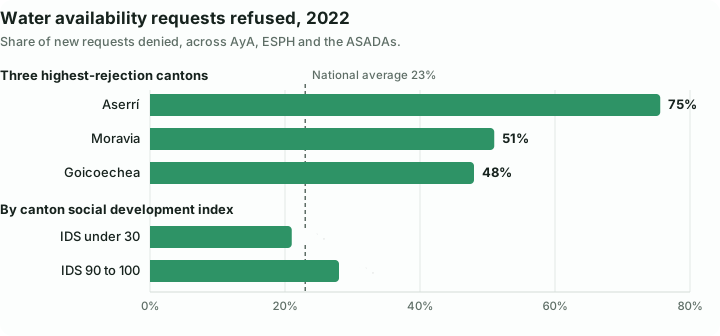
Source: reference [15].
Refusals were more common in wealthier, more developed cantons, rising from 21% in the least developed to 28% in the most. Demand and pressure on infrastructure rise together, so the desirable places are the harder ones to get served in.
The study rests on 2022 data and remains the only public measurement of its kind, so the figures are four years old. There is no reason to think the position has improved: in June 2026 AyA's executive president said publicly that in some zones the systems no longer permit issuing new availabilities at all,[16] and an El Financiero investigation that month mapped the pressure onto the Central Valley, Guanacaste and the Central Pacific, roughly where foreign buyers concentrate.[17]
Where this belongs in your due diligence
Ask for the water letter when you ask for the finca number, before you make an offer. Asking costs nothing, and it is the fastest way to learn whether you can build on the lot.
Then treat it the way you would treat liens and encumbrances: a document whose absence is informative. A seller who cannot produce one, or produces one for the wrong property or the wrong project, has told you something useful about what you are being sold.
Water is one of two questions that decide buildability. The other is the ground, and the flood and landslide mapping is free to check.
Common questions
How long is a water availability letter valid?
There is no single national validity period. AyA's service regulation binds AyA fully, applies to delegated ASADAs only as far as materially possible, and is merely optional for other operators, so the period is set by whoever issued your letter. Many sources repeat a twelve-month figure, but we could not trace it to the regulation. Ask the issuing operator and get the answer in writing.
Can I get a construction permit without one?
No. Municipalities require proof that a water operator will serve the property before issuing a construction permit. So the letter decides whether the property can be built on, which is why it is worth checking before you make an offer.
What if the property already has water?
Existing service is evidence but not proof of what you may add. A letter confirming existing service to a house is a different document from an availability letter for a new build or a subdivision. If you plan to build, add units, or split the lot, you need availability for that specific project.
Who issues the letter if the property is not on AyA?
Roughly a third of Costa Ricans are served by community-run ASADAs rather than AyA directly, and Heredia has its own utility. The operator that serves the lot issues the letter. With an ASADA you will usually have to supply the registry and cadastral certifications yourself, because many lack access to the interinstitutional platforms AyA uses.
Does a denial mean the land is worthless?
Not necessarily. When availability is refused, operators can issue a constancia de capacidad hídrica stating the water exists but infrastructure does not, and naming the works required. The lot can then become buildable if someone pays for those works, which is a materially different situation from a lot in a declared service-restriction zone.
Legal references and source notes
The numbered references below correspond to the markers in the article. Legal rules are sourced to Costa Rican statutes, regulations and official institutional documents. Market data and press reporting are identified as such.
[1] AyA, Reglamento para la Prestación de los Servicios de AyA, integral modification given in San José on December 8, 2020. Art. 138 sets it in force from March 15, 2021, and from September 2021 for operators acting by delegation. It replaced the version published in La Gaceta 242 of December 19, 2019 and absorbed the 2014 servitude regulation published in La Gaceta 43 of March 3, 2014. Later reformed by sesión 2021-84 of December 21, 2021. The board agreement number is not printed in the text itself; MOPT cites it as acuerdo 2020-442 of December 8, 2020. AyA's own site blocks automated access, so the full text is read here from an ASADA's copy. Sources: Reglamento para la Prestación de los Servicios de AyA and MOPT, Manual 1. Caminos, section 2.1.10.
[2] Art. 7, definition 12, análisis de factibilidad técnica. Test (a) requires that the networks pass in front of the property boundaries or "que se cuente con acceso directo por vía pública o servidumbre de paso del inmueble para el cual se solicita un servicio". The other three cover hydric and hydraulic capacity, quality attributes and environmental compliance. Source: Reglamento para la Prestación de los Servicios de AyA.
[3] Art. 7 defines each document separately: constancia de disponibilidad, constancia de capacidad hídrica (7.27), constancia de capacidad hídrica con inversión de obra pública (7.28), and the sewerage note, which the regulation treats as its own procedure. Source: Reglamento para la Prestación de los Servicios de AyA.
[4] Art. 2: the regulation governs AyA and the users inside its coverage zones, applies to systems delegated by AyA "en cuanto sea materialmente posible su aplicación", and "podrá ser utilizado de forma supletoria por otros operadores". Source: Reglamento para la Prestación de los Servicios de AyA.
[5] Art. 15 lists five channels for an application and requires the operator to verify cadastral and registry conditions through the official interinstitutional platforms within three calendar days. Operators by delegation that lack access to those platforms must ask the applicant for registry certifications of the property and of the plano catastrado, and certifications of legal representation. Source: Reglamento para la Prestación de los Servicios de AyA.
[6] No validity period for a constancia de disponibilidad appears in the chapters of the regulation that govern issuance. Given art. 2, a single national period is unlikely to exist. The twelve-month figure repeated across English-language pages could not be traced to the regulation. Source: Reglamento para la Prestación de los Servicios de AyA.
[7] The regulation requires the service account on the property to be current before an application is approved. Source: Reglamento para la Prestación de los Servicios de AyA.
[8] Art. 7.27: the constancia de capacidad hídrica is issued where availability is denied, states that the aqueduct has real and current capacity for a specific project, and names the primary works that would enable service. Art. 7.28 covers the variant where the denial is for lack of infrastructure. Source: Reglamento para la Prestación de los Servicios de AyA.
[9] Art. 7.131: a zona deficitaria declaration "deberá constar en la página web de la institución a partir del momento de dicha declaración". Art. 7.135, with art. 10, makes a zona de restricción de servicios depend on an express Junta Directiva acuerdo published in La Gaceta, which allows availability constancias to be suspended in that area. Source: Reglamento para la Prestación de los Servicios de AyA.
[10] Art. 7.129: inside a zona de crecimiento máximo, individual housing and individual commerce may always receive a positive constancia, while real estate developments, social-interest housing, communal projects and state projects may do so only where new flows improve the zone's capacity. Art. 10 caps at 50% the share of a new production flow that may go to new availability requests; the rest covers the existing deficit. Source: Reglamento para la Prestación de los Servicios de AyA.
[11] Ley de Aguas, Ley 276, art. 8: "toda persona física o jurídica puede abrir libremente pozos artesanales para el uso doméstico, sin permiso del MINAE." Art. 37 defines the well type. Decreto 43712-MINAE, La Gaceta 203 of October 25, 2022, states that artisanal wells "no deben ser inscritos" with the Dirección de Agua, superseding older guidance that required registration. Domestic use means consumption for a single-family household including irrigation of half a hectare. Sources: Ley de Aguas, PGR-SINALEVI; Decreto 43712-MINAE, PGR-SINALEVI; and the Dirección de Agua circular of October 25, 2022.
[12] The note at the foot of the same circular: "La perforación de pozos con empresas perforadoras requiere permiso respectivo conforme Decreto 43053-MINAE." Sources: Dirección de Agua circular and Decreto 43053-MINAE, PGR-SINALEVI.
[13] The Concejo Municipal de Distrito de Cóbano publishes its construction-permit requirements, which list a "Carta del DISPONIBILIDAD DE AGUA: Corresponderá a la ASADA o AYA de la localidad donde se pretende construir", and for wells the "aprobación del Departamento de Aguas del MINAET de la perforación y explotación del pozo, con garantía de su potabilidad por un laboratorio acreditado." Source: Concejo Municipal de Distrito de Cóbano.
[14] The notarized-declaration route could not be verified. It does not appear in Cóbano's published requirements and maps to no national INVU or BANHVI provision found. The likeliest origin is a local council agreement recorded in the minutes of acta 173-2023 rather than a published requirement. Sources: Concejo Municipal de Distrito de Cóbano and acta 173-2023.
[15] ARESEP's first national study of water-service availability, covering AyA, ESPH and the ASADAs, data year 2022, published February 2024: 23% of new availability requests refused nationally; 31 cantons with rejection rates the regulator called extremely high, led by Aserrí at 75%, Moravia at 51% and Goicoechea at 48%; refusals rising with the Social Development Index, from 21% below 30 to 28% at 90 to 100. Source: ARESEP.
[16] AyA executive president Lourdes Suárez, June 17, 2026, on record that in some zones "los sistemas ya no permiten emitir nuevas disponibilidades". Press report, not an institutional source. Source: El Financiero.
[17] El Financiero investigation of June 12, 2026 on water as a constraint on growth, concentrated in the Greater Metropolitan Area, Guanacaste and the Central Pacific. Press report, not an institutional source. Source: El Financiero.
This guide is informational and not a substitute for legal advice. For a purchase, work with an experienced attorney or notary.