Costa Rica property tax: what you actually pay every year
The rate is 0.25%, charged on the value your municipality has on record. Recording a sale or a mortgage raises that value, and on the coast a concession costs many times more.
Almost every English-language guide to Costa Rican property tax tells you the same thing: the rate is 0.25%, one of the lowest in the region, and then stops. The rate is correct, but it is the least useful part of the answer. The value it is charged on rises with ordinary recorded events, without anyone writing to tell you, and a large share of the properties foreigners buy are charged on a different basis, at a much higher rate.
Key points
- The rate is 0.25% a year nationwide, charged on the value registered with your municipality as of January 1. For a recent buyer that is normally the price in the deed. It is not the "cadastral value" most guides describe.
- Six recorded events reset that value automatically, including buying the property and taking out a mortgage against it. The base moves by operation of law, with no valuation and no notice to you.
- Owners must declare a value at least every five years. Since 2012, not declaring carries a fine equal to the tax you failed to pay.
- Inside the maritime zone, residential land pays a concession canon of up to 3% a year, twelve times the ordinary rate, instead of property tax. Buildings on it still pay 0.25%.
- Above CRC 143 million of construction value, a second annual tax applies at 0.25% to 0.55%, charged on the construction and the land beneath it.
What the 0.25% is charged on
Article 23 of Ley 7509, the Ley de Impuesto sobre Bienes Inmuebles, sets the rate at one quarter of one percent and makes it uniform across the country. Cantons do not compete on it.[1]
Article 9 defines the base as the value of the property "registered with the Administración Tributaria" on January 1 of the year, and the same article defines the Administración Tributaria as the municipal body that collects and audits the tax. So the taxing authority is your municipality, the register that matters is the municipality's, and the value in it is whatever was last put on the record for the property, whether by a declaration, a deed, or a municipal valuation.[2]
Declaring does not mean naming any number you like. Land is valued against a plataforma de valores de terrenos por zonas homogéneas, a per-zone price map each municipality publishes officially in La Gaceta, and buildings against Hacienda's Manual de Valores Base Unitario por Tipología Constructiva. Both are maintained by the Órgano de Normalización Técnica and published through a public map viewer. You put forward a figure; article 16 gives the municipality the following fiscal period to correct it, and your number stands only if it does not.[3]
It is not the value on the plano catastrado. The Catastro is a separate institution with its own register and purpose, and the widely repeated line that Costa Rica taxes the "cadastral value" is wrong. Our explainer on what a folio real is covers how the two registers relate.
Six recorded events reset your base automatically
Article 14 lists the changes that modify the taxable value "in automatic form." The base moves by operation of law, with no valuation process and no notice to you:
- A transfer of ownership: the higher value stated in the public deed becomes the new base, so buying the property resets it to the price you wrote down.
- A mortgage: if the amount the property answers for exceeds the registered value, that amount becomes the base. Several mortgages are added across their grades.
- A correction of area or a merger of properties. Merged fincas take the sum of their registered values.
- A higher value you formally recognize in your declaration.
- A subdivision.
- Construction requiring a permit, where the work is assessed at 20% or more of the registered value. Agricultural land is excluded for improvements that benefit production or workers.[4]
The first two only raise the base, never lower it. The first affects every buyer; the second is the one buyers rarely expect, since financing your purchase can push the annual bill above what the price alone would have set.
A revaluation is not retroactive. Article 21 says a change takes effect from January 1 of the year after you are notified, so a new valuation cannot apply to a period when someone else owned the property.[5]
Declare every five years, or pay a fine equal to the tax
Article 16 requires owners to declare the value of their property to the municipality at least every five years. Article 10 limits the municipality to revaluing once in the same five-year cycle.[6]
If you never declare, article 17 gives the municipality two powers. It may impose a fine equal to the difference you failed to pay, and it may value the property itself, using the area recorded in the Registro Público and the values of the zona homogénea, meaning the group of nearby properties with similar development and use. That fine was added by a 2012 reform.[7]
Article 3 states in terms that the owner's declaration "shall not have the character of a sworn declaration."[8] The luxury tax below takes the opposite approach.
The exemption most foreign owners do not get
Article 4(e) exempts a property that is the bien único, the sole property, of a natural person, up to 45 salarios base. For 2026 the salario base is CRC 462,200, set by the Consejo Superior of the Poder Judicial in December 2025, so the exemption covers CRC 20,799,000, about USD 46,000 at the Banco Central reference selling rate of CRC 451.72 on September 2, 2026. Tax is still due on the excess.[9]
A typical foreign buyer fails all three of its conditions. It covers only natural persons, so property held through a corporation gets nothing; only a sole property, so a second lot anywhere in the country disqualifies both; and only up to a low ceiling.
The exemption is also not automatic. Municipalities run an application procedure, usually called no afectación por bien único, and at least one publishes advice to file it in the first quarter of the year.[10]
There is no national payment deadline
Article 22 makes the tax annual, running January 1 to December 31, and then leaves the schedule to each municipality: annual, semiannual, or four quarterly installments, whichever that canton chooses. Article 25 lets a municipality offer a discount for paying ahead, capped at the Banco Central's tasa básica pasiva.
Owners abroad miss payments for this reason: there is no single date or national notice, and the discount, the channel and the deadline all change across a cantonal line. Late payment accrues interest under the Código de Normas y Procedimientos Tributarios, not at the flat monthly percentage several guides quote.[11]
On the coast, the land pays a higher charge under a different name
Inside the zona marítimo terrestre, the 200-meter strip along both coasts, land is held by concession rather than owned. Article 48 of Ley 6043 states that the concession sets a canon to be paid, and that "this canon replaces the property tax."
Although the word suggests rent, the canon is a compulsory annual payment to the same municipality that collects property tax inland, owed in place of that tax.
Ley 7509 says the same: article 6(c) makes concessionaires liable only for the buildings and fixed installations, "since for the land, the corresponding municipal canon shall govern."[12]
Article 49 of the regulation to Ley 6043 sets the canon rates as ranges that each municipality fills in through its coastal Plan Regulador:[13]
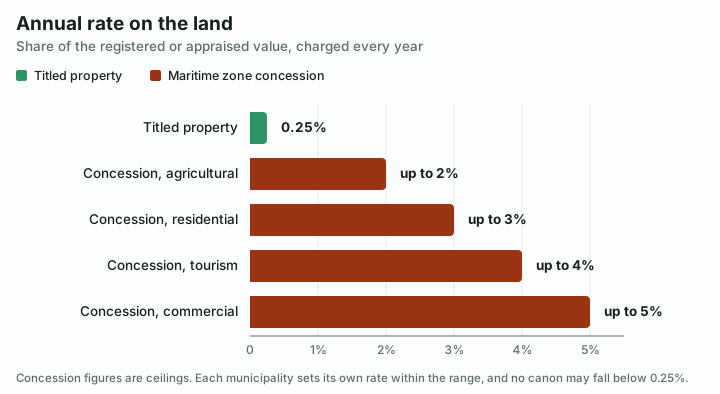
Sources: references [1] and [13].
A residential concession can therefore cost up to 3% of the appraised land value every year, twelve times the rate on titled land. No canon may fall below 0.25%.
The appraisal also follows published values: the Órgano de Normalización Técnica publishes a separate plataforma de valores for the maritime zone, distinct from the inland zone maps, so a coastal canon is calculated from the same kind of published basis as an inland tax bill, by the same body. Where a canton has not issued its own coastal regulation, the pre-2013 percentages continue to apply, which makes the presence or absence of a Plan Regulador a financial question as well as a land use one.[14]
Above CRC 143 million of construction, a second tax starts
The impuesto solidario, in force since 2009, is usually called the luxury home tax. For 2026 it reaches residential property where the construction and fixed installations are worth more than CRC 143 million, roughly USD 317,000, under Decreto 45358-H.[15]
The threshold is tested on the construction, but the tax is charged on the construction plus the land. The Ministerio de Hacienda sets out both steps: value the main building and its accessories, including ranchos, pools, walls, internal roads and sports courts, and only once that figure clears the exempt amount do you value the land and add the two together. A house that crosses the line by a little is taxed on a total that can be several times larger, though most guides report the threshold as though it were the base.[16]
Rates then run progressively from 0.25% on the first CRC 359 million to 0.55% above CRC 2,162 million. The declaration is form D-174, filed through TRIBU-CR, and unlike the property tax declaration it is a sworn declaration. It is due every three years within the first 15 calendar days of January. The current cycle runs 2025 to 2027, so the next ordinary filing falls in January 2028, and Hacienda's notice confirms that someone who bought during the cycle must file if the value is above the threshold.[17]
Bare land is outside it entirely. Concession holders are inside it, but declare only the construction.[18]
What the seller owes, and whether the closing catches it
Unpaid property tax is a hipoteca legal preferente, a preferential legal mortgage over the property itself, under article 28 and article 79 of the Código Municipal. Article 8 goes further: the current owner "is jointly liable for the taxes that have not been paid," with a three-year limit and a right to reclaim from whoever owned it before, which is only useful if you can find that person.[19]
Most guides say a transfer cannot be recorded unless municipal taxes are current, and cite article 29 of Ley 7509 for it. Article 29 was repealed in 1998 by the Código Notarial.[20]
The requirement does still exist, in article 94 of the Código Municipal, and it is broader than the repealed article: certification that the parties are current on all municipal tributos, not just the property tax. But the annotated edition of the Código Municipal, published by IFAM and updated to February 2024, prints a note directly beneath it saying compliance "is not currently required by the Registro Nacional." By contrast article 93, which requires municipal stamps of 2 colones per 1,000 of value, is enforced, and the Registry will not record a transfer without them.[21]
So your protection against inheriting municipal debt is your notary's diligence, not a check at the Registry. That is also why the recorded encumbrances on a property are only part of the answer: the municipal account is kept separately, and while a PropScan report shows the encumbrances, checking the account still takes a call to the municipality.
Common questions
How much is property tax in Costa Rica?
The rate is 0.25% a year, the same in every canton, set by article 23 of Ley 7509. It is charged on the value registered with your municipality as of January 1. If you bought recently that is normally the price recorded in your deed, because article 14 resets the base to the higher of the deed value and the value already registered.
Do I really have to declare my property value every five years?
Yes. Article 16 of Ley 7509 requires owners to declare the value to their municipality at least every five years. Since a 2012 reform, failing to declare carries a fine equal to the tax you did not pay, and the municipality may value the property itself using the registered area and the values of your zona homogénea.
Do you pay property tax on beachfront concession land?
Not on the land. A maritime zone concession pays an annual canon to the municipality, which article 48 of Ley 6043 says replaces the property tax. Buildings on the concession still pay the ordinary 0.25%. Residential canons run up to 3% of the appraised land value, so the land can cost far more per year than titled property.
What is the luxury home tax threshold for 2026?
CRC 143 million of construction value, including fixed and permanent installations, under Decreto 45358-H. If your construction is worth more than that, the tax is charged on the construction plus the land, at progressive rates from 0.25% to 0.55%. Bare land with no construction is outside the tax entirely.
Does unpaid property tax transfer to the buyer?
It can. Unpaid tax is a preferential legal mortgage on the property under article 28, and article 8 makes the current owner jointly liable for what a previous owner never paid, for three years back. Article 94 of the Código Municipal requires a municipal certificate before a transfer is recorded, though the annotated code says the Registry does not currently demand it.
Legal references and source notes
The numbered references below correspond to the markers in the article. Legal rules are sourced to Costa Rican statutes, regulations and official government guidance. Market-practice figures are identified as such.
[1] Ley 7509, art. 23: "En todo el país, el porcentaje del impuesto será de un cuarto por ciento (0,25%) y se aplicará sobre el valor del inmueble registrado por la Administración Tributaria." Source: Ley 7509, PGR-SINALEVI.
[2] Ley 7509, art. 9, sets the base as "el valor del inmueble registrado en la Administración Tributaria, al 1 de enero del año correspondiente", and the same article defines that authority as the municipal body that collects and audits the tax. Art. 3 assigns the role to each municipality for its own territory. Source: Ley 7509, PGR-SINALEVI.
[3] Ley 7509, arts. 12, 10 bis and 16. Art. 12 creates the Órgano de Normalización Técnica, which maintains the plataforma de valores de terrenos por zonas homogéneas each municipality publishes in La Gaceta and Hacienda's Manual de Valores Base Unitario por Tipología Constructiva. Art. 10 bis requires an avalúo to be produced by a professional registered with the Colegio de Ingenieros Agrónomos or the CFIA. Art. 16 gives the municipality the following fiscal period to correct a declared value. Source: Ley 7509, PGR-SINALEVI.
[4] Ley 7509, art. 14, "Modificación automática de la base imponible", lists the six triggers: transfer of ownership, mortgage or cédulas hipotecarias, rectificación de cabida or merger of properties, a higher value the owner recognizes, subdivision, and permitted construction assessed at 20% or more of the registered value. Source: Ley 7509, PGR-SINALEVI.
[5] Ley 7509, art. 21: a value change applies "a partir del primer día del año siguiente" to notification. Source: Ley 7509, PGR-SINALEVI.
[6] Ley 7509, art. 16, requires a declaration at least every five years; art. 10 allows one general or individual valuation per five-year period. Source: Ley 7509, PGR-SINALEVI.
[7] Ley 7509, art. 17, as reformed by Ley 9069 of September 10, 2012: where the owner has not declared, the municipality "le impondrá una multa de un monto igual a la diferencia dejada de pagar" and may value the property de oficio from the area recorded in the Registro Público and the values of the zona homogénea. Source: Ley 7509, PGR-SINALEVI.
[8] Ley 7509, art. 3, as reformed by Ley 7729: "La declaración que presente el sujeto pasivo no tendrá el carácter de declaración jurada." Source: Ley 7509, PGR-SINALEVI.
[9] Ley 7509, art. 4(e), exempts the bien único of a natural person up to 45 salarios base, with tax due "sobre el exceso de esa suma". The 2026 salario base of CRC 462,200 was set by the Consejo Superior del Poder Judicial in session 113-2025, article LXV, of December 16, 2025, effective January 1, 2026. The dollar figure uses the Banco Central de Costa Rica reference selling rate of CRC 451.72 on September 2, 2026. Sources: Ley 7509, PGR-SINALEVI; Poder Judicial, Circular 246-2025; Banco Central de Costa Rica, tipo de cambio de referencia.
[10] The exemption is applied for rather than granted automatically. Municipalities publish a no afectación por bien único procedure, and the Municipalidad de La Cruz advises filing "durante el primer trimestre del año (enero, febrero y marzo)". Source: municipal procedure pages, Escazú and La Cruz.
[11] Ley 7509, arts. 22 and 25. Art. 22 runs the tax from January 1 to December 31, leaves the schedule to each municipality as annual, semiannual or four quarterly installments, and refers late payment to the Código de Normas y Procedimientos Tributarios. Art. 25 caps any early-payment discount at the Banco Central's tasa básica pasiva. Source: Ley 7509, PGR-SINALEVI.
[12] Ley 6043, art. 48: a concession must state the canon and how it is paid, and "Ese canon sustituye el impuesto territorial." Ley 7509, art. 6(c), makes concessionaires liable only for the fixed installations and construction, "pues, para el terreno, regirá el canon municipal correspondiente." Sources: Ley 6043, PGR-SINALEVI and Ley 7509, PGR-SINALEVI.
[13] Reglamento a la Ley 6043, Decreto Ejecutivo 7841-P, art. 49, as reformed by Decreto 37882 of July 24, 2013: up to 2% for agricultural use, 3% residential, 4% hotel, tourism and recreation, 5% commercial, industrial and extractive, and not less than 0.25% for any use. Each canton sets its own figure within those ranges through its coastal regulation. Source: Decreto Ejecutivo 7841-P, PGR-SINALEVI.
[14] The transitorio único added by Decreto 37882 keeps the pre-2013 percentages in force where a canton has not issued its own coastal regulation. The Órgano de Normalización Técnica publishes a plataforma de valores for the maritime zone separate from the inland zone maps. Sources: Decreto Ejecutivo 7841-P, PGR-SINALEVI; Órgano de Normalización Técnica.
[15] Ley 8683, Impuesto Solidario para el Fortalecimiento de Programas de Vivienda, in force since 2009. Decreto 45358-H, La Gaceta 239 of December 19, 2025, sets the 2026 exempt amount at CRC 143,000,000 of construction and fixed installations. The threshold fell from CRC 145 million because the adjustment tracks the consumer price index, which was negative for the reference period. Sources: Ley 8683, PGR-SINALEVI and Decreto 45358-H, PGR-SINALEVI.
[16] Hacienda's Dirección de Valoraciones sets out both steps: value the main construction and its accessories, "rancho, piscina, muros, calles internas, canchas deportivas", against the Manual de Valores Base Unitario por Tipología Constructiva, and "Una vez determinado que el valor de la construcción supera el monto exento del período, se calcula el valor del terreno... y se suman ambos." Source: Ministerio de Hacienda, Dirección de Valoraciones.
[17] Bands for 2026 run from 0.25% up to CRC 359 million to 0.55% above CRC 2,162 million. Art. 7 of Ley 8683 and art. 8 of its regulation require a declaración jurada within the first 15 calendar days of January of each three-year period; the current period is 2025 to 2027. The form is D-174, filed through TRIBU-CR. Sources: Ley 8683, PGR-SINALEVI and the Ministerio de Hacienda 2026 notice.
[18] Ley 8683: bare land has no construction to test against the threshold, and concessionaires, permisionarios and occupants of the franja fronteriza and the maritime zone are liable but declare only the construction value. Source: Ley 8683, PGR-SINALEVI.
[19] Ley 7509, art. 28, makes unpaid tax a hipoteca legal preferente over the property by reference to the Código Municipal, whose operative text is art. 79: "Las deudas por tributos municipales constituirán hipoteca legal preferente sobre los respectivos inmuebles." Art. 8 of Ley 7509 makes the current owner jointly liable for unpaid tax, with a three-year prescription and a right to reclaim from the predecessor in title. Sources: Ley 7509, PGR-SINALEVI and Código Municipal, PGR-SINALEVI.
[20] Ley 7509, art. 29, was repealed by art. 190(d) of the Código Notarial, Ley 7764, of April 17, 1998, and SINALEVI prints that repeal on the article. The repealing text cites the pre-1997 numbering, "el artículo 27 de la Ley del impuesto sobre bienes inmuebles, N° 7509". Sources: Ley 7509, PGR-SINALEVI and Código Notarial, PGR-SINALEVI.
[21] Código Municipal, art. 94: "Para inscribir en el Registro Público operaciones de bienes inmuebles, se requerirá comprobar, mediante certificación, que las partes involucradas se encuentran al día en el pago de los tributos municipales del cantón donde se encuentra el bien." The annotated edition published by IFAM and the UNGL, updated to February 2024, prints beneath it that "El cumplimiento de esta disposición actualmente no es exigido por el Registro Nacional." Art. 93 sets the municipal stamp at two colones per thousand and states that without payment the Registro Público cannot record the transaction. Sources: Código Municipal, PGR-SINALEVI and the annotated Código Municipal, IFAM and UNGL, February 2024.
This guide is informational and not a substitute for legal advice. For a purchase, work with an experienced attorney or notary.