Costa Rica's Zona Marítimo Terrestre and "beachfront" ownership
If a Costa Rican listing says beachfront, the land is almost certainly State property in the maritime zone or "Zona Marítimo Terrestre" (ZMT). What a concession is, who may hold one and how.
Costa Rica's maritime zone begins at the ordinary high-tide line, which the law defines as a height: the contour 115 centimeters above mean sea level on the Pacific coast, and 20 centimeters above it on the Caribbean coast, which the law calls the Atlantic.[1] Apart from a few exceptions covered below, the 200 meters inland from that line belong to the State and cannot be bought, or acquired by occupying them for any length of time.[2]
So a beachfront listing usually offers one of two things: a concession, which is a right to use State land for a fixed term, or a building with no legal right behind it at all. The documents for the two can look alike.
Key points
- The first 50 meters from the ordinary high-tide line, and any mangrove however far it runs inland, are public zone. Outside narrow exceptions, no one may occupy it.
- In the next 150 meters a municipality can grant a concession, a right to use a parcel for 5 to 20 years. It is never ownership, but it can be renewed, sold with approval and inherited.
- No building may be approved until the tourism institute has declared the stretch, a coastal plan is published and the concession is registered in the Registro Nacional.
- A foreigner can hold a concession after five years of continuous residence, and before that can own up to half of a Costa Rican company that holds one, usually 49%.
- Canon receipts, a permiso de uso and a precarious-use payment are not concessions. Without a coastal plan, a building in the restricted zone older than the 2014 law may be kept only until July 30, 2033.
The maritime zone is a 200-meter strip measured from a contour line
Ley 6043 of 1977 defines the maritime zone (zona marítimo terrestre, or ZMT) as a strip 200 meters wide along both coasts, whatever the land is like, measured horizontally from the ordinary high-tide line. It includes the islands, apart from Isla del Coco and a few governed by other laws.[3] Measured horizontally means a map distance: on a slope, 200 meters paced along the ground stops short of the zone's inland edge.
The strip has two parts. The zona pública is the first 50 meters, plus whatever the sea uncovers at low tide. The zona restringida is the 150 meters behind it.[4] A mangrove is public zone however far it extends, and where one runs past 50 meters, the restricted zone starts at the mangrove's inland edge.[5]
Except where the law itself allows, the public zone cannot be occupied under any title, and nobody can claim a right over it. It is kept for public use and passage.[6]
Fixing the public zone is the exclusive job of the Instituto Geográfico Nacional (IGN), which places boundary markers, or mojones, publishes each delimitation in La Gaceta and loads it into the Sistema Nacional de Información Territorial (SNIT). The cadastre will not register a concession plan that does not match that line, or one on a stretch the IGN has not delimited.[7] The IGN also redraws the line: in September 2026 it canceled five markers around a mangrove at Playa Junquillal, in Santa Cruz.[8]
A concession is a 5- to 20-year right of use that can be renewed and sold
A concession gives the use of a defined area of the restricted zone, for a term and on conditions the law sets, and the land stays the State's.[9] Only the municipality grants one, and in a zone declared for tourism the Instituto Costarricense de Turismo (ICT) must approve it.[10] The term runs from 5 to 20 years, and the annual canon the holder pays replaces the property tax on the land, at rates covered in our article on Costa Rican property tax.[11]
The law allows successive renewals, each for up to 20 years, if the municipality agrees and the ICT approves. The municipality must warn the holder six months to a year before expiry, and the holder then has three months to apply, or the last six months of the term if no warning came. The canon must be paid up, and it is reset at the rate in force on the renewal date. A late application counts as a new request.[12] A concession that runs out with no timely application is extinguished, and where that happens through the holder's fault, the buildings stay with the municipality and nothing is paid for them.[13]
A concession can also be sold, used to secure a loan and inherited. A sale or a pledge needs the express authorization of the municipality and the ICT, and a contract that skips it has no validity at all.[14] Banks in the national banking system may lend against a concession and its buildings, and once half the term has run, the holder can ask for an early renewal to use the concession as security for new investment, improvements or refinancing. On the holder's death, the rights can be awarded to the heirs.[15]
Six things must exist before anyone may build in the zone
Nothing may be built in the maritime zone until the ICT has declared the stretch suitable for tourism or not.[16] After that, the municipality may not approve any construction until a coastal plan is approved and published and the concession is registered.[17]
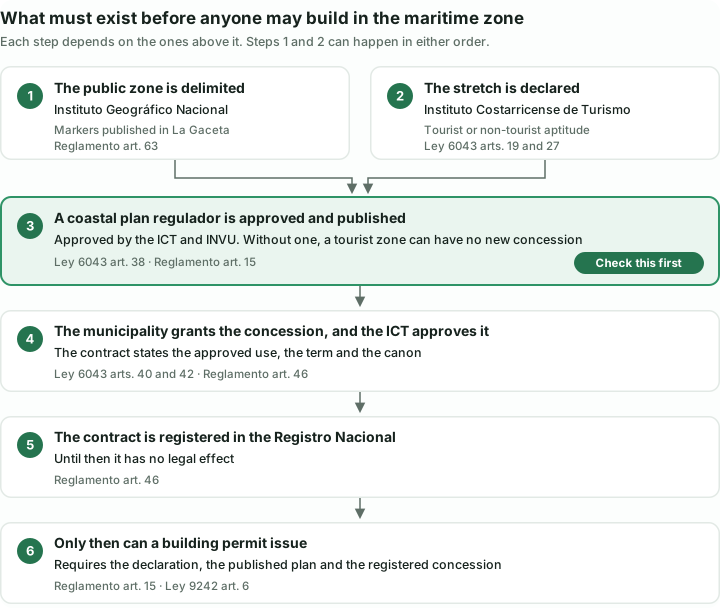
Figure 1. The sequence the law and its regulation require. Sources: references [7], [10], [16], [17], [18] and [19].
The coastal plan is the step to check first. In a zone declared for tourism, the municipality cannot grant a concession until the ICT and the Instituto Nacional de Vivienda y Urbanismo (INVU) have approved a plan for it, so in a tourist zone with no coastal plan regulador there is no valid new concession to buy.[18] The contract takes legal effect only once it is registered, and it must state the approved use, the term and the canon.[19]
Three papers that look like rights and are not
Municipalities charge a canon to people who occupy the zone without a concession, and the law says that charge gives them no right to one.[20]
A permiso de uso is a use permit the municipality issues on its own authority. The Procuraduría General de la República (PGR), the State's legal adviser, describes it as precarious, revocable at any time without compensation, limited to simple structures that are easy to remove, and no substitute for a concession where there is no coastal plan.[21]
The third is a precarious-use payment under Ley 9242 of 2014, which covers buildings already standing in the restricted zone when it was passed. Where there is no coastal plan, the municipality may keep them, unless environmental damage is shown, and let them be used against a payment that the law says "no generará derecho alguno", generates no right. The law gives municipalities a fixed period to approve their plan, and the legislature has restarted it three times, most recently in 2025 with eight years, which run to July 30, 2033.[22] When a plan takes effect, each building must fit it and its holder must apply for a concession, or the municipality evicts the occupants and demolishes the building at the owner's cost.[23]
Nothing built since the 2014 law has even that. No new building may be authorized without a registered concession, unauthorized works are demolished at the owner's expense and their occupants evicted, and building against the law carries one month to three years in prison.[24] Someone who built on an unlawfully held lot without being a poblador, a resident of the zone, has no right to payment for the building. They may still apply for a concession on the lot, and if it is granted, they are not charged for using what they built.[25]
Exceptions to the maritime zone law, and what each requires
The law does not apply to coastal cities, to areas declared urban coastal zones under a 2014 law, to properties registered to private owners "con sujeción a la ley", in accordance with the law, or to those whose legitimacy other laws recognize.[26] Even a properly titled property that takes in part of the public zone can be used privately only by express agreement of the municipality, the ICT and INVU.[27] Inside a national park, the maritime zone falls under park law instead.[28]
Forest is treated separately. Under the forestry law, rural land that a public body administers cannot be ceded or leased until the Ministerio de Ambiente y Energía (MINAE) has classified it, and if it is forested it becomes part of the Patrimonio Natural del Estado, the State's natural heritage, which cannot be sold or seized.[29]
Inside the 200 meters, whether a title is protected depends on whether it was registered in accordance with the law, a question for the registry history and a lawyer.
How foreigners hold a concession in practice
Article 47 of Ley 6043 bars five kinds of holder: a foreigner with less than five years' residence, a company with bearer shares, a company domiciled abroad, a company constituted in Costa Rica by foreigners, and a company more than half owned by foreigners.[30]
After five continuous years of residence, certified by the migration authority, a foreigner can hold a concession in their own name.[31] The constitutional chamber of the Supreme Court, the Sala Constitucional, upheld that rule in 2010.[32]
Before then, a foreigner can own up to half of a Costa Rican company that holds a concession, since article 47's ownership rule bars a company only when foreigners own more than half of it. The usual split is 49% for the foreigner and 51% for a Costa Rican partner, in a company that a Costa Rican constituted. The company then applies for a concession, or takes over an existing one with the authorization described above. A foreigner cannot buy into the seller's own company instead: once a company holds a concession, the law bars it and its partners from transferring shares to foreigners, and voids any transfer that does.[33]
A common further step is for the Costa Rican partner to hold the 51% in trust for the foreigner, under a private agreement. That gives the foreigner, in substance, the majority that article 47 denies. The PGR has said that a concession granted to a company whose capital is shown to belong more than half to foreign-controlled companies could be fraud of the law, and that a grant made in fraud of the law can be declared void.[34] A majority held in trust raises the same question, and Ley 6043 charges the PGR with seeking the annulment of any concession obtained against it.[35] The foreigner's claim to the majority also depends on a contract with one person. A Costa Rican lawyer should advise on whether to use the arrangement, and write the contract, before anything is signed.
Titled land is the alternative to a concession. Foreigners have the same rights as Costa Ricans, except where the Constitution or a law limits them,[36] so titled land beyond the 200 meters, or inside them under one of the exceptions above, can be owned outright by a foreigner.
What to check before paying anything
- Run the free registry lookup with Z in the Duplicado field, which is how a concession is filed. The step-by-step guide shows where its term appears, at the bottom among the encumbrances.
- Ask the municipality's maritime zone office, in writing, for the ICT declaration, the coastal plan and the La Gaceta issue that published it, and the concession file: contract, approved use, term, canon account and any renewal application.
- Check that the cadastral plan shows the IGN's markers for the public zone.
- If a company holds the concession, get its constitution and shareholder record and read them against article 47.
- Have a Costa Rican lawyer set up any company you buy through, and handle the transfer and its approvals, before any deposit moves.
A PropScan report identifies a concession from the Z in the folio, measures how much of the parcel lies in the restricted zone against the IGN's markers, flags a term that has run out, and says so when it cannot tell which coastal plan applies. Its sample report is a concession at Playa Las Manchas, Montezuma, whose term ran from April 17, 2002, to April 17, 2022, with no renewal on the record; whether one was requested in time is in the municipality's file.
The due diligence guide covers the checks that apply to any property, on the coast or not.
Common questions
Can a foreigner own beachfront property in Costa Rica?
Not in the first 200 meters from the ordinary high-tide line, which belong to the State outside narrow exceptions. In the inland 150 meters a municipality can grant a concession, a renewable right to use a parcel for 5 to 20 years. A foreigner can hold one after five years of continuous residence, and before that can own up to half of a Costa Rican company holding one, usually 49%. Titled land beyond the 200 meters can be owned outright.
How long does a maritime zone concession last in Costa Rica?
Between 5 and 20 years, and it can be renewed for successive terms of up to 20 years each. To renew it, the holder must apply within three months of the municipality's notice of expiry, or in the six months before expiry if no notice came, and be current on the canon. A late application is treated as a new request, and a concession that expires with no timely application is extinguished.
Is a permiso de uso the same as a concession?
No. The Procuraduría General de la República describes a permiso de uso as a precarious permit the municipality can revoke at any time without compensation. It allows only structures that are easy to remove, and it cannot stand in for a concession where no coastal plan exists.
What happens to a house in the maritime zone that has no concession?
If it predates Ley 9242 of 2014 and stands in the restricted zone of a stretch with no coastal plan, the municipality may keep it until July 30, 2033, unless environmental damage is shown, against a precarious-use payment that creates no right. Once a plan is in force it must fit the plan and obtain a concession, or it is demolished at the owner's cost.
Who decides where the maritime zone starts on a property?
The Instituto Geográfico Nacional, exclusively. It marks the inland edge of the 50-meter public zone, publishes each delimitation in La Gaceta and loads the line into the national territorial information system, and the cadastre will not register a concession plan that does not match it.
Legal references and source notes
The numbered references below correspond to the markers in the article. Legal rules are sourced to the Constitution and to Costa Rican statutes and regulations in their versión vigente, read on September 23 and 24, 2026, and to opinions of the Procuraduría General de la República. The sample report is PropScan's own, as it stood on September 23.
[1] Decreto Ejecutivo 7841-P, Reglamento a la Ley sobre la Zona Marítimo Terrestre, art. 2(ch): "La línea de pleamar ordinaria es, para el litoral Pacífico, el contorno o curva de nivel que marca la altura de 115 centímetros sobre el nivel medio del mar y para el litoral Atlántico, es el contorno que marca la altura de 20 centímetros sobre el nivel medio del mar." Version 7 of 7, July 24, 2013. Source: Decreto 7841-P, PGR-SINALEVI.
[2] Ley 6043, arts. 1 and 7. Art. 1: "La zona marítimo terrestre constituye parte del patrimonio nacional, pertenece al Estado y es inalienable e imprescriptible." Art. 7: "Los terrenos situados en la zona marítimo terrestre no pueden ser objeto de informaciones posesorias y los particulares no podrán apropiarse de ellos ni legalizados a su nombre, por éste u otro medio." Version 9 of 9, April 5, 2022. Source: Ley 6043, PGR-SINALEVI.
[3] Ley 6043, art. 9: "Zona marítimo terrestre es la franja de doscientos metros de ancho a todo lo largo de los litorales Atlántico y Pacífico de la República, cualquiera que sea su naturaleza, medidos horizontalmente a partir de la línea de la pleamar ordinaria y los terrenos y rocas que deja el mar en descubierto en la marea baja." The same article extends it to islands, islets and maritime rocks, except Isla del Coco "y aquellas otras islas cuyo dominio o administración se determinen en la presente ley o en leyes especiales." Source: Ley 6043, PGR-SINALEVI.
[4] Ley 6043, art. 10: the zone is made up of "la ZONA PUBLICA, que es la faja de cincuenta metros de ancho a contar de la pleamar ordinaria, y las áreas que quedan al descubierto durante la marea baja; y la ZONA RESTRINGIDA, constituida por la franja de los ciento cincuenta metros restantes". Source: Ley 6043, PGR-SINALEVI.
[5] Ley 6043, art. 11: "Zona pública es también, sea cual fuere su extensión, la ocupada por todos los manglares de los litorales continentales e insulares y esteros del territorio nacional." Decreto 7841-P, art. 4: "Partiendo de la línea de vegetación a la orilla de los esteros y del límite de los manglares o bosques salados cuando éstos se extiendan por más de 50 metros de la pleamar ordinaria, comienza la zona restringida." Sources: Ley 6043 and Decreto 7841-P, PGR-SINALEVI.
[6] Ley 6043, art. 20: "Salvo las excepciones establecidas por la ley, la zona pública no puede ser objeto de ocupación bajo ningún título ni en ningún caso. Nadie podrá alegar derecho alguno sobre ella. Estará dedicada al uso público y en especial al libre tránsito de las personas." Source: Ley 6043, PGR-SINALEVI.
[7] Decreto 7841-P, art. 63: "El Instituto Geográfico Nacional deberá publicar aviso en el Diario Oficial, de cada porción de la zona marítimo-terrestre en que haya demarcado la zona pública. La Dirección General de Catastro no registrará ningún plano que no lleve el visto bueno del Instituto Geográfico Nacional en lo referente a la delimitación de la zona pública." Registro Nacional, Directriz DRI-001-2016 and DIG-007-2016 of November 10, 2016: the delimitation is "función exclusiva del Instituto Geográfico Nacional", it is public as a digital layer in the SNIT, registrars check each plan against it, and "Cuando no se cuente con información sobre la delimitación de la Zona Marítimo Terrestre en el SIRI, el registrador consignará como defecto tal situación." Sources: Decreto 7841-P and Directriz DRI-001-2016, PGR-SINALEVI.
[8] Instituto Geográfico Nacional, Aviso Nº 017-2026: "Cancelación de los mojones 8, 9, 10, 11 y 12 que delimitan un sector de manglar ubicado en Playa Junquillal, en el distrito 03º Veintisiete de Abril, cantón 03º Santa Cruz, provincia 05º Guanacaste." Dated September 9, 2026 in SINALEVI, where a search by name for zona marítimo terrestre returns further IGN delimitations from the same month. Source: IGN, Aviso 017-2026, PGR-SINALEVI.
[9] Ley 6043, art. 41: "Las concesiones serán únicamente para el uso y disfrute de áreas determinadas en la zona restringida, por el plazo y bajo las condiciones que esta ley establece." Art. 39 confines concessions to the restricted zone. Source: Ley 6043, PGR-SINALEVI.
[10] Ley 6043, art. 40: "Unicamente las municipalidades podrán otorgar concesiones en las zonas restringidas correspondientes a la zona marítimo terrestre de su respectiva jurisdicción". Art. 42: "Las concesiones en las áreas turísticas requieren la aprobación del Instituto Costarricense de Turismo." Source: Ley 6043, PGR-SINALEVI.
[11] Ley 6043, art. 48: "Las concesiones se otorgarán por un plazo no menor de cinco ni mayor de veinte años y deberán indicar el canon a pagar y su forma de pago. Ese canon sustituye el impuesto territorial." Source: Ley 6043, PGR-SINALEVI.
[12] Ley 6043, art. 50: "Las concesiones podrán prorrogarse sucesivamente, al término de su vencimiento o de la prórroga anterior, por plazo no mayor que el estipulado en el artículo 48, siempre que lo solicite el interesado, lo acuerde la municipalidad respectiva y lo apruebe el Instituto correspondiente." Decreto 7841-P, art. 53: the municipality must notify the holder "con una anticipación no menor de seis meses ni mayor de un año"; the application is due "dentro de los tres meses siguientes a la notificación", and without notice may be made in the six months before expiry; the holder must be current on the canon. Ley 6043, art. 50: "En caso de prórroga, el canon a pagar será el vigente, conforme al reglamento correspondiente, a la fecha en que se acuerde la prórroga por la municipalidad respectiva", and "La solicitud de prórroga presentada extemporáneamente se tendrá como nueva solicitud de concesión." Sources: Decreto 7841-P and Ley 6043, PGR-SINALEVI.
[13] Ley 6043, art. 52(a): a concession is extinguished "Por vencimiento del plazo fijado sin haber solicitud de prórroga en forma legal". Art. 55: "Extinguida una concesión por motivos imputables al concesionario, las mejoras, edificaciones e instalaciones que hubiere en esa parcela quedarán en favor de la municipalidad respectiva, sin que ésta deba reconocer suma alguna por aquellas." Source: Ley 6043, PGR-SINALEVI.
[14] Ley 6043, art. 45: "Es prohibido ceder o comprometer, o en cualquier otra forma traspasar o gravar, total o parcialmente, las concesiones o los derecho derivados de ellas, sin la autorización expresa de la municipalidad respectiva y del Instituto Costarricense de Turismo o del Instituto de Tierras y Colonización, según sea el caso. Carecerán de toda validez los actos o contratos que infringieren esta disposición." Source: Ley 6043, PGR-SINALEVI.
[15] Ley 6043, art. 67: "Los bancos del Sistema Bancario Nacional e instituciones del Estado quedan autorizados para conceder préstamos a los concesionarios de la zona restringida en la zona marítimo terrestre, con garantía de la respectiva concesión y sus edificaciones, mejoras e instalaciones." Art. 50, fourth paragraph, added by Ley 9974 of April 9, 2021: the municipality may grant an early renewal "únicamente cuando el objetivo sea utilizar los derechos de concesión como garantía financiera para desarrollar nuevas inversiones o realizar mejoras en el inmueble, o para readecuar o refinanciar condiciones crediticias", and "La solicitud podrá plantearse una vez que haya transcurrido al menos la mitad del plazo otorgado en la concesión." Art. 49: "En caso de fallecimiento, o ausencia declarada del concesionario, sus derechos podrán adjudicarse a sus herederos o presuntos herederos parientes." Source: Ley 6043, PGR-SINALEVI.
[16] Ley 6043, art. 19: "Hasta tanto no se produzca la respectiva declaratoria de aptitud turística, no podrán autorizarse obras ni construcciones, reconstrucciones o remodelaciones, de ninguna clase, en la zona marítimo terrestre." Art. 27 gives the ICT the power to make that declaration and requires its publication in the Diario Oficial. Source: Ley 6043, PGR-SINALEVI.
[17] Decreto 7841-P, art. 15, as reformed by Decreto 29059-MP-MEIC-TUR of November 3, 2000: "Las municipalidades no podrán aprobar obras de construcción, reconstrucción o remodelación hasta tanto no se produzca la declaratoria de zona de aptitud turística o no turística por parte del ICT, se haya aprobado y publicado el plan regulador costero, y se cuente con el respectivo contrato de concesión debidamente inscrito en el Registro General de Concesiones de la Zona Marítimo Terrestre en el Registro Nacional." Source: Decreto 7841-P, PGR-SINALEVI.
[18] Ley 6043, art. 38: "Las municipalidades no podrán otorgar concesiones en las zonas turísticas, sin que el Instituto Costarricense de Turismo y el Instituto Nacional de Vivienda y Urbanismo hayan aprobado o elaborado los planos de desarrollo de esas zonas." Source: Ley 6043, PGR-SINALEVI.
[19] Decreto 7841-P, art. 46, as reformed in 2000: "Los contratos no surtirán efectos legales hasta tanto no se cuente con la inscripción en el Registro General de Concesiones del Registro Nacional." The contract must state, among other things, the dates of the ICT declaration and of the plan's publication, the use approved, the term and the canon. Source: Decreto 7841-P, PGR-SINALEVI.
[20] Ley 6043, Transitorio VII, added by Ley 6890 of September 4, 1983: municipalities charge the canon "para los ocupantes" of the zone, provisionally until the development plan takes effect, and the charge "no produce derecho alguno para los ocupantes en lo que a concesión se refiere." Source: Ley 6043, PGR-SINALEVI.
[21] Procuraduría General de la República, dictamen C-166-2017 of July 17, 2017, to the Concejo Municipal de Cóbano, conclusion 4: the permiso de uso "corresponde a un acto unilateral de la Administración, de carácter precario, que concede a un particular el uso privativo sobre un bien de dominio público. Dicha figura solo permite obras sencillas de fácil remoción". In the body: it is "revocable a discreción de esta y sin responsabilidad a su cargo", and "no puede considerarse como un sustituto de la concesión en ausencia de plan regulador dentro de una zona de aptitud turística." Source: PGR, C-166-2017.
[22] Ley 9242, Ley para la regularización de las construcciones existentes en la zona restringida de la zona marítimo terrestre, in force June 9, 2014. Art. 2 limits it to structures fixed to the land before the law. Art. 4, as rewritten by Ley 10735 of July 1, 2025: municipalities without a coastal plan "dispondrán de ocho años para concretar la aprobación del plan", may keep existing buildings unless environmental damage is shown, and may let them be used "a título precario" against a canon, and "El pago por uso de suelo en precario no generará derecho alguno." Ley 10735, art. 3, starts the eight years at its entry into force, July 30, 2025. Earlier versions of art. 4 gave four years (Ley 9408 of November 18, 2016) and four years again (Ley 9984 of May 24, 2021). Sources: Ley 9242 and Ley 10735, PGR-SINALEVI.
[23] Ley 9242, art. 3: where a coastal plan is in force, buildings that fit it may stay and the holder must apply for a concession; those that need changes get six non-extendable months, and failing that "la municipalidad procederá al desalojo y la demolición de las obras... El costo de demolición o destrucción se cobrará al dueño de la construcción o instalación." Art. 4 applies the same procedure once a plan takes effect. Source: Ley 9242, PGR-SINALEVI.
[24] Ley 9242, art. 6: municipalities "no podrán autorizar ni permitir nuevas construcciones que no estén respaldadas en una concesión debidamente aprobada, inscrita y ajustada al plan regulador costero vigente." Ley 6043, art. 13: the authorities proceed "al desalojo de los infractores y a la destrucción o demolición de las construcciones... sin responsabilidad alguna", and "El costo de demolición o destrucción se cobrará al dueño de la construcción o instalación." Art. 62 sets "prisión de un mes a tres años" for building against the law. Sources: Ley 9242 and Ley 6043, PGR-SINALEVI.
[25] Decreto 7841-P, art. 75: "Quienes no siendo pobladores hayan construido o edificado en la zona restringida en predios ilegalmente poseídos, no tendrán derecho al pago de mejoras. Sin embargo, podrán solicitar concesión sobre el predio y, si se les otorgare, no se les cobrará por el uso, y disfrute de esas mejoras." The same article lets pobladores who are Costa Rican by birth, with more than ten years of continuous residence in the zone, stay in possession of their lot if it is their only property. Source: Decreto 7841-P, PGR-SINALEVI.
[26] Ley 6043, art. 6, as reformed by Ley 9221 of March 27, 2014: "Las disposiciones de esta ley no se aplicarán a las áreas de las ciudades situadas en los litorales, ni a las zonas urbanas litorales, ni a las propiedades inscritas, con sujeción a la ley, a nombre de particulares, ni a aquellas cuya legitimidad reconozcan las leyes." Source: Ley 6043, PGR-SINALEVI.
[27] Ley 6043, art. 25: "En el caso de fincas debidamente inscritas en el Registro Público, que comprendan parcial o totalmente la zona pública, el uso particular de las mismas sólo se permitirá de conformidad con acuerdos expresos de la respectiva municipalidad, el Instituto Costarricense de Turismo y el Instituto Nacional de Vivienda y Urbanismo." Source: Ley 6043, PGR-SINALEVI.
[28] Ley 6043, art. 73: "La presente ley no se aplica a las zonas marítimo terrestres, incluidas en los parques nacionales y reservas equivalentes, las cuales se regirán por la legislación respectiva." Source: Ley 6043, PGR-SINALEVI.
[29] Ley 7575, Ley Forestal, version 14 of 14. Art. 13 includes in the Patrimonio Natural del Estado the forests and forest land "de las pertenecientes a municipalidades, instituciones autónomas y demás organismos de la Administración Pública". Art. 14 makes that land "inembargables e inalienables". Art. 15: public bodies "no podrán permutar, ceder, enajenar, de ninguna manera, entregar ni dar en arrendamiento, terrenos rurales de su propiedad o bajo su administración, sin que antes hayan sido clasificados por el Ministerio del Ambiente y Energía. Si están cubiertos de bosque, automáticamente quedarán incorporados al patrimonio natural del Estado". Source: Ley 7575, PGR-SINALEVI.
[30] Ley 6043, art. 47: "No se otorgarán concesiones: a) A extranjeros que no hayan residido en el país por lo menos durante cinco años; b) A sociedades anónimas con acciones al portador; c) A sociedades o entidades domiciliadas en el exterior; ch) A entidades constituidas en el país por extranjeros; y d) A entidades cuyas acciones o cuotas o capital, correspondan en más de cincuenta por ciento a extranjeros." Source: Ley 6043, PGR-SINALEVI.
[31] Decreto 7841-P, art. 25(a): no concession "A extranjeros que hayan residido en el país menos de 5 años en forma continua, según conste en certificación extendida para tales efectos por las autoridades nacionales de Migración". Source: Decreto 7841-P, PGR-SINALEVI.
[32] Sala Constitucional, Voto 11351-2010 of June 29, 2010, as quoted in PGR dictamen C-254-2013: the five-year rule in Ley 6043 art. 47(a) and Decreto 7841-P art. 25(a) does not exclude foreigners as such, is an objective distinction, and "busca un fin legítimo como lo es el dar ventaja a nacionales y los extranjeros con cierto arraigo, en el uso y disfrute de bienes de dominio del Estado". Source: PGR, C-254-2013, via SINALEVI.
[33] Ley 6043, art. 47(ch) and (d) bar concessions "A entidades constituidas en el país por extranjeros" and "A entidades cuyas acciones o cuotas o capital, correspondan en más de cincuenta por ciento a extranjeros." Its last paragraph: "Las entidades que tuvieren concesiones no podrán ceder o traspasar cuotas o acciones, ni tampoco sus socios, a extranjeros. En todo caso, los traspasos que se hicieren en contravención a lo dispuesto aquí, carecerán de toda validez." The 49% and 51% split is the usual practice; the law's figure is the 50% in (d). Source: Ley 6043, PGR-SINALEVI.
[34] Procuraduría General de la República, dictamen C-254-2013 of November 19, 2013, to the Concejo Municipal del Distrito de Cóbano, transcribing the PGR's opinión jurídica OJ-052-2011 of August 31, 2011: "cuando se otorgue una concesión al amparo de ese artículo 47 a una persona jurídica y se logre acreditar que su capital accionario pertenece en más de un cincuenta por ciento a personas jurídicas controladas por extranjeros, podría configurar un fraude de ley", and "la sanción que conllevan los actos administrativos dictados en fraude de ley es la nulidad de dicho acto". On the one-concession rule of art. 57(e), the same opinion looks at who controls the company: fraud of the law may exist where a concession goes to a company "controlada en forma dominante por una persona física sujeta a esa prohibición". The same opinion quotes art. 58 of Ley 8422, which sets one to five years in prison for an official who acts in fraud of the law, and the same for a private party who knowingly benefits from it or takes part. Sources: PGR, C-254-2013, via SINALEVI and Ley 8422, PGR-SINALEVI.
[35] Ley 6043, art. 4: the PGR "ejercerá el control jurídico para el debido cumplimiento de las disposiciones de esta ley. En consecuencia, hará las gestiones pertinentes respecto a cualesquiera acciones que violaren o tendieren a infringir estas disposiciones... o para anular concesiones, permisos, contratos, actos, acuerdos o disposiciones obtenidos en contravención a las mismas." Source: Ley 6043, PGR-SINALEVI.
[36] Constitución Política, art. 19: "Los extranjeros tienen los mismos deberes y derechos individuales y sociales que los costarricenses, con las excepciones y limitaciones que esta Constitución y las leyes establecen." Version 28 of 28. Source: Constitución Política, PGR-SINALEVI.
This guide is informational and not a substitute for legal advice. For a purchase, work with an experienced attorney or notary.