Closing costs in Costa Rica: what buying property actually costs
A practical guide to transfer taxes, Registry charges, notarial fees, escrow, due diligence and broker commissions, including what changes when the seller finances the purchase.
THE SHORT VERSION
For a straightforward purchase of titled property, a useful first-pass budget is about 4% of the purchase price for acquisition costs. A realistic working range is roughly 3.5% to 5%, depending on who pays which items and what professional work is needed. Broker commission is a major transaction cost, but in the usual Costa Rican sale it is paid by the seller from the agreed sale proceeds, not added to the buyer's closing budget.
A $500,000 property in Costa Rica does not normally cost a buyer exactly $500,000 to acquire. If the buyer carries most standard transfer expenses, another $17,500 to $25,000 is a reasonable early budget. The exact amount depends on the property, the services used and what buyer and seller agree to pay.
There is no single "closing fee." Some charges are fixed by law, others depend on the property value, and professional services vary with the transaction. Once those categories are separated, the calculation is fairly straightforward.
Start with the government charges
The largest statutory item is the property transfer tax, or impuesto de traspaso. The rate is 1.5%. For the declaration and payment, the taxable base is generally the higher applicable value rather than automatically the lowest number appearing in the transaction. The tax is paid in one amount, even when the seller has agreed to finance part of the purchase price.[1]
The National Registry charges 5 colones per 1,000 colones of value for a real estate transfer, or 0.5%. The municipal stamp is 2 colones per 1,000, or 0.2%. The general agrarian stamp on a property transfer is 1.50 colones per 1,000, or 0.15%, although qualifying residential property can receive lower agrarian-stamp rates.[2]
| Typical core charge | Approx. rate |
|---|---|
| Transfer tax | 1.50% |
| National Registry | 0.50% |
| Municipal stamp | 0.20% |
| Agrarian stamp, typical higher-value example | 0.15% |
| Illustrative subtotal | 2.35% |
There are also small Archivo Nacional and Colegio de Abogados stamps. One item that should no longer appear in a current closing estimate is the old fiscal stamp. Ley 10586 repealed the relevant Fiscal Code provisions effective in December 2024.[3]
Then comes the notary
A Costa Rican real estate transfer is formalized through a public deed authorized by a Costa Rican notary. The published notarial tariff is progressive: 2% on the first ₡11 million, 1.5% on the next band up to ₡16.5 million, 1.25% up to ₡33 million, and 1% on the amount above ₡33 million.[4]
The effective notarial percentage therefore falls as the transaction value rises. On a ₡250 million transaction, the tariff calculation is about ₡2.68 million, or 1.07% of value. Professional services are generally subject to 13% IVA, so IVA on that notarial fee adds about another 0.14% in this example.[5]
Using the higher-value agrarian-stamp assumption above, the illustrative baseline is about 3.57% before escrow, inspections, surveys, financing or separate due diligence. It assumes the buyer carries the full transfer and notarial package; a negotiated split with the seller can reduce the buyer's cash requirement.
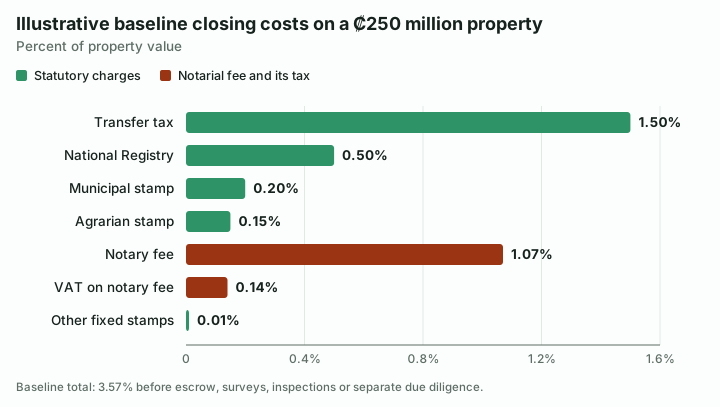
Figure 1. Illustrative transaction baseline on a ₡250 million titled property. Broker commission is not included because it is normally paid from the seller's proceeds.
Why the percentage falls slightly on more expensive properties
Most government charges rise directly with the property value. Notarial fees do not, because the higher percentages apply only to the first bands. Above ₡33 million, the marginal notarial rate is 1%, so the total closing-cost percentage falls slightly as property values rise.
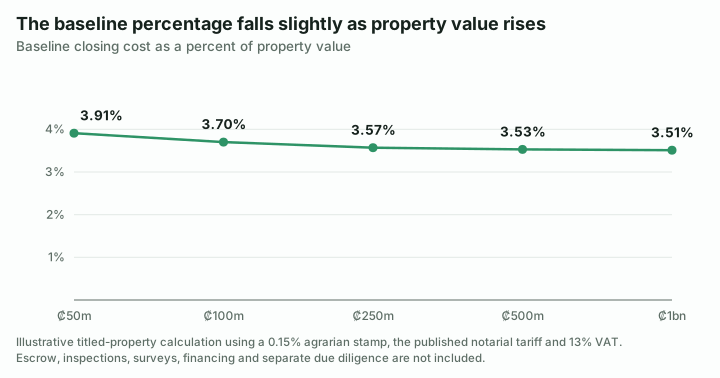
Figure 2. Illustrative baseline using the published notarial tariff, 13% IVA and a 0.15% agrarian stamp assumption. Escrow, inspections, surveys, financing and separate due diligence are excluded.
Legal due diligence may be separate
Preparing and registering the deed is not the same as investigating the property. Due diligence can include title and liens, the cadastral plan, municipal taxes, easements, condominium obligations, permits, land use, water availability and corporate records. Ask for a written legal quote that states what is included.
Escrow is another variable
Escrow is not a government tax and has no statutory price. It is commonly used when purchase funds come from abroad. Current market guides put typical fees around $500 to $1,500, although the actual quote depends on the provider and transaction.[6]
Who actually pays the closing costs?
Costa Rican law makes the transferor and buyer taxpayers in equal parts for the property transfer tax and jointly responsible for it. The purchase agreement can still allocate the economic burden differently between the parties, which is why buyers sometimes agree to pay most or all closing expenses.[7]
That allocation should be clear in the offer. Taking on $20,000 of expenses that otherwise would have been shared changes the economics of a $500,000 deal even though the purchase price itself has not changed.
What about the real estate commission?
If a broker is involved, there is another substantial cost in the transaction, but it normally sits on the seller's side of the closing statement.
Brokerage is different from taxes and notarial fees because Costa Rica does not set a statutory private real estate commission. Current market practice commonly falls around 5% to 6% of the agreed sale price plus 13% IVA. Established agencies often work at 6% plus IVA and divide that commission between the buyer-side and seller-side representatives when two brokers are involved. Independent brokers often negotiate around 5%.[8]
| Example on a $500,000 sale | Commission | Commission + 13% IVA |
|---|---|---|
| Independent / negotiated example | 5% = $25,000 | $28,250 |
| Full-service agency example | 6% = $30,000 | $33,900 |
Usually the seller pays the commission from the sale proceeds, so a buyer should not take the 4% acquisition-cost estimate and simply add another 5% or 6%. A buyer only needs a separate brokerage budget if an agreement specifically requires the buyer to pay a representative, consultant or finder.
Seller financing changes the payment schedule, not the transfer-tax calculation
Seller financing separates the transfer date from the seller's payment schedule. The property may transfer now even though part of the price is paid over months or years.
That does not prorate the transfer tax. The 1.5% transfer tax applies to the applicable full transfer value and must be paid in one amount. Under the current statutory rule, payment is due within fifteen business days of execution of the transfer deed. Seller financing changes when the seller receives the price, not the taxable value of the transfer.[9]
Broker commission timing is contractual. It is usually paid at closing from the seller's proceeds, but a seller and broker can agree to defer or prorate it alongside seller-financing installments. No Costa Rican rule requires that proration.
For the buyer this matters mostly indirectly. On a $500,000 sale, 6% plus IVA is $33,900. If the seller receives only $100,000 at closing, paying the full commission immediately uses a large part of that cash and can influence the down payment or financing terms the seller is willing to accept.
Buying the company does not automatically eliminate transfer tax
Ley 6999 expressly includes indirect transfers that shift control of a legal entity holding Costa Rican real estate, so buying the shares of the corporation that owns the property can still trigger the property transfer tax.[10]
It can also widen due diligence because the buyer may be acquiring the company's history, contracts and liabilities along with the real estate.
If the seller is not domiciled in Costa Rica, the buyer has a withholding job
Ley 7092 requires the buyer to withhold 2.5% of the total agreed consideration and pay it to Hacienda. That 2.5% is not the seller's capital-gains tax rate. It is a payment on account of the seller's capital-gains tax.[11]
The seller's underlying capital-gains tax is generally 15% of the taxable gain, meaning the difference between the acquisition value and the transmission value after the adjustments allowed by law. For a qualifying first sale of property acquired before July 1, 2019, the seller may instead elect to pay 2.25% of the gross sale price.[12]
For a buyer, the practical point is simple: make sure the withholding is handled correctly at closing. The buyer is the withholding agent even though the tax ultimately belongs to the seller.
And after closing?
After closing, the ordinary municipal property tax is 0.25% per year of the taxable property value recorded by the municipal tax administration. Higher-value residential property can also fall under the Impuesto Solidario. For 2026, Hacienda set the threshold at ₡143 million for the value of residential construction and fixed permanent installations, with progressive rates beginning at 0.25%.[13]
Condominium fees, insurance, maintenance, corporation costs and local services are separate ownership costs, but they belong in the same purchasing decision.
The number to remember
If you are looking at property in Costa Rica and want a quick number before speaking to a lawyer, add about 4% to the purchase price as an initial buyer-side acquisition budget. Then replace that estimate with an actual closing statement as soon as the transaction becomes serious.
Before signing, get clear answers to four questions: What value are the taxes being calculated on? What exactly is included in the legal fee? What does escrow cost? Who pays each line item under the purchase agreement? If a broker is involved, add one more: does the buyer owe any brokerage compensation beyond the agreed purchase price? In the usual Costa Rican sale, the answer is no.
Those answers tell you much more about the real acquisition cost than the number printed on the listing.
Common questions
How much are closing costs in Costa Rica?
For a straightforward purchase of titled property, about 4% of the price is a useful first-pass budget, with a realistic working range of roughly 3.5% to 5%. The statutory core is 2.35%: a 1.5% transfer tax, 0.5% to the National Registry, a 0.2% municipal stamp and a 0.15% agrarian stamp. The notarial fee and its 13% IVA sit on top.
Who pays closing costs in Costa Rica, the buyer or the seller?
Costa Rican law makes the transferor and the buyer taxpayers in equal parts for the property transfer tax and jointly responsible for it. The purchase agreement can still allocate the economic burden differently, which is why buyers sometimes agree to pay most or all closing expenses. That allocation belongs in the offer.
When is the Costa Rican transfer tax due?
Article 7 of Ley 6999 requires the 1.5% to be paid in one amount within fifteen business days of the deed, on the applicable transfer value, and seller financing does not change that. Two other figures circulate: the following month, from article 11, which was repealed in 1985, and three months, from the 1992 regulation, which predates the current article 7.
Does the buyer pay the real estate commission in Costa Rica?
Normally no. Costa Rica sets no statutory commission, and market practice of roughly 5% to 6% plus 13% IVA is usually paid by the seller out of the sale proceeds. A buyer only needs a separate brokerage budget if an agreement specifically requires them to pay a representative, consultant or finder.
What happens if the seller is not domiciled in Costa Rica?
The buyer must withhold 2.5% of the total agreed consideration and pay it to Hacienda. That is not the seller's capital-gains rate; it is a payment on account. The underlying capital-gains tax is generally 15% of the taxable gain, and a qualifying first sale of property acquired before July 1, 2019 may instead elect 2.25% of the gross sale price.
Legal references and source notes
The numbered references below correspond to the markers in the article. Legal rules are sourced to Costa Rican statutes, regulations, court decisions or official government guidance. Market-practice figures are identified as such.
[1] Ley 6999, arts. 7 and 8. Art. 8 sets the rate at 1.5%: "La tarifa del impuesto será del uno y medio por ciento (1,5%)." Art. 7 addresses the taxable base, the one-payment rule and the deadline. Source: Ley 6999, PGR-SINALEVI.
[2] Ley 4564, art. 2(b): "Pagarán cinco colones por cada mil colones" for transfers. Código Municipal, art. 93: two colones per thousand. Ley 5792, art. 14(e): 1.50 colones per thousand, with lower residential rates in specified cases. Sources: Ley 4564, Código Municipal and Ley 5792, PGR-SINALEVI.
[3] Ley 10586, art. 8, repealed the Fiscal Code provisions that supported the old fiscal-stamp charges used in these transactions. The repeal took effect in December 2024. Source: Ley 10586, PGR-SINALEVI.
[4] Decreto Ejecutivo 41457-JP, art. 74. The tariff starts: "Hasta once millones de colones, el dos por ciento (2%)." Subsequent bands are 1.5%, 1.25% and 1%. Source: Decreto Ejecutivo 41457-JP, PGR-SINALEVI.
[5] Ley 6826, arts. 9(3) and 10. Art. 10 states: "La tarifa del impuesto es del trece por ciento (13%)." IVA applies to professional services such as notarial fees; the real estate transfer itself is separately subject to transfer tax. Source: Ley 6826, PGR-SINALEVI.
[6] Escrow is a private service, not a statutory closing charge. The $500 to $1,500 range cited here comes from current Costa Rican buyer-market guidance and varies by provider and transaction. Source: The Buyer's Office.
[7] Ley 6999, art. 6: the transferor and buyer are taxpayers "por partes iguales" and are jointly liable. A purchase agreement can allocate who bears the economic cost, but it does not change the statutory liability. Source: Ley 6999, PGR-SINALEVI.
[8] Private real estate brokerage has no statutory commission rate. Sala Primera, Resolución 343-F-2007, describes brokerage as governed by "la autonomía de la voluntad de las partes." The 5% to 6% figures and seller-paid custom are market practice. Sources: Poder Judicial, Resolución 343-F-2007 and GAP Real Estate.
[9] Ley 6999, art. 7: the tax "deberá cancelarse dentro de los quince días hábiles siguientes a la fecha del otorgamiento del documento respectivo", in one amount. Seller financing does not create installment transfer-tax payments. Two other figures circulate and neither is the rule in force. Art. 11, which gave the following month, was repealed in full by art. 121 of Ley 7015 in November 1985, and SINALEVI prints that repeal above a later text reforming the same article. Art. 5 of the 1992 regulation, Decreto 21743-J-H, still says three months, and it predates the 2012 rewrite of art. 7. Source: Ley 6999, PGR-SINALEVI.
[10] Ley 6999, art. 2, includes indirect transfers involving "la transferencia del poder de control" over a legal entity that owns the property. A share sale can therefore trigger transfer tax. Source: Ley 6999, PGR-SINALEVI.
[11] Ley 7092, art. 28 ter: for Costa Rican real estate owned by a non-domiciled seller, the buyer must "retener e ingresar el dos coma cinco por ciento (2,5%)" of the agreed consideration as a payment on account of capital-gains tax. Source: Ley 7092, PGR-SINALEVI.
[12] Ley 7092, arts. 30, 30 bis and 31 ter. The general capital-gains rate is 15% of taxable gain. For the first sale of qualifying property acquired before July 1, 2019, art. 31 ter allows an election for 2.25% of the gross sale price. Source: Ley 7092, PGR-SINALEVI.
[13] Ley 7509, art. 23, sets the ordinary municipal property-tax rate at 0.25%. Ministerio de Hacienda's 2026 notice sets the Impuesto Solidario threshold at ₡143 million for residential construction and fixed permanent installations. Sources: Ley 7509, PGR-SINALEVI and the Ministerio de Hacienda 2026 notice.
This guide is informational and not a substitute for legal advice. For a purchase, work with an experienced attorney or notary.