Costa Rica property title search: how to run one, and what it proves
How to look up a Costa Rican property on the Registro Nacional's own site, step by step, how to read the report it returns, and what the report proves and what the Registry never checks.
You can look up any Costa Rican property's registry record yourself, free, on the Registro Nacional's own site. The report lists who holds the property and what is recorded against it. It cannot tell you whether the land matches the record, because the Registry never checks that; its own regulation says so.
Key points
- The lookup is free once you have an account, and the password rules are strict.
- Read the report to the bottom. On the beach concession in this guide, the concession's term, which ended in 2022, appears only in the last section.
- The free report is a consultation. A certified literal, with a number anyone can verify, costs 2,925 colones.
- Anyone can verify a certification they were handed, with no account.
- The record is presumed true and exact (article 35), but nobody checks it against the land (article 249), and registration does not cure a void contract (article 456 of the Código Civil).
Step by step
-
Find the folio real. You look everything up by this number. It is on the last deed, the municipal tax receipt and the cadastral plan, and it is written like 1-234567-000: province, property number, derecho. An address will not work.
-
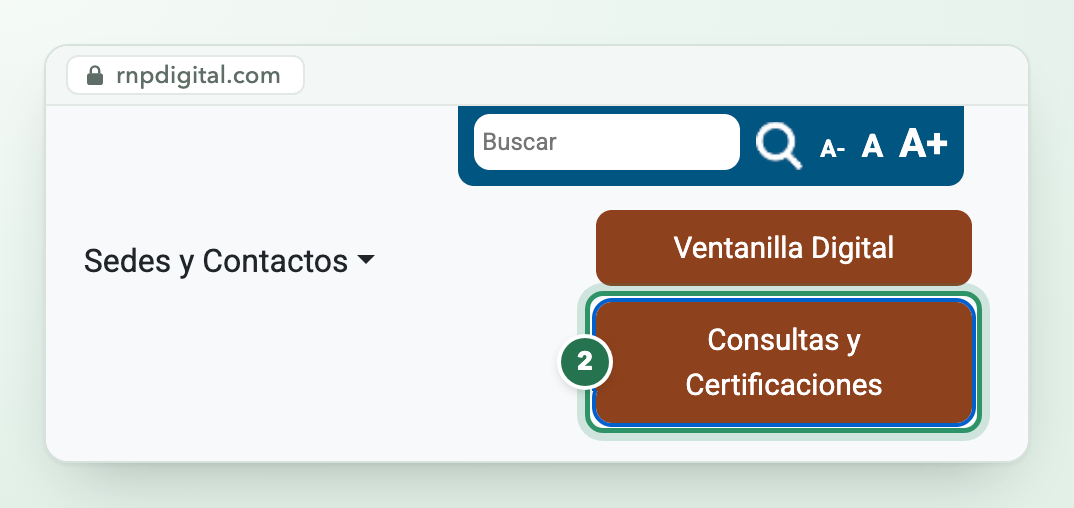
Open rnpdigital.com and click Consultas y Certificaciones, the orange button at the top right. (Ventanilla Digital, the button above it, is for filing documents.)
-
Register by clicking Registrarse por primera vez. The form asks for a first name, both surnames, a mobile number, an email and a password, and no identification number. Two requirements are easy to miss:
- The second surname is mandatory, so if you have only one, you still have to fill that box.
- The password (clave) needs at least 12 characters, including an uppercase letter, a lowercase letter, a number and a special character. The form shows this rule only after you submit a password that fails it.
Accept the terms and conditions, then click Registrarse.
-
Activate the account from the link the Registry emails you. Opening it also signs you in; after that, you log in on the same page.
-
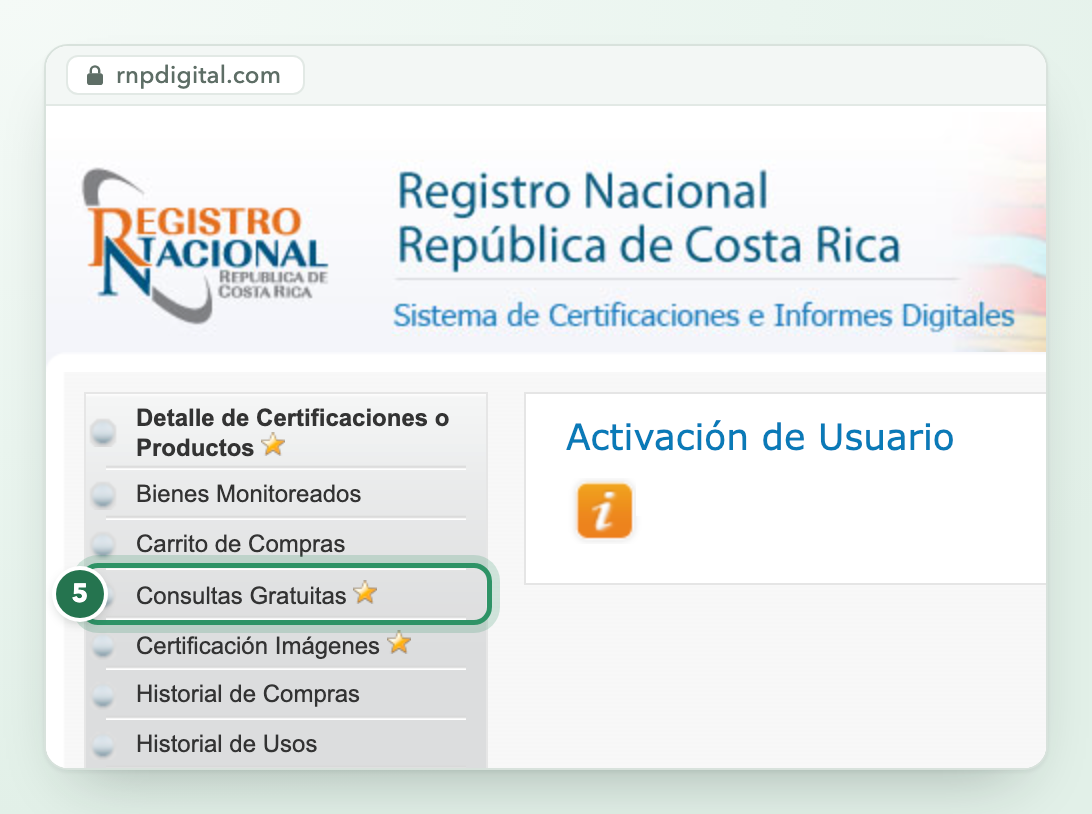
Open Consultas Gratuitas in the menu on the left.
-
Under Bienes Inmuebles, choose Consulta por Número de Finca.
-
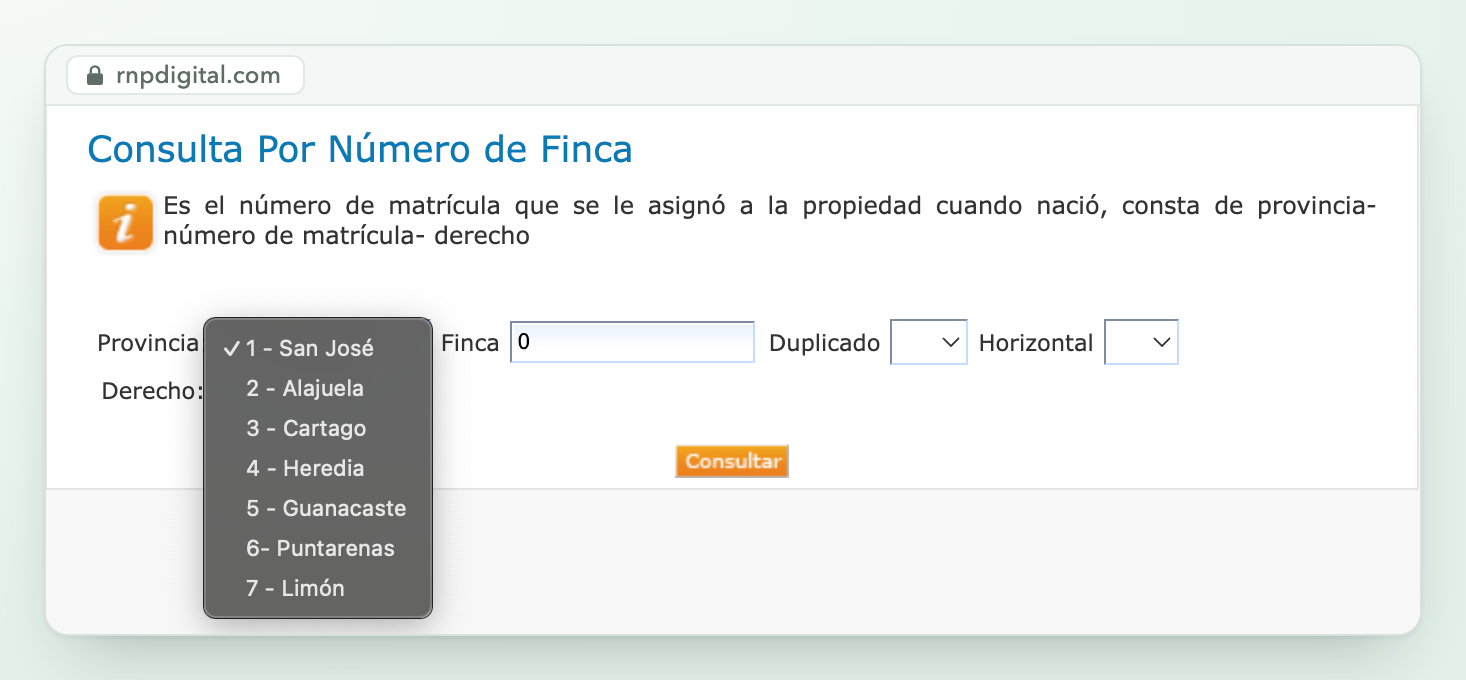
Split the folio real across the form. The province has its own dropdown, from 1 San José to 7 Limón. The Finca box takes the property number alone, in digits; type the whole folio real, dashes and all, and the form rejects it with "debe ser un número." The derecho goes in its own box, 000 for a property held whole. Leave Duplicado and Horizontal empty for an ordinary property. Duplicado offers the letters A to Z, and a concession in the maritime zone takes Z, chosen from that dropdown; typed into the Finca box, it is rejected. Horizontal offers F and M, for a condominium unit (filial) and its master property (matriz). Then click Consultar.[1]
Reading the report
What comes back is headed Consulta por número de finca. The example here is a concession in the maritime zone at Playa Las Manchas, in Montezuma:
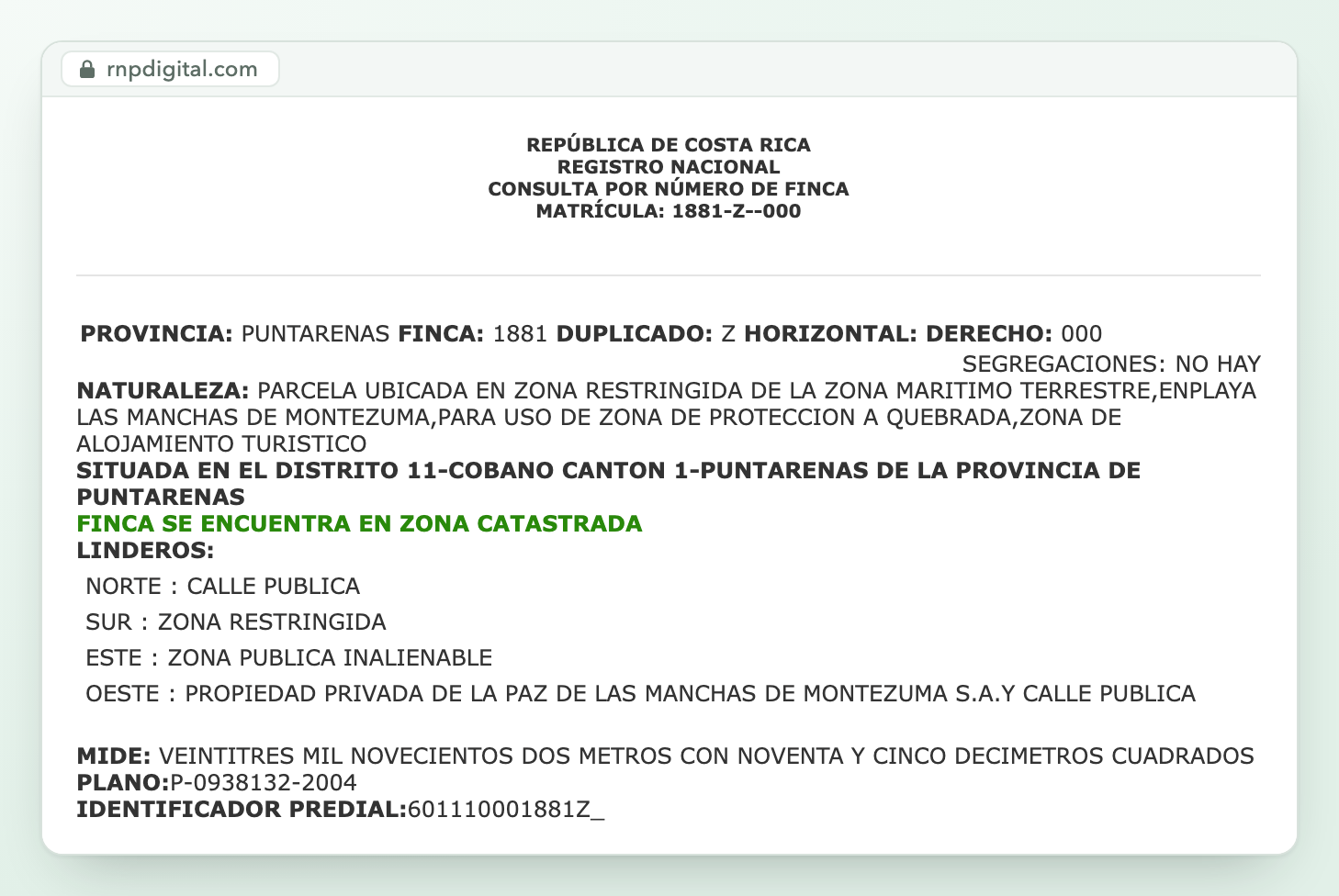
Registro Nacional, Consulta por Número de Finca, issued September 10, 2026. Reference [1].
- Provincia, finca, duplicado and derecho confirm you pulled the right property; the Z in duplicado marks the concession.
- Naturaleza is how the record describes the land and what it may be used for: here, a parcel in the maritime zone's restricted strip, for use as a stream protection area and for tourist lodging.
- Linderos are the boundaries, given by what lies on each side, with no coordinates: a public road to the north, the inalienable public zone to the east.
- Mide is the area, written out in words: 23,902.95 square meters.
- Plano is the number of the cadastral plan, the surveyed map the record refers to.
Naturaleza, linderos and mide describe the land. The Registry recorded them as the filed documents stated them and did not check them against the land.[2]
Read it to the bottom
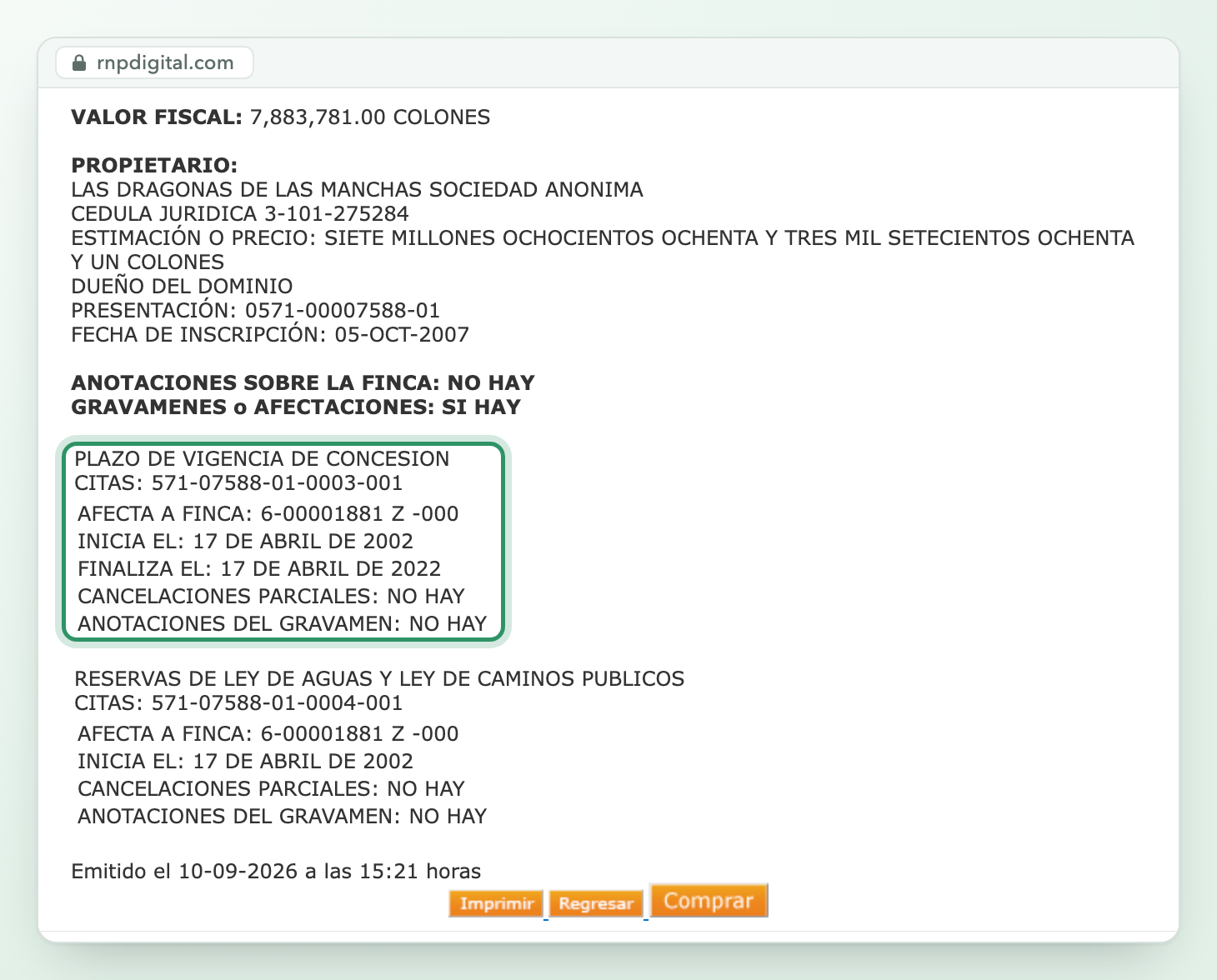
Valor fiscal is the 7,883,781 colones declared in the document recorded in 2007, the same figure shown under the holder as estimación o precio, so it is no guide to what the concession is worth today.
Propietario names the holder, with an identification number and the reference and date of the document that put it on record. On a concession the report still says propietario and dueño del dominio, its standard wording, but inside the maritime zone land is held by concession rather than owned.
Below the owner, Anotaciones sobre la finca lists provisional entries, pending documents among them, and here there are none. Gravámenes o afectaciones lists burdens, and here there are two.
The first is the concession's own term, from April 17, 2002, to April 17, 2022, which ended more than four years before this lookup. Nothing at the top of the report says so, and no renewal appears anywhere on it; whether there was one is a question for the municipality that granted the concession.
The second is a reserva de ley under the water and public-roads laws, a statutory strip that takes usable area at the edges.
The report ends with the minute it was issued, emitido el 10-09-2026 a las 15:21 horas, and a Comprar button. Because a filing takes effect from the day it is presented, run the lookup again just before closing: a new document shows up under anotaciones. For the entries that led to the current record, the same menu has Consulta de Historia de Fincas.[3]
Consultation or certification
What you have now is a consultation. It has no certification number, so nobody else can check it against the Registry. The certification is the formal document, issued and dated by the Registry, and you buy it from the same account through its shopping cart.
Ley 4564's tariff schedule names the certifications ("de fincas, bienes muebles, historial, literal, gravamen, personería") and still prints 300 colones for each. The prices below come from the Registry's service tariff, Acuerdo Firme J342-2025 of November 24, 2025; for a purchase, the literal is usually the one you want.
| Product | Price |
|---|---|
| Certification of a literal, first ten pages | ¢2,925 plus ¢5 to the Archivo Nacional |
| Certificado catastral | ¢8,495 plus ¢5 |
| Simple copies of document images, first ten sheets | ¢2,800, then ¢500 per sheet |
The statutory schedule and the tariff agreement do not say the same thing, and the agreement is what you pay.[4]
The account menu has an item called Título de Propiedad. It verifies titles of movable property, such as vehicles, issued digitally since July 2023, and has nothing to do with land.[5] Buyers are often told to obtain an estudio registral, a phrase found in neither Decreto 44647 nor Ley 3883. The Registry does sell "Estudios Registrales," at 8,495 colones, but its tariff defines them as studies of records held in non-automated systems. When an agent says estudio registral, they mean a service someone assembles from the certifications above, which is why two of them can contain different things and cost very different amounts.[6]
Verify a certification you were handed
Every digital certification has a number beginning RNPDIGITAL-, including the PDF a seller's agent may send you. The Registro Nacional's login page has a box for that number under Verificación de certificaciones, and it needs no account. The Registry describes the service as verification and download of the certifications it generated, so you can compare the copy you were sent with the Registry's own. That catches a forged or altered document. A certification describes the record at the moment it was issued, though, so anything recorded since shows only in a fresh lookup.[7]
What the report proves, and what it does not
Article 34 of Decreto 44647 makes what the registry publishes opposable to third parties: once something is recorded, nobody can claim not to have known it. Under article 455 of the Código Civil, an unregistered title affects third parties only from the date it is presented, whatever the dates of signing or payment. That is why the lookup is worth running again just before closing, and why an unresolved annotation outranks a seller's assurance.[8]
Article 35 says registry publicity "se presume cierta y exacta." That presumption protects someone who relied on the record in good faith, whether or not the record is correct. Article 456 of the Código Civil limits what registration does: "La inscripción no convalida los actos o contratos inscritos que sean nulos o anulables conforme a la ley." Registration does not validate a void contract. It protects the next buyer down the chain instead, someone who bought in good faith from a seller the record showed as entitled to sell.[9]
Article 249 of Decreto 44647 explains why no one checks the record against the land. It defines an inaccuracy of extra-registral origin as information wrong about physical reality that cannot be caught during qualification, the registrar's examination of a filed document, "ya que tal verificación no forma parte del marco de calificación registral": because that verification is not part of the registrar's job. The Registry qualifies documents; where the fence runs, how the land is used and whether anyone lives on it are questions for a surveyor and a site visit.[10]
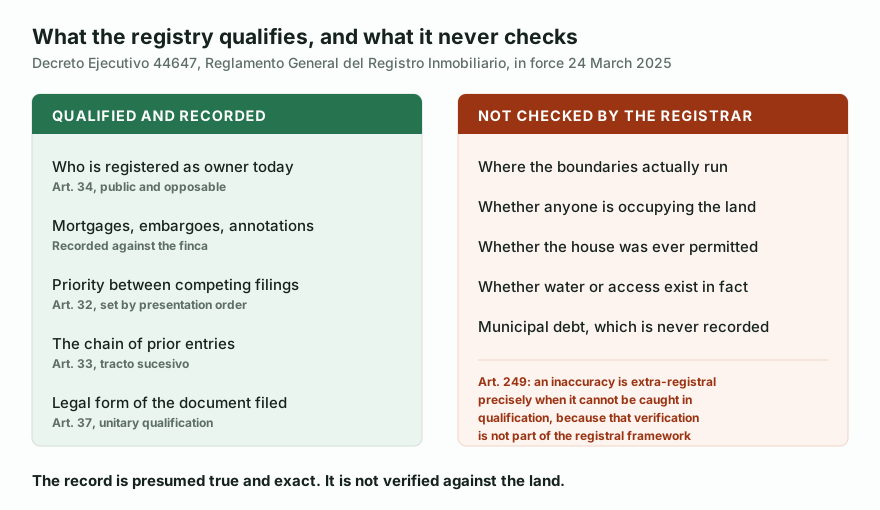
Source: Decreto Ejecutivo 44647, arts. 32, 33, 34, 37 and 249. References [2], [8], [9] and [10].
When the record is wrong
The Registry corrects its own errors "a la mayor brevedad," under article 251. A claim to a better right than the registered owner's is different: article 250 requires it to be heard in court.[11]
A nota de prevención de inexactitud is recorded when someone alleges the record may be wrong. Under article 291 it exists "para efectos exclusivamente de mera publicidad noticia," "sin que impida la inscripción de documentos posteriores": it is a public notice only, and later documents, a sale included, can still be recorded.[12]
What else to check
Boundaries, access, water, zoning and what is legally built have to be checked elsewhere, and municipal debt never appears in the registry at all.
PropScan's own sample report is for this same property if you'd like to see a full report. It reads the expired term out of the encumbrances and marks it critical, then cross-checks the record against sources the registry does not include, and finds another cadastral plan, inscribed in 2022, that covers 93 percent of the parcel.
Common questions
How do I run a title search in Costa Rica?
Register at rnpdigital.com through Consultas y Certificaciones and activate the account from the email the Registry sends. Then open Consultas Gratuitas, choose Consulta por Número de Finca, and enter the province from its dropdown, the property number as digits only, and the derecho, usually 000. A maritime-zone concession also needs Z chosen from the Duplicado dropdown. The lookup is free; a certified literal costs 2,925 colones.
Do I need a Costa Rican ID to register?
No. The registration form asks for a first name, both surnames, a mobile number, an email and a password, and no identification number. The second surname is mandatory even if you have only one, and the password must be at least 12 characters with an uppercase letter, a lowercase letter, a number and a special character.
How can I check that a certification I was given is genuine?
Every digital certification carries a number beginning RNPDIGITAL-. Enter it in the Verificación de certificaciones box on the Registro Nacional's login page, which needs no account, and compare what you were given with the Registry's own copy. That shows whether it is genuine. Anything recorded after it was issued shows only in a fresh lookup.
Does a clean registry report mean the property is safe to buy?
No. Article 35 of Decreto 44647 presumes the record true and exact, which protects a buyer who relied on it in good faith. But article 249 puts checking the record against the land outside the registrar's job, and article 456 of the Código Civil says registration does not validate a void contract. Boundaries, use and occupation are checked by a surveyor and a site visit.
What is an estudio registral, legally speaking?
Not a legal instrument: the phrase appears in neither Decreto 44647 nor Ley 3883. The Registro Nacional does sell a product called Estudios Registrales, at 8,495 colones, but defines it as a study of records held in non-automated systems. What an agent means is a service assembled from ordinary certifications, which is why two from different providers can contain different things.
Legal references and source notes
The numbered references below correspond to the markers in the article. Legal rules are sourced to Costa Rican statutes and regulations in their versión vigente. The walkthrough, the forms and the report come from the Registro Nacional's own site as it stood on September 10, 2026.
[1] The registration flow, the Consultas Gratuitas menu, the Consulta por Número de Finca form and its validation behavior were worked through on rnpdigital.com on September 10, 2026. The worked example is concession 6-1881-Z-000 at Playa Las Manchas, Montezuma, and the report reproduced here was issued at 15:21 that day. Source: Registro Nacional.
[2] Decreto Ejecutivo 44647, Reglamento general del Registro Inmobiliario, art. 249, defines an inaccuracy of extra-registral origin as information at odds with physical reality that cannot be caught during qualification, "ya que tal verificación no forma parte del marco de calificación registral". Source: Decreto Ejecutivo 44647, PGR-SINALEVI.
[3] The free lookup menu also carries Anotaciones, Trámites y Marginales, Condominios and Consulta de Historia de Fincas. The Consultas Gratuitas page states a limit of ten free lookups every two minutes, above which the account is blocked automatically. Source: Registro Nacional.
[4] Ley 4564, Ley de Aranceles del Registro Público, still prints 300 colones for a certification. The figures charged are set by the Registry's service tariff, Acuerdo Firme J342-2025 of sesión 31-2025 of November 24, 2025: 2,925 colones for the first ten pages of a literal, 8,495 for a certificado catastral, and 2,800 for the first ten sheets of simple copies, each with 5 colones to the Archivo Nacional under art. 6 of Ley 43. The Registry's tariff page blocks automated access, so it is named here rather than linked. Sources: Ley 4564, PGR-SINALEVI; Registro Nacional, plataforma de servicios, aranceles.
[5] The Título de Propiedad menu item opens Verificación de título de propiedad: "Aquí puede verificar los títulos de propiedad de bienes muebles generados digitalmente a partir del mes de julio del año 2023." Movable property only. Source: Registro Nacional.
[6] The phrase estudio registral appears in neither Decreto 44647 nor Ley 3883, Ley de Inscripción de Documentos en Registro Público, reformed by Ley 10768 of October 30, 2025. The Registry's own tariff does sell "Estudios Registrales" at 8,495 colones and defines them as studies of records held in non-automated systems, which is narrower than the agent usage. Sources: Decreto Ejecutivo 44647, PGR-SINALEVI; Ley 3883, PGR-SINALEVI; Ley 10768, PGR-SINALEVI.
[7] The Registro Nacional login page carries a Verificación de certificaciones box that takes a number beginning RNPDIGITAL- and needs no account. The Registry describes the service as verification and download of the certifications it generated. Source: Registro Nacional.
[8] Decreto Ejecutivo 44647, art. 34, makes what the registry publishes opposable to third parties. Código Civil, art. 455: a title subject to registration that is not registered does not prejudice a third party except from the date it is presented to the Registry. Sources: Decreto Ejecutivo 44647, PGR-SINALEVI and Código Civil, PGR-SINALEVI.
[9] Decreto Ejecutivo 44647, art. 35: registry publicity "se presume cierta y exacta". Código Civil, art. 456: "La inscripción no convalida los actos o contratos inscritos que sean nulos o anulables conforme a la ley." The Code then protects the other side of the trade: an act granted by someone the Registry showed as entitled, once registered, is not invalidated against a third party merely because the grantor's right is later annulled under an unregistered title. Sources: Decreto Ejecutivo 44647, PGR-SINALEVI and Código Civil, PGR-SINALEVI.
[10] Decreto Ejecutivo 44647, arts. 32, 33 and 37, set what the registrar qualifies, and art. 249 sets what is outside qualification. On SINALEVI the Código Civil is cataloged as Ley 30; Ley 63 of September 28, 1887 is only the decree setting the date the codes took effect. Sources: Decreto Ejecutivo 44647, PGR-SINALEVI and Código Civil, PGR-SINALEVI.
[11] Decreto Ejecutivo 44647, art. 251, requires the Registry to correct its own errors "a la mayor brevedad"; art. 250 sends a claim to a better right than the registered owner's to court. Source: Decreto Ejecutivo 44647, PGR-SINALEVI.
[12] Decreto Ejecutivo 44647, art. 291: the nota de prevención de inexactitud is recorded "para efectos exclusivamente de mera publicidad noticia", "sin que impida la inscripción de documentos posteriores". Source: Decreto Ejecutivo 44647, PGR-SINALEVI.
This guide is informational and not a substitute for legal advice. For a purchase, work with an experienced attorney or notary.