Entry Nº 014
Possession rights in Costa Rica: untitled land, squatters and the ten-year rule
How long before squatters gain rights in Costa Rica? One year can give a right to possess and ten can lead to ownership through a court, but some land never becomes private.
Ask how long squatters need to gain rights in Costa Rica and you will hear one year or ten. Both figures are right, and both come from one article of the Código Civil, the civil code: one year of possession gives the right to possess land, and ten years is the minimum to acquire ownership of it.[1] Even after ten years, only a court can declare the possessor the owner, and the court also checks how the land was held.
A buyer meets possession in two forms: land offered with no registry entry, which the buyer would have to title in court, and titled land with someone living on it. The same time limits govern both.
Key points
- One year of possession in good faith gives the right to possess. Ten years is the minimum for ownership by prescription, which only a court can declare.
- Land with no registry entry is titled in court through an información posesoria. For three years after it is recorded, a title obtained against the law can be annulled in the same court file.
- Possession never makes private property of the maritime zone, State forest land, parks and reserves, indigenous territories or the 2 km border strip.
- The police can remove squatters during the first year: on the spot in the first two weeks, then on an order from the public security ministry. An interdict must be filed within three months.
- In June 2026, 4.3% of the parcels on the Registro Nacional's cadastral map carried a P, the mark of a parcel with no registry entry.
What possession gives under Costa Rican law: one year and ten years
The civil code defines posesión, possession, as holding a thing under your control and will.[2] It can lead to two different rights.
The first is the right to go on possessing. Someone who holds land in good faith for more than a year acquires that right, counting from the day they took possession publicly, or, if they took it in secret, from when the person they displaced learned of it. Good faith means believing, when taking possession, that one had the right to possess, and the law presumes it when in doubt. Acts the owner merely tolerates give no right.[3] Once someone is in possession, even the owner may not take the land back by force while the possessor objects; the owner has to go to court.[4]
The second is ownership, through usucapión, also called prescripción positiva. For land it takes ten years of possession as owner, continuous, public and peaceful. Time held by force counts only from when the violence stops, and hidden possession does not count.[5] A lawsuit, attachment or seizure served on the possessor interrupts the ten years, and so does the possessor's acknowledgment of the owner. After an interruption, the time already run no longer counts.[6]
Land with no folio real: what possession means in the registry
The rules of the Registro Nacional's property registry call anyone who holds land without a recorded title a persona poseedora, a possessor.[7] Land that was never recorded has no folio real, the registry record, and no finca number. The Registro's mapa catastral, its map of the country's parcels, still draws it, with a parcel identifier but no finca number.[8]
The identifier is printed on the map: codes for province, canton and district, then the finca number and two more characters. In Cóbano, a registered parcel reads 60111012164900. A parcel with no registry entry has a P and six digits where the finca number would be, as in 60111P00173400. The P stands for predio, parcel, and the map usually gives these parcels code 1 in the Registro's list of flags: no cadastral or registry information.[9]
In June 2026, 90,628 of the map's 2,122,974 parcels, 4.3%, carried a P.[10] The P says only that the registry has no entry, not whether anyone holds the land as a possessor.
A survey plan made for titling says "Para información posesoria" and names the possessor after "En posesión de".[11] A derecho, an undivided share of a registered finca, is something else: it is recorded, and its holder is a co-owner.
How possession becomes a title: the información posesoria
Land with no registry entry is titled in court through an información posesoria, under Ley 139 of 1941. The applicant must have no registered or registrable title and more than ten years of possession meeting the civil code's conditions. Earlier possessors' years count, but only with the public document in which the previous possessor transferred the right to the applicant; a private contract is not enough.[12]
The case needs:
- A registered survey plan, certified by the environment ministry, the Ministerio de Ambiente y Energía (MINAE), which states whether the land is in a protected area. Inside one, the possession must go back ten years before the area was created.[13]
- A sworn petition describing the possession, the crops and buildings, and from whom the right was acquired. A false statement is perjury.[14]
- Notice to the neighbors and co-owners, and an edict in the Boletín Judicial that gives anyone a month to come forward. The Procuraduría General de la República (PGR), the State's attorney, is a party to every case, and the Instituto de Desarrollo Rural (INDER), the rural development institute, to agrarian ones.[15]
- Three witnesses from the canton to at least ten years of possession without a break, public, peaceful and as owner.[16]
A written objection sends the dispute to an ordinary lawsuit. An objection by the State or INDER closes the file, leaving the applicant a lawsuit against them.[17] Otherwise the judge orders the land registered "sin perjuicio de tercero de mejor derecho", without prejudice to anyone with a better right.[18] The survey plan drawn for the case is canceled if no registry entry cites it within three years.[19]
For three years after the title is recorded, it can be annulled in the same court file if it was obtained against the law. After that, a challenge takes an ordinary lawsuit, and the property is consolidated for third parties. Banks may lend on it after one year.[20]
Three routes to ownership through possession
The Sala Primera, the Supreme Court's civil and agrarian chamber, distinguished three routes in 2007:
| Route | Land | What it requires |
|---|---|---|
| Información posesoria (Ley 139) | No registry entry | More than ten years of possession as owner; no registrable title |
| General usucapión (Código Civil arts. 853 and 860) | Registered to someone else | Ten years of possession as owner, a transfer document from someone who was not the owner, and good faith, all together |
| Agrarian usucapión (Ley 2825 art. 92) | Registered to someone else, farmed out of need | More than a year of possession to claim through INDER, ten to register; need replaces good faith and the transfer document |
Of the general route, the court said that if one requirement is missing, prescription fails.[21] An occupant who moved onto registered land with no document and no good faith cannot acquire it that way by waiting ten years. The agrarian route covers people farming someone else's land for their own or their family's subsistence, and INDER takes those conflicts first, seeking a direct sale from the owner to the occupants.[22]
Land where possession never becomes ownership
Some land can never become private, however long anyone holds it:
| Land | Rule |
|---|---|
| The maritime zone, 200 meters inland from the high-tide line | Cannot be titled through an información posesoria or appropriated any other way; occupying it without authorization is prohibited[23] |
| Patrimonio Natural del Estado, the forests and forest land of national reserves and of public land | Possession creates no right, and the State's claim to recover it never expires[24] |
| Indigenous territories | Cannot be sold or acquired by prescription; deals for land there between indigenous and non-indigenous people are void[25] |
| A 2 km strip along the borders with Nicaragua and Panama | Cannot be acquired by possession, unless already held privately under a legitimate title[26] |
| National parks, biological and forest reserves, unregistered State land | The judge rejects an información posesoria[27] |
On the coast, land is held only by concession, as the maritime zone article explains.
A 2018 law, extended twice to about mid-2027, suspends administrative evictions and demolitions in the maritime zone, the border zone and State natural heritage, except under a final order based on environmental damage. It says that in no case does it create rights for the occupants.[28]
Squatters on titled land: the deadlines for an owner
In October 2026, The Tico Times, reporting an investigation by CORRECTIV and the Swiss broadcaster SRF, said about 600 people were occupying teak plantations. Most of the plantations are around Pocosol, near the Nicaraguan border, and the investigation found that the registry lists two Costa Rican companies as owners of more than 40 km² of plantation land.[29] The report did not say how long the occupants have been there, and that decides which of these deadlines apply.
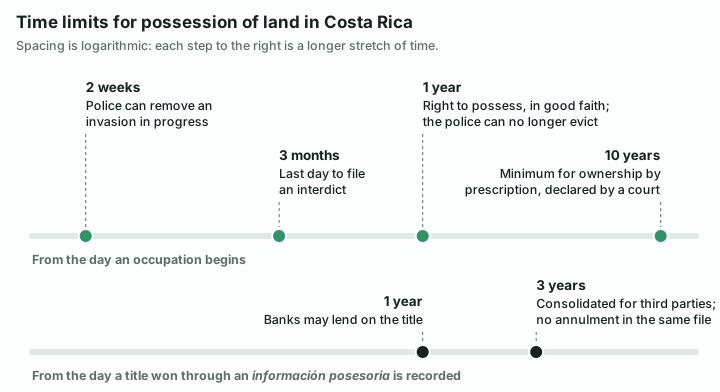
Counted from the start of an occupation, and from the recording of a title won through an información posesoria. Sources: references [1], [3], [20], [30], [31] and [32].
- Two weeks. While an invasion is under way or less than two weeks old, the regional police check the entry date and the owner's registry certificate on site and evict without further delay. After that, the owner can apply in writing to the Ministerio de Seguridad Pública, the public security ministry, for an administrative eviction order. The occupants have three working days to appeal; the police carry it out.[30]
- Three months. An interdicto, the summary court action that protects current possession, must be filed within three months. It decides nothing about ownership.[31]
- One year. An occupant who has held the land publicly and in good faith for more than a year has the right to possess it,[3] and the police can no longer remove them. The Sala Constitucional, the Supreme Court's constitutional chamber, allows police help only against occupants without that right, and on farmland the Código Procesal Agrario bars an administrative eviction once an occupation passes a year.[32] On farmland, since February 13, 2026, an occupant needs three months of possession, down from a year, to bring an interdict against the owner who held the land before them.[33]
- Ten years. The minimum for ownership by prescription.
In court, a desahucio, an eviction suit, ends an occupation the owner tolerated, and the acción reivindicatoria, the claim to recover the property, lasts until someone else acquires it by prescription.[34] Where the occupants farm for their subsistence, the claim goes to INDER first. The owner can go to court if INDER has not declared a conflict within three months, or has not solved it within a year of declaring one. The ten years do not run while the claim is with INDER.[22]
Taking land by violence, threats, deceit, abuse of trust or stealth is usurpación, punished with six months to four years in prison.[35] On rural land, the complaint is rejected unless fences or cleared strips at least three meters wide mark the boundary, though civil claims remain.[36]
What buyers can do before paying for possession, or for occupied land
Land offered with no registry entry
- Find the parcel in the Registro's free map viewer, SIRI. A P where the finca number belongs means no registry entry: you would be buying possession and taking it to court yourself.
- Ask for the seller's public deed of acquisition, and for who held the land before them and for how long. Their years count toward your ten only through a public document transferring the possession to you.
- Read the plan: whether it says "Para información posesoria", which possessor it names, and its date, since it lapses after three years.
- Check the land against the list above: its distance from the high-tide line and from the border, what MINAE's certificate says about protected areas, and whether it lies in an indigenous territory.
- You can buy the possession by public document and title it yourself, or have the seller title it first and pay the balance from escrow once the title is recorded. Either way, the neighbors, the PGR or INDER can oppose, an objection by the State or INDER ends the case, and the title stays open to challenge for three years. Have a Costa Rican lawyer check the possession's history before you pay anything.
PropScan's free map scan shows whether there is a registered finca at a location. If the map outlines a parcel with no registry entry, the scan answers "No registered finca at this address", and there is no report to buy.
Titled land with someone living on it
- Visit before you sign and ask who lives on or uses the land, and on what terms. The registry record, which a title search reads, does not show occupants.
- Write vacant possession at closing into the opción de compra and the deed, and hold back part of the price until the land is handed over.
- Ask how the finca was first registered. If it was titled through an información posesoria less than three years ago, have a lawyer read the court file, where the title can still be annulled.
- If you own land and someone moves in, the deadlines run from the day they arrived: two weeks for the police to act on the spot, three months for an interdict, and a year for an eviction ordered by the public security ministry. Do not try to remove occupants by force.
- On rural land, keep fences or cleared boundary strips in place, or a usurpation complaint will be rejected.
- Owners of occupied land also negotiate: a written agreement for the occupants to leave, which may include a payment, or, on subsistence farmland, a direct sale to the occupants through INDER. Have a lawyer draft the agreement.
Common questions
How long do squatters need to gain rights in Costa Rica?
Someone who holds land publicly and in good faith for more than a year acquires the right to possess it. Ownership takes at least ten years of possession as owner, continuous, public and peaceful, and only a court can declare it. Against a registered owner, the general rule also requires a transfer document and good faith; only people farming the land for their subsistence have a route without them, through INDER. The owner's fastest remedies expire much sooner: an interdict after three months, a police eviction after a year.
Can I buy land in Costa Rica that has no folio real?
You can buy the possession, not a registered title. With no registry entry, the land has to be titled in court through an información posesoria, which needs more than ten years of possession. The seller's years count toward yours only if they transfer the possession to you in a public document. The maritime zone, State forest land, parks and reserves, indigenous territories and the 2 km border strip can never be titled this way.
What is an información posesoria?
The court case that registers land with no registry entry in the name of its possessor, under Ley 139 of 1941. The applicant needs more than ten years of possession as owner, a registered survey plan certified by the environment ministry, three witnesses, and notice to the neighbors, to the public by edict, to the Procuraduría General de la República and, for agrarian land, to INDER.
Can the police remove squatters from my property in Costa Rica?
Yes, during the first year. While an invasion is under way or less than two weeks old, the regional police check the entry date and the owner's registry certificate on site and evict. After that, the owner applies in writing to the public security ministry, the Ministerio de Seguridad Pública, which can order an eviction for the police to carry out. Once an occupation is more than a year old, the owner has to go to court.
Is a property titled through información posesoria safe to buy?
It is a registered title, but for three years after it is recorded, a title obtained against the law can be annulled in the same court file. After that, a challenge takes an ordinary lawsuit, and the title is consolidated for third parties. Banks may lend on it after one year. Before buying within the three years, have a lawyer read the court file, including who was notified and whether anyone objected.
Legal references and source notes
[1] Código Civil, version 22 of 22, art. 860: "Para adquirir la propiedad de los inmuebles, o algún derecho real sobre ellos por prescripción, se necesita una posesión de diez años. El derecho de poseer se prescribe por la posesión de un año." Ownership through possession is declared by a judge: in an información posesoria, the judge approves the case and orders the registration (note 18); against a registered owner, in a lawsuit such as the one in note 21. Source: Código Civil, PGR-SINALEVI.
[2] Código Civil, art. 277: "El derecho de posesión consiste en la facultad que corresponde a una persona de tener bajo su poder y voluntad la cosa objeto del derecho." Source: Código Civil, PGR-SINALEVI.
[3] Código Civil, art. 279: "Independientemente del derecho de propiedad, se adquiere el de posesión: 1º.- Por consentimiento del propietario. Los actos facultativos o de simple tolerancia no dan el derecho de posesión. 2º.- Por el derecho de conservar la posesión por más de un año. El año corre desde que se tome públicamente la posesión, o si fuere tomada clandestinamente, desde que eso conste al despojado." Art. 284: "Para que la posesión por más de un año confiera el derecho de poseer, es necesario que dicha posesión sea de buena fe." Art. 285: "se considera poseedor de buena fe al que en el acto de la toma de posesión creía tener el derecho de poseer." Art. 286: "En caso de duda, se presume de buena fe la posesión." Source: Código Civil, PGR-SINALEVI.
[4] Código Civil, art. 317: "No podrá tomarse la posesión de una manera violenta, ni por aquel a quien legalmente corresponde; mientras el actual poseedor se oponga, debe reclamarse judicialmente." Source: Código Civil, PGR-SINALEVI.
[5] Código Civil, art. 856: "La posesión ha de ser en calidad de propietario, continua, pública y pacífica." Art. 857: "La posesión adquirida o mantenida con violencia, no es útil para la prescripción, sino desde que cesa la violencia." Art. 858: "la posesión oculta impide la prescripción, mientras no haya sido debidamente registrada o no pueda ser conocida de los que tengan interés en interrumpirla." Art. 860 sets the ten years (note 1). Source: Código Civil, PGR-SINALEVI.
[6] Código Civil, art. 876: "Toda prescripción se interrumpe civilmente: 1º.- Por el reconocimiento tácito o expreso que el poseedor o deudor haga a favor del dueño o acreedor de la propiedad o derecho que trata de prescribirse; y 2º.- Por el emplazamiento judicial, embargo o secuestro notificado al poseedor o deudor." Art. 878: "El efecto de la interrupción es inutilizar para la prescripción todo el tiempo corrido anteriormente." Source: Código Civil, PGR-SINALEVI.
[7] Decreto 44647-MJP, Reglamento general del Registro Inmobiliario, version 2 of 2, art. 2, definition 48: "Persona poseedora: Persona física o jurídica que carece de título inscrito en el Registro Inmobiliario." Source: Decreto 44647, PGR-SINALEVI.
[8] Decreto 44647-MJP, art. 2, definition 27: "Identificador predial de inmueble: Conjunto de caracteres numérico o alfanumérico único que se le asigna a cada predio dentro del mapa catastral." Art. 39: "los predios que no tengan titular registral deben contener un identificador predial." Source: Decreto 44647, PGR-SINALEVI.
[9] The Registro's Manual de Conformación del Mapa Catastral, version 15 (2018), is not online. A University of Costa Rica thesis quotes it: "Si el predio no presentara número de finca, se le indica un consecutivo con la Letra P (se refiere a predio); por ejemplo, P000001 (quiere decir predio N°1)." Its list of the map's inconsistency codes begins with code 1, "Predio sin información catastral ni registral". The thesis gives the identifier's parts as province, canton, district, finca, duplicado (a letter for fincas given the same number by mistake) and horizontal (M or F for condominiums, 0 otherwise). The Registro's own presentation of the map illustrates code 1 with a parcel whose finca reads P000790 and which has no plan. The identifiers in the text are from Cóbano, district 11 of canton 01 of province 6. Parcel 60111012164900, finca 121649, is labeled in the view of the map shown in our cadastral plan article. Parcel 60111P00173400, read from the Registro's map service on October 28, 2026, has the finca field P001734, no plan, and code 1. Of 311 P parcels in nine regions read from the same service on October 26, 2026, 292 carried code 1. Sources: J. Solís Salazar and A. Chinchilla Soto, Metodología para realizar estudios técnicos referente al saneamiento de predios que presentan situaciones conflictivas en el Mapa Catastral del Registro Inmobiliario, Universidad de Costa Rica, 2019, thesis IT-8328, pp. 13 and 27; Registro Nacional, Conceptos básicos del mapa catastral; SIRI map service.
[10] The count of parcels on the Registro Nacional's cadastral map (SIRI) in June 2026: 90,628 of 2,122,974 have a finca field beginning with P. The count covers parcels, not area, and says nothing about who holds each one. Source: SIRI, the Registro's map viewer.
[11] Decreto 44647-MJP, art. 92(5): "En titulaciones, se debe indicar corno razón de inscripción: "Para información posesoria", agregar: "En posesión de ... " indicando el nombre de la persona titular y su número de identificación." Source: Decreto 44647, PGR-SINALEVI.
[12] Ley 139, Ley de Informaciones Posesorias, version 9 of 9, art. 1: "El poseedor de bienes raíces que careciere de título inscrito o inscribible en el Registro Público podrá solicitar que se le otorgue, de acuerdo con las disposiciones de la presente ley. Para ese efecto deberá demostrar una posesión por más de diez años con las condiciones que señala el artículo 856 del Código Civil." And: "Cuando el titulante no haya tenido la posesión decenal del inmueble podrá aprovechar la ejercida por sus transmitentes, según lo dispuesto en el artículo 863 del Código Civil; pero en este caso deberá presentar documento público en que conste el traspaso de su derecho, aunque no el de anteriores poseedores." Source: Ley 139, PGR-SINALEVI.
[13] Ley 139, art. 7, as reformed by the Ley Forestal, Ley 7575 of 1996: "Cuando el inmueble al que se refiera la información esté comprendido dentro de un área silvestre protegida, cualquiera que sea su categoría de manejo, el titulante deberá demostrar ser el titular de los derechos legales sobre la posesión decenal, ejercida por lo menos con diez años de antelación a la fecha de vigencia de la ley o decreto en que se creó esa área silvestre." And: "Sin excepción alguna, los planos catastrados que se aporten en diligencias de información posesoria, deberán ser certificados por el Ministerio del Ambiente y Energía, por medio del ente encargado, el cual dará fe de si el inmueble que se pretende titular se encuentra dentro o fuera de esas áreas silvestres protegidas." Art. 1 requires "Un plano inscrito en la Oficina de Catastro". Source: Ley 139, PGR-SINALEVI.
[14] Ley 139, art. 1: the petition states "El tiempo que lleva el solicitante de poseer el inmueble, la descripción de los actos en que ha consistido esa posesión y extensión aproximada de los cultivos y bosques existentes, las construcciones y demás mejoras realizadas", the person "de quien adquirió su derecho", and that the land "no ha sido inscrita en el Registro Público". Art. 3: "En todos los casos, las afirmaciones del titulante tendrán carácter de declaración jurada, y cualquier falsedad le hará incurrir en las penas del perjurio". Source: Ley 139, PGR-SINALEVI.
[15] Ley 139, art. 5, as reformed by the Código Procesal Agrario, Ley 9609 of 2018: the judge "citará a los colindantes, así como a los condueños, si los hubiere, para que en el término de un mes contado a partir de la notificación, se presenten a hacer valer sus derechos"; an edict in the Boletín Judicial gives interested parties one month; "Se ordenará también tener como partes a la Procuraduría General de la República, en todo caso, y al Instituto de Desarrollo Rural (Inder), cuando el proceso corresponda conocerlo a la jurisdicción agraria." Source: Ley 139, PGR-SINALEVI.
[16] Ley 139, art. 6: possession is proved by "la declaración de tres testigos, vecinos del cantón donde se halle situado el inmueble", asked whether the land "ha estado sometida por el titulante o por anteriores dueños a posesión durante un período continuo no inferior a 10 años, si esa posesión ha sido en forma pública, pacífica y en concepto de dueño". Source: Ley 139, PGR-SINALEVI.
[17] Ley 139, art. 8: a written objection suspends the case "para que en juicio declarativo las partes definan sus derechos"; "Si dentro de los términos indicados en el artículo 5º, surgiere oposición del Estado o del ITCO, se ordenará archivar el expediente y se tendrá por agotada la vía administrativa a efecto de que el titulante pueda accionar en la vía contencioso-administrativa". The ITCO is now INDER. Source: Ley 139, PGR-SINALEVI.
[18] Ley 139, art. 10: the judge approves the case and orders "en el Registro Público de la Propiedad, la inscripción solicitada, sin perjuicio de tercero de mejor derecho". Source: Ley 139, PGR-SINALEVI.
[19] Decreto 44647-MJP, art. 151, as reformed by Decreto 45815-JP of June 2026: plans are registered provisionally for one year, except that plans "para información posesoria, para usucapir y para localizar derechos" have three; once the period passes with no registry entry citing the plan, its registration "quedará cancelada de pleno derecho." Sources: Decreto 44647, PGR-SINALEVI, Decreto 45815, PGR-SINALEVI.
[20] Ley 139, art. 16: "La propiedad que se adquiera por la presente ley, queda definitivamente consolidada para terceros a los tres años, los cuales se contarán a partir del día de la inscripción del respectivo título en el Registro Público"; "Este plazo se reducirá a un año únicamente para el efecto de solicitar y obtener préstamos de los organismos del Sistema Bancario Nacional o del Instituto Nacional de Vivienda y Urbanismo." Art. 17, as reformed by Ley 9609: within the three years, "si se demuestra que el título posesorio se obtuvo contra las leyes vigentes, podrá el tribunal decretar en el expediente original ... la nulidad absoluta del título y de su respectiva inscripción"; "Transcurrido el término de tres años de la inscripción del título, toda demanda deberá decidirse en proceso ordinario." Source: Ley 139, PGR-SINALEVI.
[21] Sala Primera de la Corte Suprema de Justicia, resolución 536-2007 of July 27, 2007, considerando V. On the agrarian route: "no es determinante la existencia de buena o mala fe, en tanto este elemento es sustituido por la necesidad", and "no se exige el título traslativo de dominio". On Ley 139, which it mentions "a modo de referencia": the possessor "que carece de un título inscribible o inscrito" seeks a registrable title to ownership acquired through more than ten years of possession. On the general route, under Código Civil arts. 853 and 860, the requirements are "justo título traslativo de dominio; buena fe; posesión y transcurso del tiempo", and "Dichos presupuestos son concurrentes, de modo que de estar ausente solo uno de ellos, será entonces improcedente la prescripción adquisitiva." Código Civil art. 853: "Para la prescripción positiva se requieren las condiciones siguientes: Título traslativo de dominio. Buena fe. Posesión." Sources: Sala Primera, resolución 536-2007, Nexus PJ, Código Civil, PGR-SINALEVI.
[22] Ley 2825, Ley de Tierras y Colonización, version 6 of 6, art. 92, as reformed by Ley 3336 of 1964: "es poseedor en precario todo aquel que por necesidad realice actos de posesión estables y efectivos, como dueño, en forma pacífica, pública e ininterrumpida, por más de un año, y con el propósito de ponerlo en condiciones de producción para su subsistencia o la de su familia, sobre un terreno debidamente inscrito a nombre de un tercero en el Registro Público"; those with ten years "podrán inscribir su derecho ... por el procedimiento de información posesoria". Art. 94: solutions are sought "fundamentalmente a través de contratos directos de compra-venta entre el propietario y los ocupantes, con intervención del Instituto"; before any lawsuit, "los propietarios deberán presentar su reclamo ante el Instituto"; the owner may go to court after "tres meses a partir del recibo de la gestión respectiva sin que el Instituto haya declarado la existencia de un conflicto de posesión de tierras, o un año desde esa declaratoria, sin que el conflicto haya sido solucionado"; "Mientras el asunto esté en el Instituto, no correrá el término de la prescripción para ninguna de las partes." The Instituto is now INDER. Source: Ley 2825, PGR-SINALEVI.
[23] Ley 6043, Ley sobre la Zona Marítimo Terrestre, version 9 of 9, art. 7: "Los terrenos situados en la zona marítimo terrestre no pueden ser objeto de informaciones posesorias y los particulares no podrán apropiarse de ellos ni legalizados a su nombre, por éste u otro medio." Art. 12 prohibits, "sin la debida autorización legal", any "desarrollo, actividad u ocupación" in the zone. Source: Ley 6043, PGR-SINALEVI.
[24] Ley Forestal, Ley 7575, version 14 of 14, art. 13: the State's natural heritage is made up of "los bosques y terrenos forestales de las reservas nacionales, de las áreas declaradas inalienables, de las fincas inscritas a su nombre y de las pertenecientes a municipalidades, instituciones autónomas y demás organismos de la Administración Pública". Art. 14: "su posesión por los particulares no causará derecho alguno a su favor y la acción reivindicatoria del Estado por estos terrenos es imprescriptible. En consecuencia, no pueden inscribirse en el Registro Público mediante información posesoria". Source: Ley 7575, PGR-SINALEVI.
[25] Ley Indígena, Ley 6172, version 11 of 11, art. 3: "Las reservas indígenas son inalienables e imprescriptibles, no transferibles y exclusivas para las comunidades indígenas que las habitan. Los no indígenas no podrán alquilar, arrendar, comprar o de cualquier otra manera adquirir terrenos o fincas comprendidas dentro de estas reservas." And: "Todo traspaso o negociación de tierras o mejoras de éstas en las reservas indígenas, entre indígenas y no indígenas, es absolutamente nulo". Source: Ley 6172, PGR-SINALEVI.
[26] Ley 2825, art. 7: the following are "inalienables y no susceptibles de adquirirse por denuncio o posesión, salvo los que estuvieren bajo el domino privado, con título legítimo", among them, in (f), "Los comprendidos en una zona de 2.000 metros de ancho a lo largo de las fronteras con Nicaragua y con Panamá". Source: Ley 2825, PGR-SINALEVI.
[27] Ley 139, art. 11: the judge rejects the case "si llegare a constatar que se pretende titular indebidamente baldíos nacionales o terrenos pertenecientes a cualquier institución del Estado, lo mismo que reservas forestales, parques nacionales o reservas biológicas." Source: Ley 139, PGR-SINALEVI.
[28] Ley 9577, Protección a los Ocupantes de Zonas Clasificadas como Especiales, in force July 20, 2018, version 3 of 3. Art. 1, as reformed by Ley 10489 of May 13, 2024, extends the 36-month period "por un periodo de tiempo igual, con idénticos efectos de suspensión sobre las acciones administrativas de desalojo de personas, la demolición de obras, ... en la zona marítima terrestre, zona fronteriza y patrimonio natural del Estado, salvo aquellas que sean ordenadas mediante resolución judicial o administrativa en firme, fundadas en la comisión de daño ambiental". Ley 10000, in force July 2, 2021, made the first extension. Art. 4: "En ningún caso, la aplicación de esta ley favorecerá la constitución de derechos a favor de los ocupantes de las zonas objeto de la moratoria." Three periods of 36 months from July 20, 2018 end on July 20, 2027; the laws do not say whether each extension runs from the end of the last period or from its own date. Sources: Ley 9577, PGR-SINALEVI, Ley 10000, PGR-SINALEVI, Ley 10489, PGR-SINALEVI.
[29] The Tico Times, "Thousands of European Investors Fear Losses as Costa Rica Teak Scheme Collapses", October 19, 2026, reporting an investigation by CORRECTIV and SRF's Rundschau into Life Forestry Switzerland AG: the reporters found the plantations occupied by about 600 people, most of them from Nicaragua; most of the roughly 60 plantations lie in the Pocosol area of the Northern Zone, near the Nicaraguan border; and the national registry lists two Costa Rican companies as owners of more than 40 km² of plantation land. Source: The Tico Times.
[30] Decreto 37262-MSP, Reglamento para el trámite de desalojos administrativos presentados ante el Ministerio de Seguridad Pública, version 4 of 4, art. 13: "Cuando se estuviere produciendo una invasión a una propiedad, o la misma se hubiere llevado a cabo en un lapso inferior a dos semanas, por tratarse de una invasión en curso, la parte perjudicada podrá acudir a la Autoridad de Policía de la Región que corresponda, la cual realizará una breve indagación con el objeto de comprobar la fecha aproximada de ingreso de los ocupantes y constatará en el sitio el derecho de propiedad o posesión del interesado, a efectos de realizar el desalojo sin mayores dilaciones." The owner brings "la certificación registral en la que conste ser dueño del bien". Arts. 1 to 12 set the general procedure: the written application states how the occupants entered ("Tolerancia, invasión, relación laboral, o cualquiera otra de las causales que taxativamente disponga la ley", art. 4) and proves title (art. 5); the order grants "un plazo de tres días hábiles para presentar recurso", and an appeal does not suspend it (art. 3); the police carry out the eviction (art. 12). SINALEVI also records resolución 1490-2020 DM of April 16, 2020, by which the minister suspended the police's execution of evictions, administrative and court-ordered, "hasta nuevo aviso" during the COVID-19 emergency. Resolución 1897-2020 DM of April 25, 2020 let the police carry out an eviction "excepcionalmente y en casos especiales" if it put no one's health at risk and followed the health ministry's protocols. We found no act revoking either, and SINALEVI lists the first as in force. The national emergency ended on August 17, 2022 (Decreto 43650-MP-S). The ministry still orders evictions for the police to carry out: Sala Constitucional resolución 17181-2026 of May 15, 2026 describes one ordered in February 2026 and sent to the police in April, and a police legal opinion of the same month cited resolución 1897-2020 DM. Sources: Decreto 37262, PGR-SINALEVI, Resolución 1490-2020 DM, PGR-SINALEVI, Decreto 43650-MP-S, PGR-SINALEVI, Sala Constitucional, resolución 17181-2026, Nexus PJ.
[31] Código Procesal Civil, Ley 9342, version 5 of 5, art. 106.1: "Los interdictos solo procederán respecto de la posesión actual y momentánea de bienes inmuebles. De ninguna manera afectarán las cuestiones de propiedad o de posesión definitiva"; "No podrá ser establecido un interdicto si han transcurrido tres meses desde el inicio de los hechos u obras contra las cuales se reclama." For farmland, the Código Procesal Agrario, Ley 9609, art. 265, sets the same three months. Sources: Código Procesal Civil, PGR-SINALEVI, Código Procesal Agrario, PGR-SINALEVI.
[32] Sala Constitucional, resolución 7433-2026 of February 27, 2026, repeating its resolución 3275-96 of July 3, 1996: the owner or possessor keeps the right to repel force with force, "incluso con el auxilio de la fuerza pública", "siempre que se trate de repeler la invasión en curso o de recuperar la posesión frente a quien carezca de título de posesión o no lo haya adquirido por el transcurso de más de un año". Código Procesal Agrario, Ley 9609, art. 55, as reformed by Ley 10779: "En inmuebles destinados a actividades agrarias, el desahucio administrativo será improcedente cuando: ... 3- Se trate de personas que tengan una ocupación del inmueble superior a un año." The same clause was in art. 55 before the reform, which narrowed the article from land "destinados o destinables" to farming to land "destinados" to it. Sources: Sala Constitucional, resolución 7433-2026, Nexus PJ, Código Procesal Agrario, PGR-SINALEVI.
[33] Ley 10779 of October 29, 2025, La Gaceta 30, Alcance 15, of February 13, 2026, in force that day, reformed the Código Procesal Agrario. Art. 269, as reformed: if the interdict is brought "contra quien, inmediata y anteriormente, poseyó como dueño o dueña, la parte actora deberá probar que por más de tres meses ha poseído pública y pacíficamente como dueña". Before the reform it said more than a year, as Código Procesal Civil art. 106.2 still does for other land. Sources: Ley 10779, PGR-SINALEVI, Código Procesal Agrario, PGR-SINALEVI.
[34] Código Procesal Civil, art. 104.1: "Procederá el desahucio cuando se pretenda la desocupación de un inmueble como consecuencia de la terminación del contrato de arrendamiento en los casos previstos por la ley, o hacer cesar la mera tolerancia." Código Civil, art. 320: "La acción reinvindicatoria puede dirigirse contra todo el que posea como dueño, y subsiste mientras otro no haya adquirido la propiedad de la cosa por prescripción positiva." Sources: Código Procesal Civil, PGR-SINALEVI, Código Civil, PGR-SINALEVI.
[35] Código Penal, Ley 4573, version 104 of 104, art. 225, as reformed by Ley 8720 of 2009: "Se impondrá prisión de seis meses a cuatro años: 1) A quien por violencia, amenazas, engaño, abuso de confianza o clandestinidad despojare a otro, total o parcialmente, de la posesión o tenencia de un inmueble ..., sea que el despojo se produzca invadiendo el inmueble, manteniéndose en él o expulsando a los ocupantes." Source: Código Penal, PGR-SINALEVI.
[36] Ley 2825, art. 129, as reformed by Ley 3336 of 1964: "Será rechazada toda acusación o denuncia por usurpación o daños que establezca el propietario contra los ocupantes de terrenos que no estén bien deslindados por cercas o carriles de un ancho mínimo de tres metros, que indiquen con claridad el perímetro del inmueble; quedan a salvo las acciones civiles que tuviere el dueño." Source: Ley 2825, PGR-SINALEVI.
This guide is informational and not a substitute for legal advice. For a purchase, work with an experienced attorney or notary.