Costa Rica investor residency: USD 150,000 is still the official minimum
Many pages say Costa Rica's investor residency minimum went back to USD 200,000 in July 2026. The regulation in force and the government's catalogue of procedures still say USD 150,000.
The five-year period for opting into Ley 9996's tax incentives ended on July 14, 2026. Many pages about Costa Rica's investor residency say the minimum investment went back to USD 200,000 that day. That figure came from article 87 of Decreto 37112, the 2012 immigration regulation known as the Reglamento de Extranjería. Article 31 of Decreto 43926, the regulation that implements Ley 9996, repealed that article on February 23, 2023.[1] Decreto 43926 is still in force, and it sets the minimum at USD 150,000.[2]
The same regulation is specific about property: whose name it is in, which value counts, how it was paid for and how long it must be kept. A property owned by a company does not count toward the minimum. Your shares in that company can count instead, if the company runs a business in Costa Rica and your stake in it is at least USD 150,000. A company that only owns a house does not qualify.
Key points
- The USD 200,000 investor minimum came from article 87 of Decreto 37112, the 2012 immigration regulation. That article was repealed on February 23, 2023, and no law or regulation in force sets that amount.
- Decreto 43926, the regulation in force, sets USD 150,000 with no end date. On September 30, 2026, the government's catalogue of procedures, the Catálogo Nacional de Trámites, listed USD 150,000 for every kind of investor application.
- Under Ley 8220, the law against excessive paperwork, a requirement can be demanded only if it is published both in La Gaceta, the official gazette, and in that catalogue. We found neither a rule nor a statement from Migración, the immigration authority, that sets USD 200,000.
- A property counts only if it is registered in the applicant's own name, and only at the value the municipality uses for property tax. If a company holds the property, the applicant's shares can count instead. The company must carry on an economic activity in Costa Rica, and its books must show that the applicant holds a stake of at least USD 150,000.
- The tax incentives closed to new applicants on July 14, 2026. People who opted in before then keep them for ten years from the date they were granted.
What investor residency is, and what closed on July 14, 2026
Investor residency is a category of temporary residence under Ley 8764, the migration law. It allows a person to live in Costa Rica for up to two years at a time, and it can be renewed.[3] After three consecutive years of temporary residence, a person can apply for permanent residence.[4] Investors and their dependents may not do paid work.[5]
The migration law names investors as a category but sets no amount. The amount and the proof of the investment are set by regulation, although Ley 9996 also states an amount in its article 8.
Ley 9996, in force since July 14, 2021, added tax incentives for investors, rentistas (residents living on a fixed income) and pensionados (retirees). They include a one-time exemption from import duties on household goods and up to two vehicles free of import duties and value-added tax. The income declared to qualify for the law's benefits is exempt from income tax. The transfer tax on property bought while the law is in force is reduced by 20%, if the beneficiary is the property's registered owner.[6] Article 12 allowed people to opt into those incentives only during the law's first five years. People who opted in keep them for ten years from the date they were granted.[7]
| Rule | Where it is written | After July 14, 2026 |
|---|---|---|
| Tax incentives: household goods, two vehicles, the income exemption, 20% off the transfer tax | Ley 9996, arts. 5 and 12 | Closed to new applicants. Kept for ten years by those who opted in |
| USD 150,000 minimum | Decreto 43926, arts. 4 and 7, and Ley 9996, art. 8 | In force in the regulation and listed in the government's catalogue, with no end date. Whether the figure in Ley 9996 ended in July 2026 is disputed |
| USD 200,000 minimum | Decreto 37112, art. 87 | Repealed on February 23, 2023 |
| What a property must show | Decreto 43926, art. 7 | In force |
| Rentistas USD 2,500 a month, pensionados USD 1,000 a month from a pension abroad | Ley 8764, arts. 82 and 81[8] | Unchanged |
Where the USD 200,000 was written, and when it was repealed
Article 87 of the 2012 regulation, Decreto 37112, required an investor to show capital of at least USD 200,000, whether in real estate, shares, securities or the other kinds of investment it listed.[9] Ley 9996's article 8 copied that sentence almost word for word, with USD 150,000 in place of USD 200,000. It also added a phrase: "por el plazo que establece la presente ley", for the term this law establishes.[10]
Decreto 43926, the regulation that implements Ley 9996, took effect on February 23, 2023. Its article 4 sets USD 150,000 with no end date, and its article 31 repealed articles 87 to 93 of the old regulation, the whole section on investors. SINALEVI, the official database of laws in force run by the attorney general's office, shows two versions of article 87: the 2012 text and the repeal.[11]
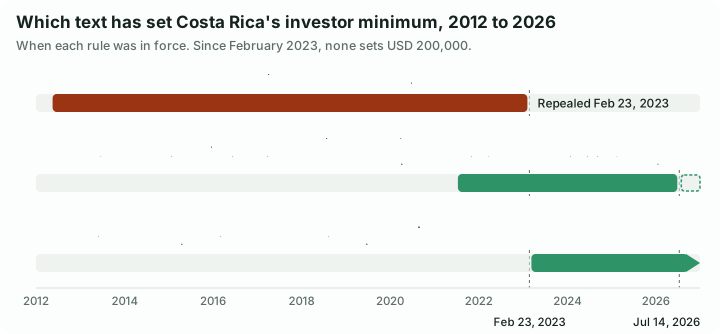
Source: references [1], [2], [9] and [10].
Article 8 does not say which term it means. The only periods Ley 9996 defines are the two in article 12: five years to opt into the incentives, and ten years to keep them. Published opinions differ on whether the USD 150,000 ended with the five years. Even if it did, there is no USD 200,000 rule to return to. Article 87, which set that amount, was repealed in 2023. Costa Rica's Civil Code says that repealing a law does not bring back the laws it had repealed, so article 87 would not return even if Decreto 43926 were repealed in turn.[12] Decreto 43926 itself has not been repealed.
The Dirección General de Migración y Extranjería, known as Migración, decides the applications. We found no public statement from Migración about applications filed after July 14, 2026, and no public report of an application approved or refused at either amount since then. Migración's official requirements are published in the Catálogo Nacional de Trámites, the government's catalogue of procedures, which the economy ministry runs. On September 30, 2026, every investor procedure listed there, from real estate to shares and securities, stated a minimum of USD 150,000.[13]
Under Ley 8220, the law against excessive paperwork, a requirement can be demanded only if it is set in a law, decree, regulation or general resolution. It must also be published both in La Gaceta and in that catalogue. Each institution must keep its entries in the catalogue up to date.[14] No rule that meets those conditions sets USD 200,000.
What a property must show to count toward investor residency
Article 7 of Decreto 43926 sets out the proof for each kind of investment. For real estate it requires four things.[15]
- The property must be registered in the applicant's own name. The regulation says so directly: "No se aceptará para estos efectos, que los bienes estén inscritos a nombre de personas jurídicas". In other words, property registered to a company does not count as a real estate investment. Migración checks the owner in the public database of the Registro Nacional, the national registry, and may review the chain of title.
- The value that counts is the municipal one. The application must include a certificate from the municipalidad, the local government, issued no more than three months before filing. The certificate must show the value the property tax is calculated on, and that municipal taxes are up to date.
- If the property is bought with a mortgage, the down payment must reach USD 150,000, on its own or combined with other qualifying investments.
- The investment must be kept. Residence is granted for two years at a time, and at each renewal the applicant must show again that the investment has been held without interruption since the residence was approved.[16]
Two challenges to the rule against company-owned property reached the Sala Constitucional, the Supreme Court's constitutional chamber, in 2024. Both were rejected outright, so the rule remains in force. In the first, the court said that whether a regulation goes beyond the law it implements is for the administrative courts to decide.[17]
The price paid affects the municipal value only through the deed. When ownership of a property is transferred, the value stated in the deed becomes the new municipal tax base if it is higher than the value on file, as the property tax article explains.[18] So a deed that understates the price also understates the investment.
Someone new to Costa Rica also cannot qualify through a beachfront concession. A foreigner may hold a maritime zone concession only after five years of residence, and a concession held through a company is excluded by the same rule as company-owned property.[19]
You can check who owns a property before making an offer. The Registro Nacional's record shows who holds a finca, a registered property, and whether the holder is a company. The title search guide shows how to look up and read that record for free, and a PropScan report lists the registered owner and every registered mortgage or other encumbrance from the same record.
How buyers make a property purchase count for residency
These are the steps people take, and all of them are lawful.
Which amount applies
- Ask Migración in writing which amount applies to an application filed on your date. Do it before committing money, and keep the answer. Ley 9097, the law on the right of petition, lets anyone petition a public body "independientemente de su nacionalidad", regardless of nationality, and the body must answer within ten business days.[20] The answer covers only your own application, and the regulation can still change.
- Invest USD 200,000 or more if you can. That amount qualifies on either reading of the law, so the dispute over article 8 does not affect you.
- If Migración asks for more than the catalogue shows, a Costa Rican lawyer can cite the catalogue entry and Ley 8220, described above.
If the property is, or will be, in a company
- Buy in your own name if residency is the goal. People hold property through companies for other reasons, and whether residency is worth giving that up is a question for a Costa Rican lawyer.
- Use the company's shares instead of the property. Under article 7, shares in a company registered in the Registro Nacional count if three conditions are met. A notary must certify, from the company's own books, that you hold an actual stake of at least USD 150,000. A certified public accountant must certify the investment. And the company must carry on an economic activity in Costa Rica, because the regulation excludes inactive companies.[21]
- Check that the company is active for tax purposes. Hacienda, the tax authority, records every company as inactive until it registers as a taxpayer carrying on an economic activity.[22] So a company that only holds a house does not qualify. A company that genuinely runs a business, such as renting the property out, and is registered with Hacienda for it, counts as active. It must then file and pay the taxes that come with that business. The regulation does not list which activities Migración accepts, so ask Migración before relying on one.
- If the shares route does not work, move the property into your own name. That is a new transfer, and it is subject to the 1.5% transfer tax and the Registro Nacional fees listed in the closing costs article.[23]
- A trust, or fideicomiso, is also allowed. The regulation says that when the investment is made through a trust, only the settlor, the person who puts the investment into the trust, may apply.[24] It does not say which documents prove an investment held in trust, so confirm the documents with Migración before setting up a trust.
Getting the value and the filing right
- Write the real price in the deed. If the value the municipality has on file is low, the owner can declare a higher one. The declared value becomes the new tax base, and property tax is charged at 0.25% a year on it.[25]
- Leave a margin above USD 150,000. The municipal value is in colones, while the minimum is in dollars, converted at the Banco Central de Costa Rica's selling rate. At CRC 457.21 to the dollar on September 29, 2026, USD 150,000 is CRC 68,581,500. If the dollar rose 10% against the colón, that same colón value would be worth about USD 136,400 at the next renewal, below the minimum.[26]
- Combine investments. Article 7 lets you reach the USD 150,000 by adding up real estate, shares, securities and the other kinds of investment it lists.[27]
- File a complete application. If a requirement is missing, Migración can ask for it and give you no more than ten business days to supply it. An application that is still incomplete is rejected.[28]
- Keep the investment while the residence is temporary. Each two-year renewal requires proof of it again, so a property sold between renewals no longer counts at the next one.
- If you opted into the tax incentives before July 14, 2026, keep the resolution that granted them and its date. Ask Hacienda before claiming the 20% transfer-tax reduction on a new purchase, because the law limits it to purchases made "en el plazo de vigencia de esta ley", during the law's term. Ask again before selling anything bought or imported with an exemption, because the regulation says beneficiaries must keep those goods for at least ten years.[29]
Common questions
What is the minimum investment for investor residency in Costa Rica?
USD 150,000. Decreto 43926, the regulation in force, sets that amount, and the government's catalogue of procedures, the Catálogo Nacional de Trámites, lists it for every kind of investor application. The USD 200,000 many pages quote came from article 87 of Decreto 37112, and that article was repealed on February 23, 2023. On September 30, 2026, we could find no statement from Migración, the immigration authority, setting another amount. Before committing money, ask Migración in writing which amount applies.
Can I get investor residency with a property owned by my corporation?
Not through the property itself, because Decreto 43926 counts real estate only when it is registered in your own name. Your shares in the company can count instead, on three conditions. The company must carry on an economic activity in Costa Rica and be registered with Hacienda, the tax authority, for that activity. A notary must certify from the company's books that you hold an actual stake of at least USD 150,000. A certified public accountant must also certify the investment. A company that only holds a house is inactive in Hacienda's records and does not qualify.
Does the purchase price or the municipal value count toward the USD 150,000?
The municipal value. The application must include a municipal certificate that is no more than three months old when you file. It must show the value the property tax is calculated on, and that municipal taxes are up to date. The price still matters, because when you buy, the value written in the deed becomes the new tax base if it is higher than the value on file. So a deed that understates the price also understates the investment.
What happened to the Ley 9996 tax benefits after July 2026?
They closed to new applicants on July 14, 2026, because article 12 of Ley 9996 allowed people to opt into them only during the law's first five years. People who opted in keep them for ten years from the date they were granted. The benefits include an import-duty exemption on household goods; up to two vehicles free of import duties and value-added tax; an income-tax exemption on the income declared to qualify for them; and a 20% reduction of the property transfer tax.
Did anything change for rentistas and pensionados?
Their minimums are set by Ley 8764, the migration law, and did not change. A rentista, someone living on a fixed income, must show at least USD 2,500 a month. A pensionado, a retiree, must show a pension of at least USD 1,000 a month paid from abroad. What ended on July 14, 2026, is the period for opting into Ley 9996's tax incentives, which were open to both groups as well as to investors.
Legal references and source notes
[1] Decreto Ejecutivo 43926-MGP-H-TUR, Reglamento a la Ley N° 9996, art. 31: "Deróguense los artículos 87, 88, 89, 90, 91 92, 93, 179, 223 y 228 incisos f) del Reglamento de Extranjería..." Published in Alcance 28 to La Gaceta 34 and in force from February 23, 2023; version 1 of 1. Decreto 37112's article 87 now reads: "(Derogado por el artículo 31 del Reglamento a la Ley N° 9996, Ley para la atracción de inversionistas, rentistas y pensionados, aprobado mediante decreto ejecutivo N° 43926 del 14 de febrero del 2023)". Sources: Decreto 43926, PGR-SINALEVI, Decreto 37112, PGR-SINALEVI.
[2] Decreto 43926, art. 4: "Podrá optar por la permanencia legal en el país bajo la subcategoría migratoria de Inversionista, la persona extranjera que realice una inversión en Costa Rica, por un monto no menor a ciento cincuenta mil dólares, moneda de los Estados Unidos de América (US$150 000, 00)..." The article sets no end date. Source: Decreto 43926, PGR-SINALEVI.
[3] Ley 8764, Ley General de Migración y Extranjería, art. 79: "La Dirección General de Migración otorgará una autorización de ingreso y permanencia por un tiempo definido, superior a noventa días y hasta por dos años, prorrogable en igual tanto, a quienes se encuentren comprendidos en las siguientes subcategorías: ... 4) Los inversionistas." Version 19 of 19, February 24, 2025. Source: Ley 8764, PGR-SINALEVI.
[4] Ley 8764, art. 78: "Podrán optar por la categoría migratoria de residente permanente, las personas extranjeras que cumplan los siguientes requisitos: 1) La persona extranjera, su cónyuge y sus familiares de primer grado por consanguinidad que hayan gozado de una residencia temporal durante tres años consecutivos." Source: Ley 8764, PGR-SINALEVI.
[5] Decreto 43926, art. 13: "La persona extranjera a la que se le otorgue la residencia temporal como inversionista y sus dependientes, no podrán realizar ninguna labor manual o intelectual remunerada." Source: Decreto 43926, PGR-SINALEVI.
[6] Ley 9996, Ley para la atracción de inversionistas, rentistas y pensionados, art. 5, incisos a) to d). Inciso d): "Exoneración de un veinte por ciento (20%) del total del impuesto de traspaso, en aquellos bienes inmuebles que adquieran en el plazo de vigencia de esta ley, siempre que la persona beneficiaria sea la titular registral del bien." In force from its publication in La Gaceta 135 of July 14, 2021; version 1 of 1, never amended. Source: Ley 9996, PGR-SINALEVI.
[7] Ley 9996, art. 12, "Vigencia de la ley": "Los inversionistas, rentistas o pensionados que opten por los beneficios otorgados en el artículo 5 de la presente ley podrán hacerlo únicamente durante los primeros cinco años a partir de su entrada en vigencia. Los inversionistas, rentistas o pensionados beneficiarios que optaron por dichos beneficios durante los primeros cinco años de vigencia de la ley, los mantendrán por un plazo de diez años a partir de la fecha en que les fueron otorgados." Source: Ley 9996, PGR-SINALEVI.
[8] Ley 8764, art. 81: pensionados must show "pensiones mensuales, permanentes y estables provenientes del exterior, cuyo monto no podrá ser inferior a mil dólares". Art. 82: rentistas must show "rentas mensuales, permanentes y estables ... por un monto mínimo de dos mil quinientos dólares ... por mes". Source: Ley 8764, PGR-SINALEVI.
[9] Decreto 37112, Reglamento de Extranjería, art. 87 as published in 2012: "Para la solicitud de residencia temporal como inversionista, la persona extranjera interesada deberá demostrar su inversión con un capital no inferior a US$200.000.00 (doscientos mil dólares) según el tipo de cambio oficial de venta que determine el BCCR, ya sea en bienes inmuebles, bienes inscribibles, acciones, valores y proyectos productivos o proyectos de interés nacional." In force from May 17, 2012, Alcance 64 to La Gaceta 95. Source: Decreto 37112, original version, PGR-SINALEVI.
[10] Ley 9996, art. 8: "Para la categoría de inversionistas, por el plazo que establece la presente ley, se establece un nuevo rango de inversión, con un capital no inferior a ciento cincuenta mil dólares estadounidenses (US$150 000, 00), según el tipo de cambio oficial de venta que determine el Banco Central de Costa Rica, ya sea en bienes inmuebles, bienes inscribibles, acciones, valores y proyectos productivos o proyectos de interés nacional." Source: Ley 9996, PGR-SINALEVI.
[11] Decreto 43926, art. 4 is quoted in note [2] and art. 31 in note [1]. SINALEVI shows article 87 of Decreto 37112 in two versions, the 2012 text and the repeal. Sources: Decreto 43926, PGR-SINALEVI, Decreto 37112, PGR-SINALEVI.
[12] Código Civil (Ley 30), art. 8, as reformed by Ley 7020 of January 6, 1986: "Por la simple derogatoria de una ley no recobran vigencia las que ésta hubiere derogado." Version 22 of 22. Source: Código Civil, PGR-SINALEVI.
[13] Catálogo Nacional de Trámites, run by the Ministerio de Economía, Industria y Comercio: the procedures of Migración's Gestión de Extranjería for investors in real estate or registrable goods, shares, securities, projects of national interest or productive projects, venture capital funds and sustainable tourism infrastructure. Each describes "una inversión en Costa Rica, por un monto no menor a ciento cincuenta mil dólares, moneda de los Estados Unidos de América (US$150 000, 00)", with requirements cited to Decreto 43926, art. 7. Records dated April and May 2025, read on September 30, 2026. Sources: real estate, procedure 9535, shares, procedure 9536.
[14] Ley 8220, Protección al ciudadano del exceso de requisitos y trámites administrativos, art. 4, as reformed by Ley 10072 of November 18, 2021: "Todo trámite o requisito, con independencia de su fuente normativa o de la materia de que se trate, para que pueda exigirse al administrado deberá: a) Constar en una ley, un decreto ejecutivo, un reglamento o en disposiciones administrativas como resoluciones generales ... b) Estar publicado en el diario oficial La Gaceta y en el Catálogo Nacional de Trámites." Each institution "deberá mantener actualizada, de forma permanente y obligatoria, la información en esta herramienta digital". Version 4 of 4. Source: Ley 8220, PGR-SINALEVI.
[15] Decreto 43926, art. 7, section A. Paragraph 1: "La persona solicitante deberá ser propietario registral de un bien inmueble o mueble debidamente inscrito ante el Registro Nacional, para lo cual la persona funcionaria deberá constatar la información, accediendo a la base de datos pública del Registro Nacional. No se aceptará para estos efectos, que los bienes estén inscritos a nombre de personas jurídicas. ... La Dirección General podrá verificar ante Registro Nacional, la información registral aportada, a efectos de consultar el tracto sucesivo de la propiedad." Paragraph 2: with a mortgage, "un pago inicial por un monto mínimo no inferior a ciento cincuenta mil dólares ... o bien que se alcance este monto en conjunto con las otras inversiones". Paragraph 3: "certificación o constancia de la Municipalidad correspondiente con fecha de expedición no mayor a tres meses a la presentación de la solicitud, en la que se demuestre el valor del inmueble sobre el cual se estiman los impuestos a cancelar y que se encuentra al día en el pago de impuestos municipales." Source: Decreto 43926, PGR-SINALEVI.
[16] Decreto 43926, art. 4: "Dicha subcategoría se otorgará por dos años prorrogables por períodos iguales, para lo cual, previo a la renovación, la persona extranjera deberá demostrar que ha mantenido su inversión de manera continua e ininterrumpida". Art. 10, inciso 8, lists among the renewal requirements the proof of the investment, "misma que deberá haberse mantenido de manera continua e ininterrumpida desde el momento de la aprobación de la permanencia legal en el país." Source: Decreto 43926, PGR-SINALEVI.
[17] Sala Constitucional, votos 2024-030533 (expediente 24-018216-0007-CO) and 2024-030534 (expediente 24-021027-0007-CO), both of October 16, 2024, on actions against article 7, section A, paragraph 1, of Decreto 43926. Each ends "Se rechaza de plano la acción." Voto 2024-030533 explains that whether a regulation exceeds its law "constituye un extremo de legalidad ordinaria que debe ser conocido y resuelto por la jurisdicción contenciosa administrativa". Sources: voto 2024-030533, Nexus PJ, voto 2024-030534, Nexus PJ.
[18] Ley 7509, Impuesto sobre Bienes Inmuebles, art. 14: "La base imponible de un inmueble será modificada en forma automática por: a) El mayor valor consignado en instrumento público con motivo de un traslado de dominio." Version 11 of 11. Source: Ley 7509, PGR-SINALEVI.
[19] Ley 6043, Ley sobre la Zona Marítimo Terrestre, art. 47: "No se otorgarán concesiones: a) A extranjeros que no hayan residido en el país por lo menos durante cinco años". Version 9 of 9. The exclusion of company-held property is in note [15]. Source: Ley 6043, PGR-SINALEVI.
[20] Ley 9097, Ley de Regulación del Derecho de Petición, art. 1: "Todo ciudadano, independientemente de su nacionalidad, puede ejercer el derecho de petición". Art. 6: the administration must acknowledge receipt, "debiendo responder en el plazo improrrogable de diez días hábiles contado a partir del día siguiente de la recepción". Version 1 of 1. Source: Ley 9097, PGR-SINALEVI.
[21] Decreto 43926, art. 2 defines shares for the regulation as "únicamente las acciones no cotizadas en bolsa o participaciones sociales de sociedades mercantiles debidamente inscritas en el Registro Nacional". Art. 7, section B, paragraph 1: "Certificación de personería jurídica y de capital accionario emitida por un Notario Público con vista en los libros legales de la sociedad, en la que conste una participación real de parte de la persona extranjera, por un monto no inferior a ciento cincuenta mil dólares", issued no more than a month before; "Solo se permitirá este tipo de inversión en sociedades con actividades económicas en el país, no así en personas jurídicas inactivas." Paragraph 2 requires a certification by a contador público autorizado. Source: Decreto 43926, PGR-SINALEVI.
[22] Dirección General de Tributación, resolución MH-DGT-RES-0013-2025 of July 1, 2025, art. 2: legal persons registered in the Registro Nacional, "independientemente si realizan o no una actividad lucrativa en el país, serán registradas de oficio y en forma automática en el Registro Único Tributario (RUT) de la Dirección General de Tributación con el estado tributario de 'Persona Jurídica Inactiva'", and to obtain a license or permit a company "deberá estar inscrita como un obligado tributario activo en el ejercicio de una actividad económica". Version 2 of 2. Source: MH-DGT-RES-0013-2025, PGR-SINALEVI.
[23] Ley 6999, art. 8, as reformed by Ley 7764 of 1998: "La tarifa del impuesto será del uno y medio por ciento (1,5 %)." Version 3 of 3. Source: Ley 6999, PGR-SINALEVI.
[24] Decreto 43926, art. 4: "En el caso de la inversión se realice a través de fideicomiso, únicamente el fideicomitente podrá optar por esta subcategoría migratoria, por ser la persona que efectúa la inversión." Source: Decreto 43926, PGR-SINALEVI.
[25] Ley 7509, art. 14, inciso d): the base changes automatically with "El mayor valor que los sujetos pasivos reconozcan formalmente mediante la declaración establecida en el artículo 3 de esta Ley", a reference to the declaration now in article 16 after the 1997 renumbering. Art. 16: "El valor declarado se tomará como base del impuesto sobre bienes inmuebles, si no se corrigiere dentro del período fiscal siguiente a la presentación de la declaración". Art. 23 sets the rate at "un cuarto por ciento (0,25%)". Source: Ley 7509, PGR-SINALEVI.
[26] Decreto 43926, art. 7, converts the minimum "al tipo de cambio de venta que determine el Banco Central de Costa Rica". The Banco Central's reference selling rate was CRC 457.21 per US dollar on September 29, 2026, read on its home page, which is named rather than linked. USD 150,000 × 457.21 = CRC 68,581,500, and CRC 68,581,500 ÷ (457.21 × 1.1) = USD 136,364.
[27] Decreto 43926, art. 7: each kind of investment may meet the minimum on its own "o bien que se alcance este monto en conjunto con las otras inversiones que se listan en los incisos de este artículo." Source: Decreto 43926, PGR-SINALEVI.
[28] Dirección General de Migración y Extranjería, resolución D. JUR-220-05-2024-JM-ABM of May 17, 2024, Alcance 109 to La Gaceta 106 of June 12, 2024, part five, item 4: every application "deberá contener todos los requisitos establecidos en la legislación migratoria vigente"; "únicamente se podrá prevenir la presentación de requisitos dentro de un plazo no mayor a diez días hábiles, cuando se hayan omitido"; and "en caso de que se omita algún requisito de admisibilidad, la petición será rechazada." Source: resolución D. JUR-220-05-2024-JM-ABM, PGR.
[29] Ley 9996, art. 5, inciso d), second paragraph: "Si la persona beneficiaria traspasara estos bienes en el plazo de vigencia de esta ley, deberá cancelar los impuestos de los cuales fue eximida." Decreto 43926, art. 22: those who opted in during the first five years "deberán conservar los bienes en su poder durante al menos 10 años." Sources: Ley 9996, PGR-SINALEVI, Decreto 43926, PGR-SINALEVI.
This guide is informational and not a substitute for legal advice. For a purchase, work with an experienced attorney or notary.