Costa Rica zoning: what the uso de suelo certificate tells you before you buy
The uso de suelo certificate sets what you may build on a Costa Rican property, and only the formal one counts. In 40 of 84 cantons there is no zoning plan, so national rules set the limits.
In Costa Rica, what you may build on a property, and what a building may be used for, is written in one municipal document: the certificado de uso de suelo, the land use certificate. It states the permitted use and the limits on building: setbacks from the property lines, coverage (the share of the lot a building may cover), density, height, and the lot's minimum frontage and area.[1] The municipality must check every building permit against it.[2]
On October 7, 2026, the Instituto Nacional de Vivienda y Urbanismo (INVU), the national housing and urban planning institute, recorded a plan regulador, a local zoning plan, in 44 of Costa Rica's 84 cantons. In 22 of the 44, the plan covers only part of the canton.[3] Everywhere else, national rules set the limits, and the certificate states those instead.
Key points
- The uso de suelo certificate states whether a use conforms to the zoning, and the building limits that apply. A building permit must conform to it, and a commercial license needs one.
- Only the formally issued certificate gives the owner a right. A certificate, once issued, stays in force until the municipal council annuls it through a formal procedure.
- On October 7, 2026, INVU recorded a plan regulador in 44 of 84 cantons, and 22 of them cover only part of the canton. No canton in Guanacaste has a plan for its whole territory.
- Where no plan applies, INVU's national regulations set the limits, and there is no zoning for the municipality to change. A lot split off without the municipality's visado cannot get a building permit.
What the uso de suelo certificate says, and why only the formal one counts
The planning law, Ley 4240 of 1968, bans any use of land or buildings that is incompatible with the zoning. An owner needs a municipal certificate showing that the intended use conforms. A use that already existed and does not conform is certified as a nonconforming use.[4] Without a certificate for the use, no license is granted for a shop or other commercial or industrial business.[5]
What the certificate must contain is set by INVU's construction regulation. It must state at least the use, setbacks, coverage, density, height, frontage and minimum area, and how long it is valid. It stays valid while the plan regulador it was issued under remains unchanged. When the plan changes, an earlier certificate lasts as long as the new plan says, or two years if the new plan says nothing.
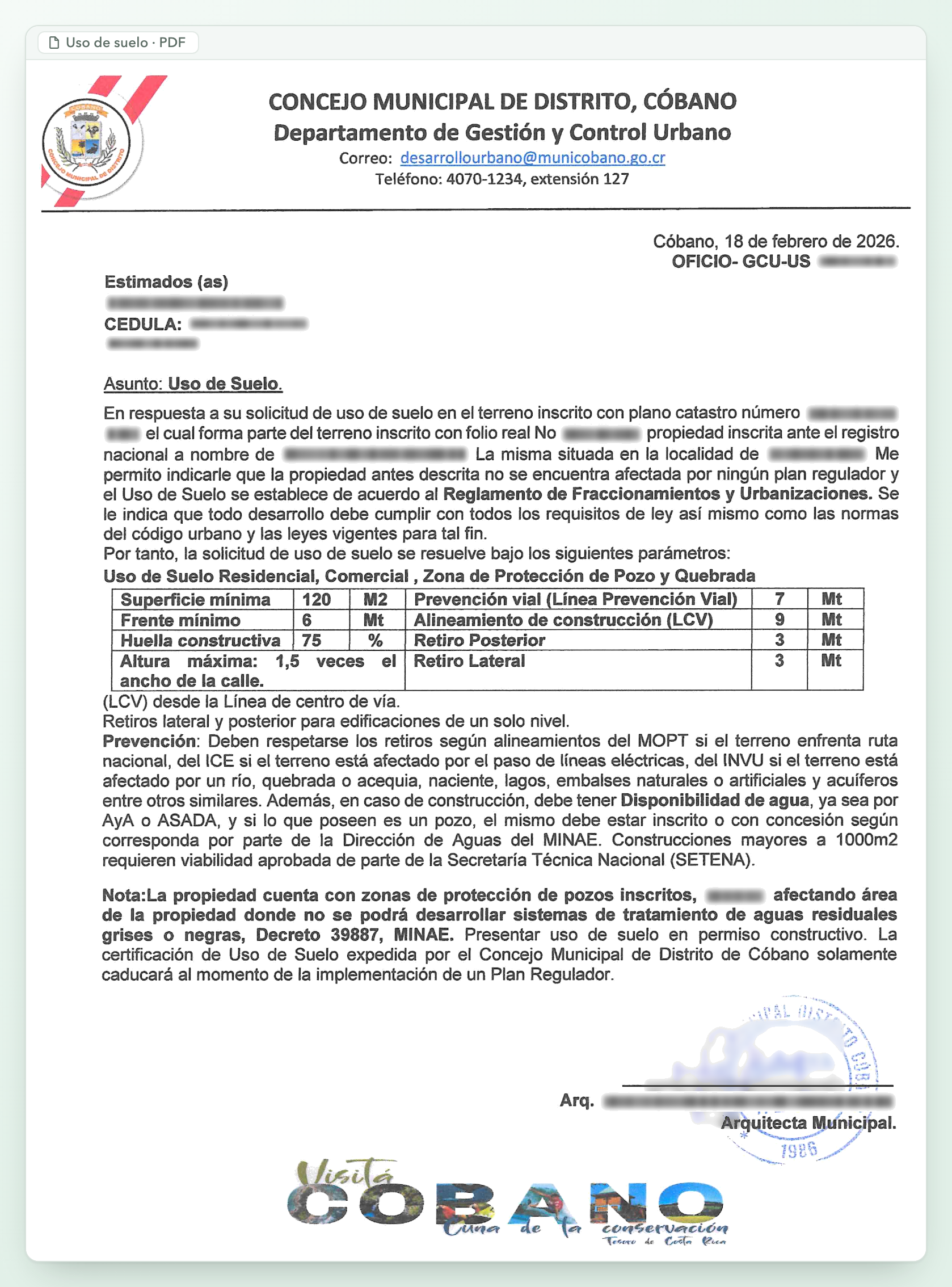
A uso de suelo certificate from the district council of Cóbano, on the Nicoya Peninsula, issued on February 18, 2026. No plan regulador covers the property, and the certificate expires only when one takes effect. Details that identify the property, its owner and the signer are blurred.
Only the formal certificate counts. In 2024 the attorney general's office, the Procuraduría General de la República (PGR), told a municipality that the law recognizes no temporary, provisional or merely informational version, and that only a certificate formally issued gives its holder a right.[6] Two weeks later it told INVU that a certificate issued against the zoning remains in force until the municipal council annuls it through a formal procedure. Anything built under it is protected until then.[7]
Each municipality runs its own procedure. Sarapiquí's, as an example, asks for a form, an ID, a registry report on the property and a certified copy of its plano catastrado, the registered survey plan. It takes fifteen calendar days and costs CRC 1,959. Every municipality must publish its requirements in the government's catalogue of procedures, the Catálogo Nacional de Trámites.[8]
Which cantons have a plan regulador
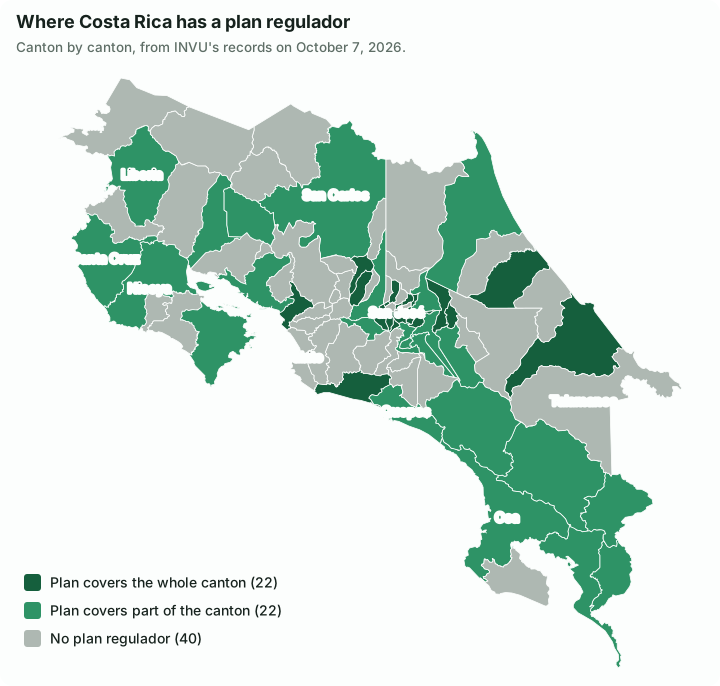
Source: reference [3]. Isla del Coco, part of Puntarenas, is not shown. The 200-meter maritime zone is governed by separate coastal plans.
Guanacaste has no canton with a plan for its whole territory: five have a partial plan and six have none. Santa Cruz's partial plan was first published in 1983 and last amended in 1994, and Nicoya's dates from 1983. Across the country, 16 plans were first published more than 30 years ago. The most recent publication is Santa Ana's plan, on October 5, 2026.
A partial plan covers specific districts, so a property elsewhere in the same canton falls under the national rules. INVU publishes the status of every canton on its SIGHAT map, and the municipality can say which districts its plan covers. The first 200 meters from the high-tide line are governed by coastal plans instead, which the maritime zone article explains.
Where there is no plan, or the plan does not cover the property
The planning law gives INVU's rules force wherever a municipality has not adopted its own.[9] So in a canton with no plan, the certificate states the requirements of INVU's national regulations. The road access article sets out those national limits: how tall you may build depends on the width of the road in front, and how much of the lot you may cover depends on its shape.
No plan also means there is nothing to rezone. In 2012 the PGR told the council of Carrillo, a Guanacaste canton with no plan, that it could not authorize a change of use, because no planning rule had divided the canton into uses. The forestry law and other national laws still apply there.[10]
What it means for a house already built, or a lot already split
A use that existed before the zoning may continue, but it can only change into a use the zoning allows. An extension needs a building permit of its own, and a municipality must refuse one that does not conform to the zoning's use, setbacks or coverage. It must also refuse a second home on a lot at or below the minimum size. And it must refuse any building in an area formally declared uninhabitable because of flooding or landslides.[11]
Splitting a lot off a larger property requires the municipality's visado, its approval of the survey plan for the new lots. It exists so that every new lot meets the planning rules: the municipality checks each one and must refuse the visado if a lot would be smaller than the minimum, lack adequate access to a public road or lack basic services. The owner applies with plans drawn by a licensed surveyor and the registered plan of the original property. Depending on the kind of split, the application also needs the uso de suelo certificate, a letter from the water provider confirming it can supply every new lot, or both. The municipality must answer within 15 days, free of charge.[12]
Without the visado, the Registro Nacional, the national registry, will not register the plan or record the split. In urban districts and other areas under planning control, public offices also treat a lot split off without it as nonexistent for building permits, utility connections, licenses and loans. The exception is a lot split off before the planning law took effect in 1968.[13]
What buyers can do before they commit
- Ask the municipality for a formal certificate for the property and for the use you have in mind, whether a home, a vacation rental or a shop, before you sign. A copy from the seller shows what the municipality said when it was issued. Check that date and the validity it states, and ask whether the plan has changed since.
- Do not rely on an email or an answer at the counter. Only the certificate gives you a right.
- Find out whether the canton has a plan, and whether it covers the property's district. In INVU's records, 18 of the 40 cantons with no plan are preparing one, and 12 of the plans in force are being updated. If either applies, ask what the new plan proposes for the property's zone. When a plan changes, a certificate issued under the old one lasts as long as the new plan says, or two years.
- Read the certificate's numbers against your plans: coverage and height for an extension, density for a second unit, minimum area and frontage for a split.
- For a lot that was split off recently, check that its survey plan carries the municipality's visado. If the seller has yet to split the lot off, the visado must come before the deed.
- If the zoning does not allow what you want, changing a plan takes a public hearing announced in La Gaceta, the official gazette, INVU's approval and a vote of the municipal council.[14] In a canton with no plan there is nothing to change, so design within the national limits.
- Keep the certificate you were issued. If the municipality later finds it should not have been granted, it stays in force until the council annuls it through a formal procedure, and what you built under it is protected until then.
A PropScan report shows whether the property's canton has a plan regulador in INVU's records, whether the plan covers the property's district, and the zone where the records allow it. It also says plainly that only the municipality's certificate is definitive.
Common questions
What is a uso de suelo certificate in Costa Rica?
It is the municipal certificate that says whether a use of a property conforms to the zoning. It must state at least the permitted use, setbacks, coverage, density, height, frontage and minimum lot area, and how long it is valid. A building permit must conform to it, and a commercial license needs one. Only the formally issued certificate gives the owner a right; an informal answer from the municipality does not.
How long is a uso de suelo certificate valid?
For as long as the plan regulador it was issued under stays in force unchanged. When the plan changes, a certificate issued earlier lasts as long as the new plan says, or two years if the new plan says nothing. The municipality must state the validity on the certificate itself, so read it there.
What applies in a canton with no plan regulador?
INVU's national construction and subdivision regulations. On October 7, 2026, INVU recorded no plan regulador in 40 of Costa Rica's 84 cantons, and in 22 more the plan covered only part of the canton. The municipality still issues a certificate, stating the national requirements. With no zoning in place, there is no zoning to change, so a council cannot grant a change of use.
Can I build on a lot that was split off a larger property?
Only if the municipality approved the survey plan for the split by granting its visado. Without it, the Registro Nacional will not register the plan or record the split, and in urban districts and other areas under planning control, public offices treat the lot as nonexistent for building permits, utility connections, licenses and loans. The exception is a lot split off before the planning law took effect in 1968.
What happens to a use that existed before the zoning?
It can continue. The municipality certifies it as a nonconforming use, and it may later change only into a use the zoning allows. New work on the property still needs a building permit, and the municipality must refuse one that does not conform to the zoning in force.
Legal references and source notes
[1] Reglamento de Construcciones, INVU, art. 102, as reformed in Alcance 145 to La Gaceta 148 of August 16, 2018: "Para el diseño y construcción de una edificación, se debe obtener un certificado municipal que acredite la conformidad de uso del suelo, según las disposiciones y restricciones contenidas en el plan regulador vigente. La vigencia del certificado de uso de suelo debe ser por el tiempo que el plan regulador permanezca vigente y no se modifique. Cuando un plan regulador cambia o se modifica, la vigencia de los certificados de uso de suelo emitidos con anterioridad debe ser la indicada en el nuevo plan regulador; en caso que no se indique, debe ser de 2 años. En caso de no contar con plan regulador, la municipalidad debe indicar los requerimientos establecidos en el presente Reglamento, según el tipo de edificación. Todo certificado de uso de suelo debe señalar como mínimo el uso, retiros, cobertura, densidad, altura, frente y área mínima. Además, la municipalidad que lo emita debe indicar en el documento el periodo de vigencia." INVU's consolidated edition, updated in Alcance 102 to La Gaceta 94 of May 23, 2022. Source: Reglamento de Construcciones, INVU.
[2] Ley 833, Ley de Construcciones, art. 74: "Previo a emitir y otorgar el permiso de construcción, la municipalidad debe verificar que la obra a realizar sea conforme a los términos del certificado de uso del suelo." Version 5 of 5. Source: Ley 833, PGR-SINALEVI.
[3] INVU's layer of plan regulador status for the 84 cantons, published on its SIGHAT geoportal, read on October 7, 2026; INVU last edited it that day. It records a plan in 44 cantons and none in 40; 22 plans cover the whole canton and 22 part of it. In Guanacaste, 5 cantons have a partial plan and 6 none. Of the 44 plans, 16 were first published in La Gaceta more than 30 years ago, among them Santa Cruz (February 10, 1983, last amended February 15, 1994) and Nicoya (January 26, 1983). The newest is Santa Ana's, published in Alcance 133 to La Gaceta 187 of October 5, 2026. Of the 40 cantons with no plan, 18 are preparing one, 16 of them listed as "En proceso de elaboración por parte de la Municipalidad"; 22 are listed as "Sin Proceso en el INVU". Of the 44 plans in force, 12 are listed as "en proceso de actualización". Sources: INVU, SIGHAT, the layer, Estado Planes Reguladores.
[4] Ley 4240, Ley de Planificación Urbana, art. 28: "Prohíbese aprovechar o dedicar terrenos, edificios, estructuras, a cualquier uso que sea incompatible con la zonificación implantada. En adelante, los propietarios interesados deberán obtener un certificado municipal que acredite la conformidad de uso a los requerimientos de la zonificación. Los usos ya existentes no conformes, deberán hacerse constar también con certificado que exprese tal circunstancia." Version 9 of 9, of November 5, 2024. Source: Ley 4240, PGR-SINALEVI.
[5] Ley 4240, art. 29, as reformed by Ley 10594 of November 5, 2024: "Sin el certificado de uso correspondiente, no se concederán patentes para establecimientos comerciales o industriales." Source: Ley 4240, PGR-SINALEVI.
[6] PGR, dictamen C-006-2024 of January 30, 2024, to the Municipalidad de Montes de Oca: "La Ley de Planificación Urbana no reconoce la existencia de un certificado de uso de suelo 'temporal' o 'provisional' o de otro documento que pueda ser utilizado únicamente para fines informativos"; and "solo el certificado de uso de suelo formalmente otorgado confiere un derecho subjetivo". Source: PGR, C-006-2024, via SINALEVI.
[7] PGR, dictamen C-018-2024 of February 12, 2024, to INVU: "Los certificados de uso de suelo son actos declarativos de derechos, por tanto, es el Concejo Municipal correspondiente quien debe gestionar la anulación de aquellos certificados otorgados en contravención de la zonificación vigente"; works built under such a certificate "se encontrarían amparadas en un acto declaratorio de derechos que aún no ha sido anulado". Source: PGR, C-018-2024, via SINALEVI.
[8] Municipalidad de Sarapiquí, "Certificado de uso de suelo", requirements sheet updated August 21, 2026: a form, an identity document, "Informe registral del inmueble" and "Copia certificada del plano catastrado del bien inmueble sin reducir"; resolution in 15 calendar days; cost CRC 1,959; validity "Indefinida. Condicionada a modificaciones del Plan Regulador". Ley 8220, art. 4, requires every requirement to be "publicado en el diario oficial La Gaceta y en el Catálogo Nacional de Trámites". Sources: Municipalidad de Sarapiquí, Ley 8220, PGR-SINALEVI.
[9] Ley 4240, Transitorio II, as left by Sala Constitucional voto 4205-96: INVU "dictará las normas de desarrollo relativas a las materias a que se refiere el artículo 21 de esta ley", which apply "en tanto las municipalidades no hubieren promulgado en la respectiva materia, o parte de ella, sus propias disposiciones locales". Source: Ley 4240, PGR-SINALEVI.
[10] PGR, dictamen C-043-2012 of February 13, 2012, to the Concejo Municipal de Carrillo: the answer is no, "porque el cambio de uso es una conducta imposible jurídicamente cuando hay ausencia de normativa de planificación"; activities remain subject to urban and non-urban rules, among them INVU's subdivision regulation and the "Ley Forestal". Source: PGR, C-043-2012, via SINALEVI.
[11] Ley 4240, art. 58: municipalities "no permitirán obras de construcción" that do not conform "por razones de uso, ubicación, retiros, cobertura y demás condiciones de la zonificación"; that would put more than one dwelling "en un lote de cabida o dimensiones equivalentes o menores a los mínimos establecidos"; or where there is "una declaratoria formal de inhabitabilidad del área, motivada en renovación urbana o protección contra inundaciones, derrumbes y otros peligros evidentes". Art. 30: "En uso no conforme, sólo podrá transformarse en otro compatible o concordante con la zonificación." Source: Ley 4240, PGR-SINALEVI.
[12] Decreto 44647, Reglamento general del Registro Inmobiliario, in force since March 24, 2025, art. 102(c): "Todo fraccionamiento requiere visado de la municipalidad respectiva, independientemente del área del levantamiento"; art. 104 makes the municipality responsible for "verificar el cumplimiento de requisitos para cada tipo de fraccionamiento". Ley 4240, art. 36: the visado is refused "Cuando del simple fraccionamiento se originen lotes que tengan menos tamaño del permitido, inadecuado acceso a la vía pública o carentes de servicios indispensable". INVU's Reglamento de Fraccionamiento y Urbanizaciones, arts. 18, 22, 27 and 36, lists what the owner files for each kind of split: the "Plano catastrado certificado de la finca madre o certificado catastral", plans signed by a "miembro activo del CIT", the professional association of surveyors, and, depending on the kind, the "Certificado de uso de suelo" (arts. 22, 27 and 36) and the water provider's letter (arts. 18, 22 and 27), which under art. 13 must guarantee water "para el abastecimiento de todos los lotes resultantes del fraccionamiento". Ley 4240, art. 34: the municipality issues the visado within fifteen days of filing, a period set by Ley 6595 of 1981, "en forma gratuita, sin estar sujeto al pago de timbres o cualquier otro tributo". Sources: Decreto 44647, PGR-SINALEVI, Reglamento de Fraccionamiento y Urbanizaciones, PGR-SINALEVI, Ley 4240, PGR-SINALEVI.
[13] Decreto 44647, art. 102: the Registro's cadastral department registers only plans that the municipality, and INVU where it applies, have admitted "mediante el visado correspondiente", and the visado "deberá ser previa a la inscripción". Ley 6545, Ley del Catastro Nacional, art. 30: every registry transaction must cite a survey plan, and the Registro "suspenderá la inscripción de los documentos que carezcan del plano catastrado". Ley 4240, art. 33: "para todo fraccionamiento de terrenos o inmuebles situados en distritos urbanos y demás áreas sujetas a control urbanístico, será indispensable haber visado antes" the plan. Art. 34: public offices that grant building permits, services, licenses or loans "tendrán como inexistentes, para estos efectos, las parcelaciones hechas sin observar lo dispuesto en el artículo anterior". Art. 58(2) bars building on a lot "originado en fraccionamiento hecho sin el visado de la ley", but the visado may be dispensed "si la certificación de propiedad acredita que la segregación se operó con fecha anterior a la vigencia de esta ley". The law took effect on November 15, 1968. Sources: Decreto 44647, PGR-SINALEVI, Ley 6545, PGR-SINALEVI, Ley 4240, PGR-SINALEVI.
[14] Ley 4240, art. 17: before adopting a plan, the municipality must call a public hearing announced in La Gaceta at least fifteen business days ahead, obtain the approval of INVU's Dirección de Urbanismo, adopt it by absolute majority and publish the adoption in La Gaceta. The same requirements apply "cuando se trate de modificar, suspender o derogar, total o parcialmente, el referido plan". Source: Ley 4240, PGR-SINALEVI.
This guide is informational and not a substitute for legal advice. For a purchase, work with an experienced attorney or notary.