Entry Nº 015
Can a Costa Rican house built without a permit be legalized?
In Costa Rica, a house built without a permit gets one if it meets today's rules or is changed to meet them, with plans, the permit fee and a fine capped at that fee.
In 2023 and 2024, the municipality of Talamanca issued 1,426 building permits. The Contraloría General de la República, the State's audit office, found that 405 of them, 28%, legalized construction the municipality had stopped because it had started without a permit.[1] In Santa Cruz, the auditors checked 30 construction projects whose owners had received notices from municipal inspectors. Ten owners had not applied for a permit, yet the municipality had taken no step to demolish what they had built.[2] The only demolitions of homes we could confirm in court records were of informal settlements inside protection zones and of houses declared uninhabitable.
Key points
- To legalize a house built without a permit, the owner presents plans from an engineer or architect and pays the permit fee, up to 1% of the construction's value, plus a fine capped at that fee. The permit is granted once the house meets the rules in force, with any changes the municipality orders.
- We found no national count of demolitions. The only demolitions of homes we could confirm were of informal settlements inside protection zones and of houses declared uninhabitable.
- A building that breaks the zoning, stands on a lot split off without municipal approval, lacks adequate road access or is inside a river's protection strip cannot get a permit, and a buyer takes over any procedure already open at the stage it has reached. Check both before signing.
- The Colegio Federado de Ingenieros y de Arquitectos (CFIA), the engineers' and architects' association, found no permit on site at 20% of the 5,934 construction projects it inspected in 2025, against 25% in 2024.
What a building permit is in Costa Rica, and the documents a permitted house should have
All construction, permanent or temporary, needs a municipal permit, the permiso de construcción.[3] Only an engineer or architect registered with the CFIA can apply for one, and must then supervise the construction.[4]
For a house, the plans are approved and stamped through the CFIA's digital platform before the professional applies to the municipality.[5] During construction, the approved plans, the permit with its number on display and the CFIA's bitácora, the construction logbook, must be kept on site.[6] When construction ends, the municipality must be notified. Ley 833, the construction law, has no certificate of occupancy: using a building before that notice is an infraction.[7]
None of this is in the registry: the folio real, the property's registry record, shows no permits. A survey plan, the plano catastrado, must show the buildings standing when it was drawn,[8] so a property's older plans can date a building, but they do not show whether it had a permit.
How legalizing a house built without a permit works
Legalizing a finished building, its regularización, means meeting all the requirements in force.[9] The owner can apply without waiting for the municipality to act: an engineer or architect presents plans that match the building, and the owner pays the permit fee and a fine. Carrillo's list of documents for a permit application, for example, does not require the work-risk insurance for buildings already finished.[10]
When the municipality finds a building finished without a permit, it records the facts and gives the owner 30 days, which cannot be extended, to present the plans and apply. If the owner does not, a second notice sets a final deadline. Once the plans arrive, the municipality checks that the building matches them and that both meet the law and its regulations, and it can order changes before granting the permit. If the owner never presents plans or does not make the changes ordered, the municipality can demolish the parts that do not comply, at the owner's cost.[11] The Tribunal Contencioso Administrativo, the administrative court, has held that a municipality may order a demolition only when the owner ignores the notices or the law bars a permit for the building, and that a building should be saved wherever the law allows.[12]
The law caps the fine at the permit fee the municipality did not collect. The fine can be imposed on the owner, the engineer or the contractor, and municipalities set the amounts within that cap.[13] The permit fee is a tax of up to 1% of the construction's value. Golfito, for example, adds a fine of 25% to 100% of that 1%, depending on how far construction has gone.[14]
What municipalities do in practice: closures, permits and the demolitions we found
In Pococí and Golfito, every procedure begins with an inspector's report on a complaint or on something the inspector noticed during weekly rounds,[15] and no source we found counts how many finished buildings municipalities find this way. In 2023 and 2024, Santa Cruz issued 3,070 building permits and did not inspect 1,827 of those projects, 59%.[2]
When someone builds without a permit, the municipality can stop the construction and close the site, a clausura,[16] and post seals marked clausurado, closed, that bar further work or use.[15] Santa Cruz closed a site in 36% of its 1,243 inspections in those two years, 448 in all, and kept no record of whether the owners complied; in 16 of the 30 projects the auditors checked, the fine had not been charged.[2] The Contraloría found both Santa Cruz and Talamanca permissive in approving permits,[1] and Santa Cruz's inspection of construction weak and disorganized.[2] Neither audit reports a demolition.
A municipality must give the owner the chance to legalize a building before demolishing it for lacking a permit, and its notices must tell the owner to present plans and apply: in February 2025 the administrative court annulled a Curridabat demolition order because none of the notices served since 2019 had done so.[16] Ley 833 does not say whether an owner can still apply once a demolition order is final. The only case we found of an application made after a final order was about a telecommunications tower: the administrative court upheld Santa Ana's refusal, and the tower also failed other requirements.[17]
We found no national count of demolitions. The only homes we could confirm demolished were in informal settlements inside protection zones or had been declared uninhabitable. In Desamparados, where the settlements stood on farms sold in shares, the municipality demolished homes in 2011 and in Patarrá in 2016, and it began more demolitions there in 2020.[18] In La Unión, after a neighbor's complaint, the municipality demolished houses that the health ministry had declared uninhabitable, when their owner did not legalize them.[19]
The other demolitions we found were of structures that could not get a permit. The municipalities of Aserrí and Vásquez de Coronado removed a wall and an entrance ramp, respectively, both built on the public road, which a municipality can recover after giving notice.[20] The municipality of Alajuela demolished a bullring built without a permit in a mainly residential zone, where that use was not allowed, in February 2026, more than ten years after ordering it.[21]
Orders to demolish other lived-in homes exist, and most of those we found began with a complaint, but we found no record that any was carried out, even in part. In Santa Bárbara de Heredia, the administrative court upheld one in 2021 against a house on a share of a farm, outside a spring's protection area, because its owner had not legalized it in time.[20]
When a house built without a permit cannot be legalized
Ley 4240, the planning law, bars permits in these cases, among others:
- The building does not conform to the zoning in its use, location, setbacks or coverage.
- The lot was split off without the municipality's visado, its approval of the survey plan.
- The lot lacks adequate access to a public road.
- The building would put more than one home on a lot of the minimum size or smaller.
- The area has been formally declared uninhabitable because of floods, landslides or other evident hazards.[22]
Building in the protection strips along rivers, streams and springs is barred, as our water setbacks article explains. The maritime zone has its own rules.
Old houses and later additions
A house's age does not legalize it. Ley 833 sets no deadline after which an unpermitted building becomes legal or the municipality loses the power to act. Whether a municipality has lost that power in a given case is for the municipality and the ordinary courts to decide; in December 2024 the Sala Constitucional, the Supreme Court's constitutional chamber, declined to rule on it.[23]
A use that predates the zoning and does not conform to it is certified as a uso no conforme, a nonconforming use, which can only change to a use the zoning allows.[24] That status concerns the use, while a building that never had a permit gets one only by meeting all the requirements in force, in the reading of the Procuraduría General de la República, the State's attorney.[9]
A house that had a permit can still have unpermitted parts. Departing from the approved plans, in part or entirely, is itself an infraction,[7] so a second floor, a closed-in terrace or a pool added later needs its own permit.
How common unpermitted construction is: the CFIA's inspections
Each year the CFIA's inspectors visit construction projects along assigned routes and compare what is built with the plans. Where they find no permit on site, they search the CFIA's records for one before reporting the project to the municipality.[25]
In 2025 they inspected 5,934 construction projects in all 84 cantons, and 1,216 of them, 20%, had no permit on site. In 2024 the share was 25%, 1,286 of 5,098.[26] Homes were 81% of the projects inspected in 2025, and 16% of the homes had no permit on site.[25]
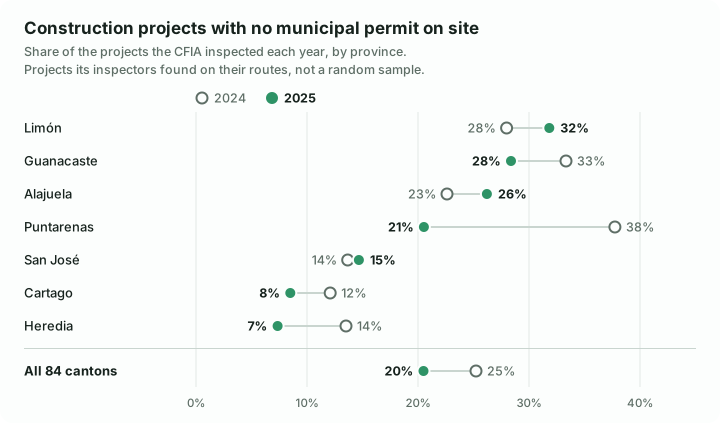
Sources: references [25] and [26].
Among cantons with at least 100 projects inspected in 2025, the highest shares were on the Guanacaste coast: Nicoya at 45% (72 of 160 projects), Santa Cruz at 45% (109 of 243) and Carrillo at 41% (91 of 220).
These are projects the inspectors came across, not a random sample, and canton figures change a lot from year to year. The inspections do not measure how many existing houses lack a permit, and no source we found does.
What buyers can do about a house built without a permit
Before you sign
- Ask the seller for the municipal permit and its number, the plans with the CFIA's stamp, and the CFIA project number. A permit takes effect only once its fee is paid, so ask for the receipt too.[3]
- Ask the municipality which permits it has issued for the property and whether a procedure is open, since a buyer takes over an open procedure at the stage it has reached.[27] In La Unión, an open procedure appears on the property's municipal tax certificate;[28] ask whether your canton's does the same.
- Have an engineer or architect compare the house with the approved plans and look for terraces or a pool the plans do not show.
- Check the lot against the limits above, since a building that breaks one may never get a permit.
- If the house needs legalizing and no procedure is open, the seller can apply for the permit at any time. The contract can require the seller to obtain it before closing, or hold part of the price in escrow until it is issued. A lower price that covers the professional's fees, the permit fee, the fine and any changes ordered passes the risk to you. Have a Costa Rican lawyer write the terms into the opción de compra, the purchase option agreement.
PropScan's report does not show building permits, which the municipality and the CFIA hold. It shows the limits a building on the lot has to meet, where the data exists: the zone's setbacks, coverage and height when the canton's plan regulador is on file, the protection strips of rivers and streams, the national emergency commission's hazard maps within 200 meters of the lot, and road access, as the sample report shows.
If you plan to renovate or extend
Small repairs, remodeling and extensions, obras menores, can be done without an engineer or architect if they cost up to ten salarios base, CRC 4,622,000 in 2026, but they still need a municipal permit. The construction regulation of the Instituto Nacional de Vivienda y Urbanismo (INVU), which applies unless a canton has its own rules, also limits them to 30 m², and work on the structure or the electrical system that puts the occupants at risk never qualifies.[29]
Common questions
Can I buy a house in Costa Rica that was built without a permit?
Yes. The folio real does not record building permits, so ask the municipality which permits it has issued and whether a procedure is open. A house that meets the rules in force, or can be changed to meet them, can be legalized with plans, the permit fee and a fine capped at that fee. A buyer takes over any open procedure at the stage it has reached, so agree in the contract who pays to legalize the house.
How much does it cost to legalize a house built without a permit in Costa Rica?
The owner pays the permit fee, a tax of up to 1% of the construction's value, and a fine that Ley 833 caps at that fee. Each municipality sets its amounts within that cap: Golfito, for example, adds a fine of 25% to 100% of that 1%, depending on how far construction has gone. The owner also pays the professional's fees for the plans and the cost of any changes the municipality orders.
How often do Costa Rican municipalities demolish houses built without a permit?
We found no national count. In 2025 audits, the State's audit office reported that Santa Cruz closed 448 construction sites in two years with no record of whether the owners complied, and that 28% of Talamanca's building permits in those years legalized construction the municipality had stopped. Neither audit reports a demolition. The only demolitions of homes we could confirm were of informal settlements inside protection zones and of houses declared uninhabitable.
Does the folio real show whether a house has a building permit?
No. The folio real, the property's registry record, has no entry for building permits. The permit and its number are with the municipality, and the approved plans carry the stamp of the Colegio Federado de Ingenieros y de Arquitectos. A survey plan must show the buildings standing when it was drawn, which dates a building but does not show that it had a permit.
Legal references and source notes
[1] Contraloría General de la República, Gestión del otorgamiento de licencias de construcción y del ordenamiento territorial en la zona urbana del cantón de Talamanca, report DFOE-LOC-IAD-00007-2025 of July 17, 2025, covering 2023 and 2024. Conclusion: "durante el periodo auditado, se otorgaron 1426 permisos de construcción sin contar con un plan regulador y sin aplicar supletoriamente la normativa del INVU. Asimismo, se determinaron 405 licencias que corresponden a procesos de regularización de obras iniciadas sin autorización previa, sin que en el expediente conste que se verifica plenamente el cumplimiento de los requisitos legales, técnicos y documentales exigidos." Paragraph 2.5: "En los años 2023 y 2024, se aprobaron 405 permisos de construcción (28% del total de 1426 trámites), producto de la clausura por obras iniciadas sin contar con el respectivo permiso." Paragraph 2.6: the lack of an urban plan regulador and of standard review procedures "ha derivado en un proceso permisivo y discrecional". The report mentions demolition only in paragraph 2.7, among the sanctions the law provides: "multas, clausura y demolición". Source: Contraloría General de la República, DFOE-LOC-IAD-00007-2025.
[2] Contraloría General de la República, Gestión del otorgamiento de licencias de construcción y del ordenamiento territorial del cantón de Santa Cruz, report DFOE-LOC-IAD-00012-2025 of September 24, 2025, covering 2023 and 2024. Paragraph 3.1(a): "Dicha situación se refleja en la insuficiente inspección efectuada en los años 2023 y 2024, si se considera, que de las 3.070 licencias de construcción otorgadas en esos años, en 1.827 casos (59% del total de obras), no se realizaron inspecciones." Paragraph 3.1(b): "En los años 2023 y 2024 se realizaron 448 clausuras de inmuebles, sin embargo, no se cuenta con la información de los resultados del seguimiento de tales gestiones, para determinar el nivel del cumplimiento de las acciones establecidas en las actas de inspección". Footnote 17: "Un 36% de obras clausuradas, de un total de 1.243 inspecciones realizadas en los años 2023 y 2024." Paragraph 3.1(e), on the follow-up of notices served during inspections: "se determinó que de 30 verificaciones a obras en proceso, en los años del 2023 y 2024, en 16 casos se incumplió con el cobro de la multa por no contar el propietario con la licencia de construcción; [...] y en 10 casos, el propietario no tramitó la respectiva solicitud del permiso de construcción, sin que a la fecha de este informe, se hayan realizado gestiones para la demolición de las obras." Conclusion: the canton's management of permits and construction does not comply with the rules in significant respects, "debido a una deficiente planificación territorial, la permisividad en aprobar permisos sin cumplirse los requisitos legales y técnicos, y una débil y desorganizada inspección de las obras en el Cantón". Besides paragraph 3.1(e), the report mentions demolition only in paragraph 2.7, among the sanctions the law provides. Source: Contraloría General de la República, DFOE-LOC-IAD-00012-2025.
[3] Ley 833, Ley de Construcciones, version 5 of 5, art. 74: "Toda obra relacionada con la construcción, que se ejecute en las poblaciones de la República, sea de carácter permanente o provisional, deberá ejecutarse con licencia de la Municipalidad correspondiente." Art. 79: "Para que una licencia surta sus efectos, es indispensable que haya sido pagado el importe de los derechos correspondientes." Source: Ley 833, PGR-SINALEVI.
[4] Ley 833, art. 83, as reformed by Ley 9482 of 2017: responsible professionals are engineers and architects "debidamente incorporados al Colegio Federado de Ingenieros y Arquitectos de Costa Rica", and "Los profesionales responsables son los únicos que tienen facultad para autorizar solicitudes de licencia para obras de construcción; además, tienen la obligación de vigilar las obras para las cuales hayan solicitado o autorizado licencia para obras de construcción." The Instituto Nacional de Vivienda y Urbanismo's Reglamento de Construcciones, Reglamento 6306, version 4 of 4, art. 6: the permit "debe ser tramitado por un profesional responsable". Sources: Ley 833, PGR-SINALEVI, Reglamento de Construcciones, PGR-SINALEVI.
[5] Decreto 36550-MP-MIVAH-S-MEIC, Reglamento para el Trámite de Revisión de los Planos para la Construcción, version 4 of 4. Art. 1 bis: the APC is the "Plataforma y módulos de trámite digital de planos y permisos de construcción administrada por el Colegio Federado de Ingenieros y Arquitectos", and MS is the Ministerio de Salud. Art. 3: for a single-family home, compliance with the requirements "se hará constar mediante una Declaración Jurada del Profesional Responsable". Art. 6: "El MS autorizará los planos constructivos de viviendas unifamiliares, incluyendo las ubicadas en Zona Marítimo Terrestre, con la sola presentación de estos", the documentary requirements and the sworn declaration; "Una vez obtenido el sello del CFIA, el profesional podrá continuar con el trámite ante la Municipalidad correspondiente." Source: Decreto 36550, PGR-SINALEVI.
[6] Reglamento de Construcciones, art. 10, as reformed in 2018: the site must keep "un juego completo de planos oficiales y en buen estado, donde conste la aprobación de las instituciones revisoras, con el permiso de construcción municipal"; "En sitio visible debe colocarse el original del permiso de construcción que muestre el número del permiso municipal"; "Igualmente, debe estar disponible en sitio la Bitácora de obra del CFIA, en su versión física; o existir en su versión digital". Source: Reglamento de Construcciones, PGR-SINALEVI.
[7] Ley 833, art. 89, lists among the infractions "c)Ejecutar una obra modificando en parte o radicalmente el proyecto respectivo aprobado", "f) No dar aviso a la Municipalidad de suspensión o terminación de obras" and "j) Ocupar o usar una construcción antes de haber dado aviso de la terminación de la obra." The law provides for no certificate of occupancy. Source: Ley 833, PGR-SINALEVI.
[8] Decreto 44647-MJP, Reglamento general del Registro Inmobiliario, version 2 of 2, art. 86(d), on what a survey plan must show: "Asimismo, se debe indicar el uso o usos del predio y las construcciones existentes." Source: Decreto 44647, PGR-SINALEVI.
[9] Procuraduría General de la República, dictamen C-225-2016 of October 31, 2016, to the Municipalidad de Desamparados: "El procedimiento descrito en el artículo 93 de la Ley de Construcciones presupone que el otorgamiento de la licencia municipal, en caso de construcciones que hayan sido levantadas sin haberla obtenido previamente, está sujeta al cumplimiento de todos los requisitos que la normativa exige". In dictamen C-145-2017 of June 23, 2017, to the Municipalidad de Esparza, it said that arts. 93 and following "permite "regularizar" las obras terminadas sin contar con la licencia o permiso de construcción respectivo". Sources: PGR, C-225-2016, SINALEVI, PGR, C-145-2017, SINALEVI.
[10] Municipalidad de Esparza, Reglamento de construcciones de la Municipalidad de Esparza of May 19, 2017, art. 19, "Construcciones terminadas sin previa licencia municipal": "Para su autorización se procederá de acuerdo a lo ordenado en los artículos 93,94, 95 y 96 de la Ley de Construcciones No.833, debiendo solicitar la Licencia de Construcción según corresponda, deberá cancelar los montos respectivos por impuestos de construcción y multa." Municipalidad de Carrillo, Reglamento de construcciones y ampliación fiscalización de obras, movimiento de tierra y permisos de demolición en el Cantón de Carrillo Guanacaste, Reglamento municipal 27 of July 3, 2018, version 4 of 4, art. 7, on the documents for a permit application, item d): "Certificación de la Póliza de Riesgos de Trabajo emitida por el INS. Para obras construidas y totalmente finalizadas no se estará solicitando este requisito, en vista de la actual imposibilidad material de cumplir con el mismo." Municipalidad de La Unión, Reglamento de regularización de construcciones del cantón de La Unión, Reglamento municipal 52 of December 23, 2024, art. 47: "Si el propietario responde a este último llamado, se procederá conforme al trámite ordinario de licencia de construcción sin perjuicio de las multas de ley." Sources: Reglamento de construcciones de Esparza, PGR-SINALEVI, Reglamento 27 de Carrillo, PGR-SINALEVI, Reglamento 52 de La Unión, PGR-SINALEVI.
[11] Ley 833, art. 93: "Cuando un edificio o construcción o instalación ha sido terminado sin licencia ni proyecto aprobado por la Municipalidad y sin que se haya dado aviso a ésta de la terminación de la obra, se levantará una información, fijando al propietario un plazo improrrogable de treinta (30) días, para que dé cumplimiento a lo estatuido en esta Ley y Reglamento, presentando el proyecto, solicitud de licencia, etc." Art. 94: "Si pasado el plazo fijado, el propietario no ha dado cumplimiento a la orden anterior, se le levantará una nueva información la que se pondrá de acuerdo con el artículo sobre Renuencia y se fijará un último plazo, oyendo al interesado." Art. 95: "Si el propietario presenta el proyecto respectivo y una vez que sea aceptado, la Municipalidad comprobará si la obra ha sido ejecutada de acuerdo con él y si ambos satisfacen los requisitos exigidos por esta Ley y su Reglamento sometiéndolo a las pruebas necesarias." Art. 96: "Si no se presenta el proyecto o no se hacen las modificaciones ordenadas, la Municipalidad ordenará la destrucción de las partes defectuosas o la hará por cuento del propietario. En ningún caso autorizará el uso de la construcción y si está en uso, impondrá multa por esta causa y dispondrá la desocupación y clausura de ella." Source: Ley 833, PGR-SINALEVI.
[12] Tribunal Contencioso Administrativo y Civil de Hacienda, Segundo Circuito Judicial de San José, resolución 2820-2023 of August 31, 2023, expediente 22-001223-1027-CA, hearing an appeal as the municipality's superior (jerarca impropio), confirmed a Municipalidad de Heredia demolition order. After complaints from a neighbors' committee in 2018, the municipality found small apartments built without permits, now lived in, inside the protection zone of the Río Burío, and in 2020 gave the owners 30 working days and then a final 45. The court held: "La Ley prevé hasta dos emplazamientos al administrado por parte del gobierno local, con el objetivo de que enderece su situación. Únicamente ante el supuesto que no haya solución de la irregularidad, ya sea por desidia del administrado que no atiende el llamado de la corporación local, o bien, porque aún tratando de corregir, no existe posibilidad de regularizar la construcción por impedimento legal -lo cual lleva a denegar definitivamente el permiso constructivo-, es que la municipalidad puede disponer el desalojo definitivo y la imposición de la orden de demolición sobre lo construido." And: "el ordenamiento da oportunidad para que el administrado regularice su situación, de modo que en la medida en que pueda rescatarse el bien construido, si la legislación lo permite, debe hacerse." Of this case, it noted that the municipality "le dio más oportunidades que las dos previstas en la ley". Source: Tribunal Contencioso Administrativo, resolución 2820-2023, Nexus PJ.
[13] Ley 833, art. 90: "El importe de la multa en ningún caso será superior a la lesión económica que implique para la Municipalidad la falta de percepción del derecho de la licencia correspondiente al concepto violado." Art. 92: "Las multas y otras penas se impondrán al propietario, Ingeniero Responsable, al Contratista, o a cualquier persona que infrinja este Reglamento." Source: Ley 833, PGR-SINALEVI.
[14] Ley 4240, Ley de Planificación Urbana, version 9 of 9, art. 70: municipalities may charge a tax of "hasta el 1% sobre el valor de las construcciones y urbanizaciones que se realicen en el futuro". Golfito, Reglamento para el cobro de tasación y multas por infracciones a la Ley de Construcciones, Reglamento municipal 13 of May 19, 2023, art. 6: besides the permit fee, the fine "de conformidad con el artículo 90 de la Ley 833" is a percentage "sobre el uno por ciento del valor de la construcción establecido en el artículo 70 de la Ley de Planificación Urbana": 25% from preliminary works to the foundations, 50% for raising walls, and 100% "por paredes con viga de corona o entrepiso en construcciones de más de un nivel", set by "el avance constructivo de la obra al momento del pago efectivo". Sources: Ley 4240, PGR-SINALEVI, Reglamento 13 de Golfito, PGR-SINALEVI.
[15] Municipalidad de Pococí, Reglamento de inspecciones, demoliciones y otras sanciones por infracciones urbanísticas y su cobro administrativo de la Municipalidad de Pococí, Reglamento municipal 15 of February 22, 2022, art. 3(a): "Todos los procedimientos serán iniciados con un acta de notificación elaborada por un inspector municipal que haya atendido una denuncia o advertido en sus rondas semanales, alguna irregularidad en una obra constructiva." Municipalidad de Golfito, Reglamento para el procedimiento de Demolición de obras civiles en el Cantón de Golfito, Reglamento municipal 13-A of May 19, 2023, art. 3(a): "Todos los procedimientos serán iniciados con un acta de inspección que haya atendido una denuncia o advertido en sus rondas semanales, alguna irregularidad en una obra constructiva." Art. 13 of each, on closing a site: in Pococí, "se procederá de inmediato con la clausura, se colocarán sellos de clausurado, a efecto de evitar que el administrado pueda seguir realizando la obra o dar uso a la misma"; in Golfito, "En la clausura se colocarán sellos de clausurado, a efecto de evitar que el administrado pueda seguir realizando la obra o dar uso a la misma." Sources: Reglamento 15 de Pococí, PGR-SINALEVI, Reglamento 13-A de Golfito, PGR-SINALEVI.
[16] Tribunal Contencioso Administrativo y Civil de Hacienda, Segundo Circuito Judicial de San José, resolución 1563-2025 of February 21, 2025, expediente 25-000468-1027-CA, on an appeal against a Municipalidad de Curridabat resolution of June 16, 2023 by which "se le ordena de manera inmediata la demolición de la construcción de 4 pisos", since "se realizó y finalizó una construcción de cuatro pisos donde ejecutó obras no contempladas dentro del permiso municipal 170-D-2018 [...], irrespetó la distancia mínima entre ventanas en colindancia, así como la cantidad máxima de pisos para zona media densidad residencial". The court held that "la ausencia de licencia constructiva, habilita al ente Municipal para paralizar, clausurar y hasta demoler obras, previo la realización del procedimiento regulado en los artículos 93 y siguientes de la Ley de Construcciones", and found, of the notices served from 2019, that "en ninguna de estas notificaciones de boletas realizadas se le advierta al recurrente que debe cumplir con los requisitos necesarios que establece la Ley de Construcciones en su artículo 93". It annulled the order, "al existir infracciones sustanciales en el procedimiento, se anula de oficio la Resolución MC-ALC-0091-06-2023", and directed: "Deberá la Municipalidad de Curridabat proceder a la brevedad a enderezar los procedimientos de la forma indicada, es decir, a realizar el procedimiento establecido en la Ley de Construcciones". Source: Tribunal Contencioso Administrativo, resolución 1563-2025, Nexus PJ.
[17] Tribunal Contencioso Administrativo y Civil de Hacienda, Sección Sexta, resolución 118-2020-VI of September 22, 2020, expediente 15-009834-1027-CA, rejected a telecommunications company's claim against the Municipalidad de Santa Ana, which in 2015 had refused a permit for a tower built without one. In 2013 the municipality had upheld its demolition order, holding that the chance to legalize the tower had passed because the property's registered owner, though notified, had not taken part in the procedure, and it found that the tower also lacked environmental approval and stood too close to another tower that had a permit. The court: "fue la desidia de la actora la que conllevó a este resultado, ya que fue cuatro años después de obtenido el certificado de uso de suelo que intentó regularizar la obra levantada sin licencia constructiva, y lo más grave aún, con un procedimiento firme dictado en su contra, que le permitió regularizar la situación, y no lo hizo." The Sala Primera, the Supreme Court's civil and administrative chamber, resolución 266-2025 of February 27, 2025: "Se declara sin lugar el recurso de casación planteado." Sources: Tribunal Contencioso Administrativo, resolución 118-2020-VI, Sala Primera, resolución 266-2025, Nexus PJ.
[18] Sala Constitucional, resolución 31509-2023 of December 5, 2023, expediente 23-025146-0007-CO, on finca 1-74193 in Patarrá, quoting its resolución 18952-2023 of August 4, 2023: the farm is in the "Zona de Protección Especial Forestal, Loma Salitral. En esa zona está autorizada únicamente una vivienda por finca", and "en esa finca existe un asentamiento informal"; "en 2016, la corporación local ejecutó un proceso de demolición de estructuras ilegales en esa finca"; resolución UCU 232 2019 of October 29, 2019 gave the owners 15 days to demolish; "en noviembre de 2020, la municipalidad recurrida inició la labor de demolición. Sin embargo, debido a las dimensiones de la intervención, no fue posible terminar la labor, por lo que logró un acuerdo con el entonces propietario para que culminará el retiro de las estructuras por cuenta propia." The 2023 ruling ordered that "en el plazo máximo de SEIS MESES, contado a partir de la notificación de esta sentencia, se proceda con la demolición de las estructuras ilegales en la finca objeto de este proceso". The residents, the court noted in December 2023, "no inscribieron los derechos que presuntamente adquirieron y construyeron sus viviendas sin contar con los permisos correspondientes". Resolución 21449-2020 of November 6, 2020 quotes the municipality's order of May 13, 2020: "en esta finca existe un antecedente del año 2016, donde se ejecutó la demolición de todas las estructuras habitacionales construidas sin licencia municipal". Resolución 1676-2022 of January 21, 2022 quotes resolución UCU 232 2019, "la finca 1-74193 B, se encuentra inscrita en el Registro", and resolución 15105-2011 of November 4, 2011, in which residents said that on October 12, 2011 "funcionarios de la Municipalidad de Desamparados [...] demolieron sus hogares", on a farm held in "derechos indivisos"; the court did not find the demolition illegitimate, since "la propiedad se encuentra localizada en la Zona Especial de Protección del Gran Área Metropolitana, donde no es posible autorizar procesos de urbanización". Sources: Sala Constitucional, resolución 31509-2023, resolución 21449-2020, resolución 1676-2022, Nexus PJ.
[19] Sala Constitucional, resolución 3056-2023 of February 10, 2023, expediente 22-028831-0007-CO, on a neighbor's complaint about buildings on a property in San Ramón de La Unión. A health inspection found that "las unidades habitacionales presentan un cuadro ruinoso, insalubre e inseguro", and the Ministerio de Salud's sanitary order MS-DRRSCS-DARSMO-OS-39-2021 of April 7, 2021 "declaró inhabitables las edificaciones que se encuentran dentro de la propiedad" and gave the owner four months "para que proceda con el desalojo de todas las unidades habitacionales y los ocupantes de estas". The municipality reported that it applied arts. 93 and following of Ley 833 and that "ante el incumplimiento del propietario registral del bien y de no demostrarse los permisos de construcción respectivos, se procedió con la destrucción de las construcciones existentes en la propiedad [...]. En el sitio no quedó construcción habitable alguna, cumpliendo con el objetivo del procedimiento administrativo de destruir las viviendas declaradas inhabitables por el Ministerio de Salud en su momento." Source: Sala Constitucional, resolución 3056-2023, Nexus PJ.
[20] Tribunal Contencioso Administrativo, Sección Tercera, resolución 276-2021 of June 29, 2021, expediente 19-004027-1027-CA, upheld the Municipalidad de Santa Bárbara's order of January 21, 2019 to demolish a house on a share (derecho 023) of a farm. The case followed an amparo over the protection areas of the Río Guaraní and the La Cebolla spring and the houses built there (Sala Constitucional, voto 17131-2017). The court found: "Si bien es cierto que la construcción se encuentra fuera del radio de protección de la naciente, este no es el único motivo para ordenar la demolición de la vivienda [...]. Prevalece, principalmente, la ausencia de licencia constructiva luego de completado el procedimiento previsto en la Ley de Construcciones, numerales 93 y siguientes", and "la orden deviene por haberse realizado la obra sin la licencia respectiva y, no haber puesto a derecho dicha construcción dentro del plazo de ley". In Aserrí, after neighbors' complaints, "luego de todas las prevenciones realizadas [...], la Municipalidad de Aserrí procedió a demoler las obras que se encontraban invadiendo la vía pública", a wall, in March 2019 (Sala Constitucional, resolución 22893-2020 of November 27, 2020). In Vásquez de Coronado, after a neighbor's complaint, the municipality demolished a ramp built on the public road at the entrance of a house on May 29, 2025, and the court held that to recover a public road the municipality "no requiere instaurar un procedimiento, con las garantías del debido proceso, sino que basta su comunicación previa" (Sala Constitucional, resolución 17744-2025 of June 10, 2025). Sources: Tribunal Contencioso Administrativo, resolución 276-2021, Sala Constitucional, resolución 22893-2020, resolución 17744-2025, Nexus PJ.
[21] Tribunal Contencioso Administrativo, Sección Tercera, resolución 179-2019 of March 27, 2019, expediente 16-002509-1027-CA: on September 28, 2015 the Municipalidad de Alajuela ordered "la demolición de un redondel en madera, perling y zinc estructural con un área aproximada de 275 metros cuadrados, construcción de tres cuadras y una bodega con material prefabricado con un área aproximada de 100 metros cuadrados"; the court rejected the appeal. Tribunal Contencioso Administrativo y Civil de Hacienda, resolución 1454-2019 of August 14, 2019, expediente 19-003937-1027-CA, at the request of the company that had bought the property: "se suspende la orden de demolición". El Observador reported on February 23, 2026 that the municipality demolished the bullring that day; according to the mayor, the case began with a complaint in 2014, and the building could not be legalized because the zoning did not allow the use in "un área básicamente residencial", in the mayor's words. Sources: Tribunal Contencioso Administrativo, resolución 179-2019, resolución 1454-2019, Nexus PJ; El Observador.
[22] Ley 4240, art. 58: "Las municipalidades no permitirán obras de construcción: 1) Cuando ellas no guarden conformidad por razones de uso, ubicación, retiros, cobertura y demás condiciones de la zonificación; 2) Si el predio de la edificación se ha originado en fraccionamiento hecho sin el visado de la ley; 3) Siempre que el interesado tratare de utilizar fundos sin requisitos de urbanización o faltos de acceso adecuado a la vía pública; 4) Para impedir que se edifique más de una vivienda en un lote de cabida o dimensiones equivalentes o menores a los mínimos establecidos; 5) En tanto lo vede alguna limitación impuesta por reserva uso público o una declaratoria formal de inhabitabilidad del área, motivada en renovación urbana o protección contra inundaciones, derrumbes y otros peligros evidentes; y 6) En los demás casos que señala el reglamento". Source: Ley 4240, PGR-SINALEVI.
[23] Ley 833 gives the owner 30 days (art. 93), a final term (art. 94) and five working days to object (art. 97), and sets no period within which the municipality must act. Sala Constitucional, resolución 37258-2024 of December 13, 2024, expediente 24-033995-0007-CO: the owner had hired someone to build three apartments, finished in April 2024, and the municipality opened a procedure. The court held that "no le corresponde a este Tribunal Constitucional verificar si se encuentra prescrita o no la potestad de la Municipalidad accionada para disponer la apertura de un procedimiento administrativo por construcción irregular en el inmueble a que hace referencia el recurrente, toda vez que es un asunto de legalidad." Sources: Ley 833, PGR-SINALEVI, Sala Constitucional, resolución 37258-2024, Nexus PJ.
[24] Ley 4240, art. 28: "Prohíbese aprovechar o dedicar terrenos, edificios, estructuras, a cualquier uso que sea incompatible con la zonificación implantada. En adelante, los propietarios interesados deberán obtener un certificado municipal que acredite la conformidad de uso a los requerimientos de la zonificación. Los usos ya existentes no conformes, deberán hacerse constar también con certificado que exprese tal circunstancia." Art. 30: "En uso no conforme, sólo podrá transformarse en otro compatible o concordante con la zonificación." Source: Ley 4240, PGR-SINALEVI.
[25] CFIA, Departamento de Inspección y Control, Informe Obras Sin Permiso 2025, INF I-225-2025-DICO. Method (section 2): inspectors follow assigned routes "en busca de obras en proceso de construcción", ask to enter and check "que lo que se indica en planos sea lo construido"; where no documents are found, they compare their findings "con los registros de los sistemas del CFIA, con el fin de localizar documentos que por alguna razón no estuvieran en obra el día de la inspección", and report to the municipality. Findings (section 3): "El CFIA realizó inspecciones de rutina en el 100% de los cantones del país. El estudio contempla un total de 5 934 proyectos inspeccionados durante el 2025." "El 20% de las obras inspeccionadas (1 216 obras), no contaban con una licencia constructiva municipal en el sitio, al momento de la inspección." "El 47% de las obras sin licencia municipal de construcción se encontraban en actividades de estructura principal, un 32% trabajaban en acabados". Homes were "un 81% (4 806)" of the inspections, with "un porcentaje de cumplimiento con la licencia municipal de construcción del 84% (4 016)", so 790 homes, 16%, had no permit on site. Province and canton figures are from Tablas 1 to 13. Source: CFIA, Informe Obras Sin Permiso 2025.
[26] CFIA, Informe Obras Sin Permiso 2024, INF I-139-2025-DICO, with the same method as the 2025 report (section 2): "El estudio contempla un total de 5 098 proyectos inspeccionados durante el 2024." "El 25% de las obras inspeccionadas (1 286 obras), no contaban con una licencia constructiva municipal en el sitio, al momento de la inspección." Province and canton figures are from Tablas 1 to 13. Source: CFIA, Informe Obras Sin Permiso 2024.
[27] Tribunal Contencioso Administrativo, Sección Tercera, resolución 179-2019 of March 27, 2019, quoting its resolución 231-2018: "una vez iniciado el procedimiento administrativo dispuesto en la Ley de Construcciones y notificado al propietario registral, quien adquiera la titularidad del inmueble mediante la transmisión del derecho de propiedad, deberá asumir el procedimiento en el estado en que se encuentre, sin necesidad de retrotraer etapas precluidas como la primera prevención del 93 de la Ley de cita." Source: Tribunal Contencioso Administrativo, resolución 179-2019, Nexus PJ.
[28] Municipalidad de La Unión, Reglamento de regularización de construcciones del cantón de La Unión, Reglamento municipal 52 of December 23, 2024, art. 39: "Una vez notificado el proceso de treinta días hábiles, se indicará en el Sistema Integrado Municipal que la finca tiene un proceso administrativo por construcción, movimiento de tierra, sin licencia municipal. Para que aparezca en la certificación municipal de impuestos de la propiedad." Source: Reglamento 52 de La Unión, PGR-SINALEVI.
[29] Ley 833, art. 83 bis, added by Ley 9482 of 2017: "Toda persona puede hacer reparaciones, remodelaciones, ampliaciones y otras obras de carácter menor, por cuenta propia o de terceros, sin necesidad de contar con la autorización del profesional contemplado en el artículo 83 de la presente ley, siempre y cuando dichas obras no excedan el equivalente a diez salarios base", but "deberá contar con la licencia expedida por la unidad municipal correspondiente". And: "No se considerarán obras menores las obras de construcción que, según el criterio técnico especializado del funcionario municipal competente, incluyan modificaciones al sistema estructural, eléctrico o mecánico de un edificio, que pongan en riesgo la seguridad de sus ocupantes." Reglamento de Construcciones, art. 3, defines Obra Menor as "Toda obra de reparación, remodelación o ampliación con un área de construcción igual o menor a 30,00 m², cuyo costo no exceda el equivalente a 10 salarios base"; art. 2 applies the regulation "Sin perjuicio de lo establecido en los planes reguladores u otra normativa local". The 2026 salario base of CRC 462,200 was set by the Consejo Superior del Poder Judicial in session 113-2025, article LXV, of December 16, 2025. Sources: Ley 833, PGR-SINALEVI, Reglamento de Construcciones, PGR-SINALEVI; Poder Judicial, Circular 246-2025.
This guide is informational and not a substitute for legal advice. For a purchase, work with an experienced attorney or notary.