Entry Nº 016
How to buy property in Costa Rica, step by step: from offer to registration
The five steps of a Costa Rican property purchase, from the option to buy to the registry entry: the document each step produces, the dates the parties set and the limits the law fixes.
Under Costa Rica's civil code, a sale, a compraventa, is complete between buyer and seller once they agree on the property and the price, and ownership passes to the buyer by that agreement alone. Against everyone else, the purchase takes effect only from the day the deed is filed at the Registro Nacional, the national registry.[1]
Until that day, a mortgage or a second sale of the same property that reaches the registry first takes priority over the buyer's deed.[2] So the buyer needs to know what is already on the record before signing, and the notary should file the signed deed without delay.
Key points
- The buyer and the seller set their own dates in the option to buy. While the option runs, the seller is bound to sell, and the buyer uses the time for due diligence: the checks on the property and the seller.
- Where the option is silent, the civil code applies: a deposit given as arras, earnest money, counts toward the price and neither side can withdraw by forfeiting it, and an option with no date for accepting it lapses a month after it can be exercised.
- Other time limits are fixed by law, and no contract between buyer and seller can change them. A creditor of the seller can have a court impose an embargo, an order that holds the property as security for the debt and is recorded in the registry. A deed filed within three months of its signing is registered free of any embargo recorded after the signing.
- Since December 2025, registrars have had eight business days from receiving a deed to review and register it, unless the Registro temporarily sets another deadline.
- Escrow agents must register with the Superintendencia General de Entidades Financieras (SUGEF), the financial supervisor, which states that registration is not an authorization to operate.
What buying property in Costa Rica involves: the people and the documents
A purchase of titled property involves the seller, the buyer and a notary, a lawyer authorized to write public deeds. By law the notary studies the registry record, tells the parties about tax liens on the property, writes the deed and handles its registration.[3] While the option to buy runs, the buyer does due diligence, checking the property and the seller. An escrow agent often holds the money.
The purchase produces four documents:
- The option to buy, the opción de compra, usually a private contract, a documento privado. It binds the parties but cannot be registered, even after a notary copies it into a protocol.[4]
- The deed, the escritura, which the notary writes in the protocolo, the numbered volumes that hold every deed the notary authorizes.
- The testimonio, the notary's certified copy of the deed, which is filed at the registry.
- The registry entry on the property's folio real, its record in the registry.
Foreigners have the same rights as Costa Ricans, with the exceptions the Constitution and the laws set,[5] and buy through the same steps. Land in the maritime zone, the first 200 meters from the high-tide line, belongs to the State outside narrow exceptions and has its own rules for foreigners. Land with no registry entry has to be titled in court first, as our article on possession explains.
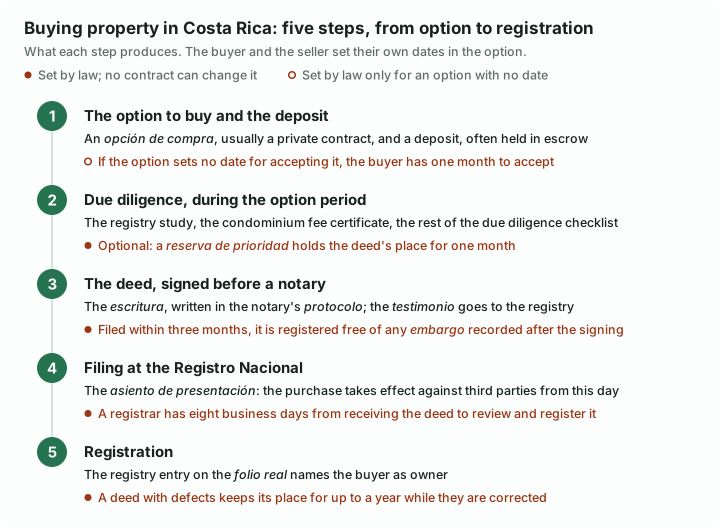
Sources: references [1], [6], [15], [19] and [20].
Step 1: the option to buy and the deposit
An accepted offer is usually written up as an option to buy. It names the property by its finca number, the price, the date for signing the deed, who pays each closing cost, and the conditions the buyer needs met first, such as a bank loan or the results of due diligence. The buyer and the seller set all of these themselves.
The civil code treats an option as a promise of sale. The Sala Primera, the Supreme Court's civil chamber, reads it as a firm offer: while the option runs, the seller cannot withdraw it, and the buyer has time to study the purchase before accepting. Only an option that sets no date for accepting it has a limit set by the code: it lapses if the buyer does not accept within a month of when it can be exercised. If the seller refuses to sign the deed after the buyer accepts, a judge can sign it in the seller's name.[6]
A deposit given as arras counts toward the price and confirms the contract, and neither side can withdraw by forfeiting it unless the option expressly allows it. Options usually say the seller keeps the deposit if the buyer does not accept by the agreed date. If the option says nothing about it and the buyer does not accept, the Sala Primera has said the seller must return it.[7]
The deposit often goes into escrow, with a company or a lawyer, until the conditions are met. Both must register with SUGEF, but registration is not an authorization to operate: SUGEF supervises them only on preventing money laundering and the financing of terrorism, not their solvency or their dealings with clients.[8] Its public register can be searched by name or ID number and gives each one's status, such as registered, suspended or revoked.
Banks must verify where the money for a transaction came from,[8] so have the records that show it ready before you wire the deposit.
Step 2: due diligence before the deed
The registry study is part of the notary's job by law;[3] our due diligence guide explains the checks beyond it, and our due diligence checklist lists them for you and your lawyer to work through.
The option usually lets the buyer withdraw and get the deposit back if the checks turn up a legal problem that affects the transfer or the property's value. The same applies if a condition the parties set is not met, such as a water availability letter, electricity service, or a land use certificate, a certificado de uso de suelo, that allows what the buyer plans to build.
Some checks determine whether the deed can be registered at all. The registrar verifies that the seller is the owner in the property's last registry entry, or someone with sufficient power to act for them, and treats any difference in the owner's name or ID number as a defect.[9]
When a company sells, the notary must confirm that it exists and that its representative may sign,[10] usually from a personería jurídica, the certificate of who can sign for it. The company's founding deed and its amendments set each representative's powers, and they can require a shareholders' meeting to approve a sale, or two representatives to sign together. Check them, and if a meeting must approve the sale, ask to see its minutes in the company's minute book.[10]
Liens and annotations appear on the registry record, as our liens article explains. A buyer of a property with a lawsuit noted on it, a demanda anotada, accepts the outcome of that suit.[11]
Condominium owners pay fees for the common costs, the cuotas, similar to HOA fees. When a unit is sold, the seller must give the notary the administrator's certificate that the fees are paid. If it shows arrears, the buyer becomes jointly liable for that amount and can claim it back from the seller.[12]
The Registro records nothing in favor of a company that is behind on the company tax, so if you buy through a company, it must be current. A selling company's unpaid tax is a hipoteca legal preferente, a preferential legal mortgage, on its real estate.[13] If the record shows a current limitation in favor of the Banco Hipotecario de la Vivienda, the housing bank, or the Instituto de Desarrollo Rural (INDER), the deed needs that institution's authorization.[14]
If the deed cannot be signed yet, the owner can sign a reserva de prioridad, a public deed naming the planned sale and its parties, for the notary to file. For one month, which cannot be extended, it reserves priority for the deed: a deed filed within that month takes effect from the day the reserve was filed, and the registrar cancels later filings that conflict with it.[15]
Step 3: signing the deed before a notary
The deed must give the property's province and finca number and describe the land's nature, measure, location and boundaries.[16]
A party who does not understand Spanish needs an official translator or one the parties and the notary accept, unless the notary knows the language and every party agrees to the notary translating. For foreign parties, the notary must make sure their identity documents and powers of attorney are authentic.[17]
A buyer who cannot travel can give someone a special power of attorney, a poder especial, for the purchase. For a registrable act it must be a public deed, and it does not need to be registered. Abroad, a Costa Rican consul can write it, since consuls act as notaries for acts that take effect in Costa Rica. A power signed before a notary in another country needs an apostille, which Costa Rica has accepted since December 14, 2011.[18] Ask the Costa Rican notary beforehand what form they need.
Transfer taxes, and the share of the price a buyer withholds when the seller is not domiciled in Costa Rica, are in our closing costs article.
Steps 4 and 5: filing the deed at the Registro Nacional and registering it
The notary files the testimonio at the Registro,[3] which takes documents in strict order of arrival and gives each an asiento de presentación, an entry that fixes its place in that order.[2]
Until the deed is filed, the record still shows the seller as the owner, so a creditor with a claim against the seller can have a court impose an embargo, an order that holds the property as security for the debt. The Registro records it as an annotation. If the deed was signed before the embargo was recorded and is filed within three months of its signing, the registrar registers it and disregards the embargo. If it is filed later, the embargo prevails, unless the buyer sues the creditor within three months of filing and proves the sale was real.[1]
Since December 11, 2025, the law has given registrars eight business days from receiving a document to review and register it. The Registro may temporarily set other deadlines by a reasoned resolution published in La Gaceta, the official journal; we found none.[19]
The registrar lists every defect at once, and a deed with defects keeps its place: it stays entered provisionally for a year while the notary corrects them, and the entry lapses only if they are not corrected in that time.[20] A few failures cancel the filing outright: the current registered owner missing from the deed, a deed in favor of a company behind on the company tax, or a missing authorization from the housing bank or INDER.[14]
No contract between buyer and seller can change these time limits, since neither the Registro nor the seller's creditors are parties to it.[1]
What buyers can do to protect the deposit and the deed
- Put the dates in the option, for due diligence and for the deed, with every condition you need and what happens to the deposit if one is not met. If either side may withdraw by forfeiting the arras, the option must say so expressly.
- Look the escrow agent up in SUGEF's register before you wire anything, and agree in writing when the money is released: at signing, or once the Registro shows you as the owner.
- Ask the seller early for the administrator's certificate on a condominium unit. When a company sells, ask for its personería jurídica, its founding deed and amendments, proof that the company tax is paid and, if a shareholders' meeting must approve the sale, the meeting's minutes.
- Ask the notary to file the deed as soon as it is signed and to give you its filing reference, the citas de presentación. If the signing has to wait, ask whether the owner will sign a reserva de prioridad, which lasts one month.
- Accept the option in writing before its date passes, and keep proof that the seller received your acceptance.
Before you sign the option, a PropScan report lists what the property's registry record holds: the owner and whether it is a company, the liens and annotations, the registered acts since 1994, and the registered plan compared with the cadastral map, as the sample report shows. It does not cover condominium fees or the company tax; ask the seller for those.
After the deed is registered
Look the finca up, as our title search article describes, and check that the record names you as the owner and shows your deed's filing reference. The transfer can also raise your property tax: the price in the deed becomes the property's taxable value if it is higher than the value already on record, as our property tax article explains.
Common questions
How long does it take to buy property in Costa Rica?
The buyer and the seller choose the dates in the option to buy, including the time for due diligence and the date for signing the deed. Once the notary files the signed deed, the law gives a registrar eight business days from receiving it to review and register it. That limit has applied since December 2025, and the Registro Nacional can change it only temporarily, by a resolution in La Gaceta. A deed with defects keeps its place in the filing order for up to a year while the notary corrects them.
When does a buyer become the owner of a property in Costa Rica?
Between buyer and seller, ownership passes as soon as they agree on the property and the price. Against everyone else, including later buyers, lenders and the seller's creditors, the purchase takes effect only from the day the deed is filed at the Registro Nacional, so the notary should file it as soon as it is signed. A creditor of the seller can have a court impose an embargo, an order that holds the property as security for the debt and is recorded in the registry. If the embargo is recorded after the signing, a deed filed within three months of the signing is still registered free of it.
What happens to the deposit if a property purchase in Costa Rica does not go ahead?
It depends on the option to buy. Options usually let the seller keep the deposit if the buyer does not accept by the agreed date, and let the buyer withdraw and get it back if due diligence turns up a legal problem or an agreed condition, such as water service, is not met. If the option says nothing about the deposit and the buyer does not accept, the Sala Primera, the Supreme Court's civil chamber, has said the seller must return it.
Can I buy property in Costa Rica without traveling there?
Yes. You can give someone a special power of attorney for the purchase, which must be a public deed and does not need to be registered. Abroad, a Costa Rican consul can write it, since consuls act as notaries for acts that take effect in Costa Rica. A power signed before a notary in another country needs an apostille. The Costa Rican notary who writes the deed must make sure the power is authentic, so ask them beforehand what form it needs.
How do I check that an escrow agent in Costa Rica is registered?
Search the public register of the Superintendencia General de Entidades Financieras (SUGEF) by the agent's name or ID number; it shows the agent's status, such as registered, suspended or revoked. Registration is not an authorization to operate: SUGEF supervises these agents only on preventing money laundering and the financing of terrorism, not their solvency or their dealings with clients. Agree in writing when the escrow releases the money.
Legal references and source notes
[1] Código Civil, version 22 of 22, art. 1049: "La venta es perfecta entre las partes desde que convienen en cosa y precio." Art. 480: "La propiedad de muebles é inmuebles se trasmite con relación a las partes contratantes, por el solo hecho del convenio que tenga por objeto trasmitirla, independientemente de su inscripción en el registro y de la tradición." Art. 455, as reformed by Ley 2928 of December 5, 1961: "Los títulos sujetos a inscripción que no estén inscritos no perjudican a tercero, sino desde la fecha de su presentación al Registro." On the embargo, the same article: "No tendrá la calidad de tercero el anotante por crédito personal, respecto de derechos reales nacidos en escritura pública con anterioridad a la anotación del decreto de embargo o de secuestro. Sin embargo, si la escritura pública fuera presentada al Registro después de tres meses de su otorgamiento y existiere ya una anotación de embargo, o de secuestro, éstas prevalecerán sobre aquélla, a menos que la persona que derive su derecho de la escritura logre demostrar en juicio ordinario contra el anotante que su derecho es cierto y no simulado, juicio que deberá plantear dentro de los tres meses siguientes a la fecha de presentación de la escritura [...]". Later in the same article: "Al inscribirse las escrituras por derechos reales presentadas dentro de los tres meses siguientes a su otorgamiento, se prescindirá de las anotaciones o inscripciones de embargo de que se ha hecho mérito sin necesidad de gestión u ocurso, o de resolución que así lo declare [...]". Art. 468: "Se anotarán provisionalmente: [...] 4.- El decreto de embargos y secuestro de bienes inmuebles, sin necesidad de practicar la diligencia de secuestro." Art. 1025: "Los contratos no producen efecto sino entre las partes contratantes; no perjudican a terceros, así como no les aprovechan, salvo lo dispuesto en los artículos siguientes." Source: Código Civil, PGR-SINALEVI.
[2] Ley 3883, Ley de Inscripción de Documentos en Registro Público, version 6 of 6, art. 2: the Registro keeps a system for receiving documents "que garantice el estricto orden de presentación en la oficina del diario". Art. 8: "No procederá inscribir un documento que estuviere en contradicción con otro presentado anteriormente, siempre que la inscripción de éste fuere admisible conforme al artículo anterior." Source: Ley 3883, PGR-SINALEVI.
[3] Código Notarial, Ley 7764, version 17 of 17, art. 34: "Compete al notario público: [...] b) Informar a los interesados del valor y la trascendencia legales de las renuncias que hagan, así como de los gravámenes legales por impuestos o contribuciones que afecten los bienes referidos en el acto o contrato. [...] g) Realizar los estudios registrales. h) Efectuar las diligencias concernientes a la inscripción de los documentos autorizados por él." Source: Código Notarial, PGR-SINALEVI.
[4] Código Civil, art. 450: "Sólo pueden inscribirse los títulos que consten de escritura pública, de ejecutoria o de otro documento auténtico, expresamente autorizado por la ley para este efecto." Código Notarial, art. 107: "La protocolización de documentos privados no les confiere la condición de instrumentos públicos; tampoco sirven para provocar inscripciones en los registros ni en las oficinas públicas [...]". Decreto 44647-MJP, Reglamento general del Registro Inmobiliario, version 2 of 2, art. 162, lists among the requirements for admitting a document the "firma de la persona notaria en el testimonio". Sources: Código Civil, PGR-SINALEVI; Código Notarial, PGR-SINALEVI; Decreto 44647, PGR-SINALEVI.
[5] Constitución Política, version 28 of 28, art. 19: "Los extranjeros tienen los mismos deberes y derechos individuales y sociales que los costarricenses, con las excepciones y limitaciones que esta Constitución y las leyes establecen." Source: Constitución Política, PGR-SINALEVI.
[6] Código Civil, art. 1053: "Si la promesa de vender una cosa mediante un precio determinado o determinable ha sido aceptada, da derecho a las partes para exigir que la venta se lleve a efecto." Art. 1054: "Tanto en el caso de promesa de venta como en el de promesa recíproca de compra-venta, la propiedad se trasmite desde el día de la venta y no desde el día de la promesa." Art. 1055: "La promesa de venta y la recíproca de compra-venta cuyo cumplimiento no se hubiere demandado dentro de un mes contado desde que es exigible, caduca por el mismo hecho." Art. 1066: "En la venta y en la promesa obligatoria de venta, si el dueño de la cosa se negare a llevar adelante el contrato, o no quisiere llenar las formalidades legales, tendrá derecho el acreedor para que el Juez, en nombre del renuente, formalice el convenio, otorgue la escritura y le haga entrega de la cosa." Sala Primera de la Corte Suprema de Justicia, resolución 51-1993 of August 11, 1993, considerando V: in an option the seller "se compromete a mantener su oferta durante un cierto plazo, y a vender un bien a un precio determinado", and the buyer "Goza, por ende, de un plazo para estudiar la propuesta, la cual debe considerarse firme durante el tiempo de la opción, sin posibilidad de ser revocada." Considerando VIII: art. 1055 "no se refiere en sentido técnico procesal a una 'demanda judicial', sino a la manifestación del optante aceptando la opción", and "el ámbito de aplicación del artículo 1055 se circunscribe a los casos en los cuales exista una promesa de venta o recíproca de compraventa exigible sin plazo estipulado. En tales eventos, el optante puede aceptar, y así perfeccionar la compraventa definitiva, en el término de un mes, el cual corre a partir de la exigibilidad del precontrato." The Sala Primera quoted that conclusion again in resoluciones 574-2003 of September 17, 2003 and 746-2003 of November 5, 2003. Sources: Código Civil, PGR-SINALEVI; Sala Primera, resolución 51-1993, Nexus PJ; Sala Primera, resolución 746-2003, Nexus PJ.
[7] Código Civil, art. 1058: "Las cantidades que con el nombre de señal o arras se suelen entregar en las ventas, se entiende siempre que lo han sido por cuenta del precio y como ratificación del contrato, sin que pueda ninguna de las partes retractarse perdiendo las arras, salvo que así esté expresamente estipulado." Sala Primera, resolución 51-1993, considerando V, on an option the buyer pays for: "según suele estipularse, la suma dada como anticipo o adelanto quedará en manos del oferente en caso de no ser aceptada la opción en el plazo convenido, pero si es aceptada, se estima como parte del precio. Empero, si las partes nada han acordado al respecto, el oferente debe devolver el dinero recibido como señal de trato en caso de no realizarse el contrato definitivo, según lo establecido por el artículo 1058 del Código Civil." Sources: Código Civil, PGR-SINALEVI; Sala Primera, resolución 51-1993, Nexus PJ.
[8] Ley 7786, version 14 of 14 (last reformed by Ley 10961 of June 9, 2026). Art. 15(d) covers "La administración de recursos por medio de fideicomisos o de cualquier tipo de administración de recursos, efectuada por personas jurídicas, que no sean intermediarios financieros"; these companies "deberán inscribirse ante la Superintendencia General de Entidades Financieras, sin que por ello se interprete que están autorizadas para operar", and must meet obligations including "La identificación de clientes y la debida diligencia del cliente". Art. 15 bis(e) applies the same duties, "incluyendo el deber de inscripción", to lawyers and notaries who carry out for clients "La compra y venta de bienes inmuebles" and "La administración del dinero, las cuentas bancarias, los ahorros, los valores u otros activos del cliente". Art. 16(c): banks and the other entities of that chapter must verify "la fuente u origen de los recursos que justifican las transacciones a realizarse". SUGEF's page on the register, read November 11, 2026: "Se advierte al público en general que la inscripción ante esta Superintendencia NO ES UNA AUTORIZACIÓN PARA OPERAR. Se aclara que la SUGEF no supervisa los negocios que realizan esos sujetos, ni vela por la seguridad, estabilidad ni solvencia de esos negocios, ni se supervisan las operaciones ni transacciones que realizan con sus clientes"; the same page says these subjects are supervised "únicamente sobre los temas de prevención de lavado de dinero y financiamiento al terrorismo". Sources: Ley 7786, PGR-SINALEVI; SUGEF, Consulta Estado de Inscripción APNFDs.
[9] Decreto 44647-MJP, art. 182: the registrar must verify that the party is the registered owner or someone "con atribuciones suficientes para actuar en nombre de esta", a check made "únicamente contra la información que conste en el último asiento registral", and "Toda diferencia en el número de identificación o en el nombre de la persona titular registral Será defecto". Source: Decreto 44647, PGR-SINALEVI.
[10] Código Notarial, art. 40, as reformed by Ley 10754 of September 11, 2025: notaries must "comprobar la existencia de las personas jurídicas, las facultades de los representantes y, en general, cualquier dato o requisito exigido por la ley para la validez o eficacia de la actuación." Código de Comercio, version 30 of 30, art. 18: a company's founding deed must state the "Forma de administración y facultades de los administradores" and the "Nombramiento de los administradores, con indicación de los que hayan de tener la representación de la sociedad". Art. 19: the incorporation of a company and "sus modificaciones" must be made in a public deed, published in the official journal and registered in the Registro Mercantil. Art. 182, for a corporation: representation belongs to the president of the board, "así como a los consejeros que se determinen en la escritura social, quienes tendrán las facultades que allí se les asignen." Art. 156: extraordinary shareholders' meetings also decide "Los demás asuntos que según la ley o la escritura social sean de su conocimiento." Art. 252: corporations and limited liability companies "deben llevar un libro de actas de asambleas de socios". Sources: Código Notarial, PGR-SINALEVI; Código de Comercio, PGR-SINALEVI.
[11] Código Civil, art. 468, on provisional entries such as lawsuits over a property: "Cualquier adquirente de un bien anotado aceptará, implícitamente, las resultas del juicio y el registrador lo consignará así en el asiento respectivo, al inscribir títulos nuevos." Source: Código Civil, PGR-SINALEVI.
[12] Ley 7933, Ley Reguladora de la Propiedad en Condominio, version 8 of 8, art. 21: "En la venta o el traspaso por cualquier título de una finca filial, el trasmitente estará obligado a presentar al notario una certificación, expedida por el administrador del condominio de que se encuentra al día en el pago de sus cuotas para gastos comunes. De estar en mora, el adquirente de la filial se considerará deudor solidario por el monto certificado, sin perjuicio de poder cobrar del trasmitente lo que por este motivo deba pagar." Source: Ley 7933, PGR-SINALEVI.
[13] Ley 9428, Impuesto a las Personas Jurídicas, version 5 of 5, art. 5: "El Registro Nacional no podrá emitir certificaciones de personería jurídica, certificaciones literales de sociedad, ni inscribir ningún documento a favor de los contribuyentes de este impuesto que no se encuentren al día en su pago." The same article: "Las deudas derivadas de este impuesto constituirán hipoteca legal preferente o prenda preferente, respectivamente, si se trata de bienes inmuebles o bienes muebles propiedad de las sociedades mercantiles [...]". Source: Ley 9428, PGR-SINALEVI.
[14] Decreto 44647-MJP, art. 172, which calls cancellation "la sanción registral más rigurosa", lists among its causes: "d) Falta de legitimación por ausencia de la persona titular registral actual del bien o derecho inscrito"; "i) Morosidad en el pago del impuesto a la Ley de Impuesto de Personas Jurídicas, Ley 9428"; and "j) Falta de autorización del Banco Hipotecario de la Vivienda o del Instituto de Desarrollo Rural en actos o contratos referentes a inmuebles, que publiciten limitaciones vigentes a la fecha de otorgamiento." Source: Decreto 44647, PGR-SINALEVI.
[15] Ley 3883, arts. 34 to 36, added by the Código Notarial in 1998. Art. 34: the request "será facultativa y se hará en escritura pública, firmada por los titulares del bien, mencionará el tipo de contrato que se pretende realizar y las partes involucradas." Art. 35: "La anotación de reserva de prioridad tendrá una vigencia improrrogable de un mes, contado a partir de su presentación al Registro." Art. 36: "Cuando se presente el contrato definitivo, sus efectos se retrotraerán a la fecha de presentación de la solicitud de reserva", and the registrar "cancelará todos los asientos de presentación posterior que contengan actos o contratos incompatibles con el documento que se inscribe." Source: Ley 3883, PGR-SINALEVI.
[16] Código Notarial, art. 88: "Si se tratare de escrituras relativas a inmuebles sujetas a inscripción en el Registro Público, deberán indicarse la provincia y el número de finca. También deberán indicarse expresamente la naturaleza, la medida, la situación y los linderos." Source: Código Notarial, PGR-SINALEVI.
[17] Código Notarial, art. 72: "Cuando algún compareciente o interesado no comprenda el español, deben intervenir un traductor oficial u otro aceptado por las partes y el notario público, salvo que este entienda el idioma del compareciente. En tal caso, el notario, bajo su responsabilidad, efectuará la traducción legal del texto, si todos los interesados en el acto o contrato lo consintieren. El interesado debe quedar enterado del texto del documento en el idioma que conoce." Art. 85: "Cuando personas extranjeras otorguen escrituras, el notario deberá tomar todas las medidas pertinentes para asegurarse de que los documentos de identificación y los poderes otorgados por ellos son auténticos." Source: Código Notarial, PGR-SINALEVI.
[18] Código Civil, art. 1256, as reformed by the Código Notarial: "El poder especial otorgado para un acto o contrato con efectos registrales deberá realizarse en escritura pública y no será necesario inscribirlo en el Registro." Código Notarial, art. 14: "Los cónsules de Costa Rica en el extranjero ejercerán el notariado público en su circunscripción territorial, respecto de los hechos, actos o contratos que deban ejecutarse o surtir efecto en Costa Rica." Ley 8923 of February 22, 2011 approved Costa Rica's accession to the Hague Convention Abolishing the Requirement of Legalisation for Foreign Public Documents, the Apostille Convention, and Decreto 36469 of March 8, 2011 completed it. The status table of the Hague Conference on Private International Law gives December 14, 2011 as the date it took effect for Costa Rica. Sources: Código Civil, PGR-SINALEVI; Código Notarial, PGR-SINALEVI; Ley 8923, PGR-SINALEVI; HCCH, Apostille Convention status table.
[19] Ley 3883, art. 3, as reformed by Ley 10800 of November 16, 2025, published in La Gaceta 233, Alcance 158, on December 11, 2025: "Recibidos los documentos por los registradores, para su debida calificación e inscripción, deberán devolverlos al Archivo, debidamente calificados en su totalidad e inscritos, en un plazo máximo de ocho días hábiles." The Dirección General may set "plazos distintos al indicado, de forma temporal, mediante resolución administrativa debidamente motivada y publicada en el diario oficial La Gaceta". We found no such resolution as of November 11, 2026. Source: Ley 3883, PGR-SINALEVI.
[20] Ley 3883, art. 6 bis: registrars "indicarán los defectos en un solo acto." Código Civil, art. 468(5): "Los títulos que no puedan inscribirse definitivamente por cualquier defecto que lo impida. Esta anotación provisional tendrá una vigencia de un año y quedará cancelada de hecho si dentro de este término no se subsanare el defecto"; the same article allows the term to be suspended for up to three months in some cases. Art. 470: "La anotación provisional y la inscripción definitiva surten efectos con respecto a terceros desde la fecha de presentación del título." Decreto 44647-MJP, art. 168: inscription is suspended "hasta por el plazo de un año contado a partir de su presentación, cuando contengan defectos", and if the document is not corrected, "el asiento de presentación caducará". Sources: Ley 3883, PGR-SINALEVI; Código Civil, PGR-SINALEVI; Decreto 44647, PGR-SINALEVI.
This guide is informational and not a substitute for legal advice. For a purchase, work with an experienced attorney or notary.